
Growth Navigate Funding: Startup Tools, Funding Options, and Business Growth Strategies
You have a good idea. Early customers like it. Yet your bank balance can’t keep up with your plans. Almost every founder hits this wall. Growth Navigate Funding is a smart way to face it. It links your goals to the right startup funding options and the right startup business tools.
This guide shows you how to fund a startup without guesswork. You will learn how to find startup capital, compare offers, and build a plan that lasts. You will also learn how to verify business funding services. Similar names exist online, so this guide teaches you to check every provider and endorses none.
What Is Growth Navigate?
Have you seen the name and wondered what it means? You’re not alone. Several websites use it for tools, advice, and business funding solutions. Some pages overlap. Others don’t. A clear definition helps you sort fact from noise.
This section covers four points. You will see what the term means, what one website offers, how it works as a method, and how it differs from a similar program. Keep one habit as you read. Growth Navigate legitimacy and reliability depends on proof. Names alone prove nothing.
What Does Growth Navigate Mean in Business?
Think of a ship at sea. The captain needs a map, a compass, and enough fuel. In business, Growth Navigate business growth works the same way. Your goals are the map. Your data is the compass. Your startup capital is the fuel. Without all three, you drift. With them, you steer on purpose. The phrase simply describes planned growth backed by numbers and money. It isn’t magic. It is a habit of choosing a clear path, checking progress, and funding each step with care.
GrowthNavigate.com: Website, Services, and Purpose
Online pages describe GrowthNavigate.com as a place for planning tools, growth advice, and funding help. Treat those descriptions as leads. Always open the official site yourself. Read the services page, the pricing page, and the terms. Note what the site actually shows rather than what other pages say about it. Look for named staff, a real address, and written fees. This is the first step in how to evaluate funding providers. Good providers explain their purpose in plain words. Weak ones stay vague.
Growth Navigate as a Business Growth Strategy
You can also treat the name as a method. This method follows four steps. First, name one problem. Second, check the evidence. Third, take the smallest useful action. Fourth, measure the result. Then repeat. This loop is a simple startup growth planning framework. It supports growth strategy planning at any size. For example, a bakery with low weekday sales tests one lunch deal for two weeks. The owner tracks sales and keeps the deal only if the numbers rise. Small tests protect cash and teach fast.
Growth Navigate vs. the Growth Navigator Program
The names look alike. The programs may not be related. Always confirm who owns each one before you trust a claim. The table below shows the checks to run on any two similar names.
| Check | Growth Navigate | Growth Navigator Program |
| Owner | Confirm on the official website | Confirm on the official website |
| Purpose | Verify in writing | Verify in writing |
| Audience | Check who the services target | Check who the program targets |
| Cost | Request a full fee list | Request a full fee list |
| Proof | Company registry record | Company or agency record |
Don’t assume the two share a link. Ask each one directly and keep the answers in writing.
What Are Growth Navigate Startup Tools?
A tool is a map and not a car. It shows the road but it won’t drive for you. Growth Navigate startup tools usually cover planning, marketing, money, and teamwork. Each group solves a different pain. Pick the one that matches your biggest problem first.
Tools only pay off when you use them every week. A great app on a dusty shelf does nothing. Think of business development tools as habits with a screen. Choose few. Use them well. Then add more as your team grows.
Essential Business Planning and Goal-Setting Tools
Planning tools turn a vague dream into dated tasks. “Grow sales” becomes “sign 40 new customers by June.” Good tools split that goal into weekly steps. They also store your business plan in one place so a lender can read it fast. Many include templates for business growth milestones, such as the first 10 customers or the first $10,000 month. This is the base of business growth planning. Your whole team sees the same finish line. That focus saves time and prevents mixed signals.
Marketing and Customer Acquisition Tools
Marketing tools show where buyers come from. They track ads, emails, and social posts. The key number is customer acquisition cost. Say you spend $500 on ads and win 25 buyers. Each buyer costs $20. Now compare that cost with profit per buyer. If each buyer spends $80 but your profit on that sale is only $15, you lose money. If profit is $40, the math works. A strong customer acquisition strategy depends on this check. These digital marketing tools make how to improve customer acquisition a matter of data and not hunches.
Financial Planning and Performance Tracking Tools
Money tools support financial planning for startups. You can build a budget, forecast sales, and watch cash. This is business cash flow management in practice. Many tools also draft financial projections for the next year. Track three numbers closely. They are monthly revenue, monthly costs, and cash left in the bank. If cash runs low, you see it early. Early warnings give you time to act. This habit also makes how to manage startup cash flow far less scary. Strong business performance tracking begins with these three lines.
Productivity and Business Management Tools
Management tools keep a team in sync. They assign tasks, set reminders, and store files. They also end the “who was doing that?” confusion. Time savings add up fast. If your team saves five hours a week, that is about 20 hours a month. That equals roughly two and a half workdays. You can spend those days selling or serving customers. This is how to reduce business operating costs without cutting quality. It also lifts business operating efficiency across the whole company.
How to Choose the Right Startup Tools
Start with the problem and not the product. Write down what hurts most. Then test two or three tools with free trials. Check the price, the cancellation terms, and the support quality. Make sure the tool connects with software you already use. Ask your team if they will actually open it each day. Tools that need long training often fail. A simple tool that people use beats a fancy one they ignore. Review your choices every six months and drop what you don’t use.
How to Develop an Effective Business Growth Strategy
Growth is a choice and not a sprint. You pick one clear path and park the rest for now. Trying everything at once drains cash and energy. Focus beats speed here. This is the core of how to create a business growth strategy.
Four steps shape the path. Find the bottleneck. Set an objective. Spend where it counts. Then check the results. The table below shows the full loop with an example.
| Step | Question to ask | Example |
| Bottleneck | What blocks growth most? | Visitors don’t buy |
| Objective | Which number will change? | Raise sales rate from 1% to 2% |
| Resources | Where do time and money go? | Fix checkout first |
| Results | Did the number move? | Review every month |
Identify Your Biggest Business Growth Bottleneck
A bottleneck is the narrow neck of a bottle. Everything slows down there. Picture an online shop with 10,000 visitors a month and only 50 sales. Traffic looks fine. The real business growth bottleneck sits on the product page or at checkout. More ads would waste money. A faster page or clearer buttons might double sales with no extra ad cost. Always find the true blocker before you spend. Study your data, read customer feedback, and ask your team where buyers get stuck.
Set Measurable Business Growth Goals
Vague goals bring vague results. Use numbers and dates. “Add 30 paying clients by December” is clear. “Do better this year” is not. Good measurable growth goals answer three questions. What number? By when? Who owns it? Link each goal to your business growth objectives so progress stays visible. Small wins keep the team upbeat. Also write goals where everyone can see them. A goal you can measure is a goal you can reach.
Allocate Resources Based on Business Priorities
Time and money run short for every founder. Spend both where the payoff is highest. One simple budget rule helps. Give about 70% of your growth budget to your top priority. Split the remaining 30% among smaller tests. This rule guides how to allocate resources for growth. It differs from working capital management, which covers the cash you need for daily bills. Keep both in view. Protect bill money first. Then invest the rest with purpose.
Track Key Performance Indicators and Adjust Your Strategy
Check your numbers once a month. Compare them with your targets. If a plan works, do more of it. If it fails, change it fast. Don’t cling to a bad idea because you already paid for it. That mistake is called the sunk-cost trap. Strong business performance tracking also uses a short list of KPIs. Pick five at most. This is how to track business performance metrics without drowning in charts. Slow and steady often beats a wild sprint. It also builds sustainable business growth.
Growth Navigate Funding: What Startups Need to Know
Funding should follow strategy and never replace it. Money without a plan vanishes fast. Money with a plan opens doors. This section answers the questions founders ask most. Read it before you contact any lender or investor.
Here you will learn what the term means, who supplies the cash, and how much you may need. You will also see how funding changes by stage. A clear business funding strategy saves months of stress. It also helps you talk with lenders in plain numbers.
What Is Growth Navigate Funding?
Growth Navigate Funding is best understood as a growth-first way to find capital. You start with your goals. Then you match them with the right business financing options. The idea sounds simple. Choosing well is the hard part. Think of it as a method and not a promise of money. This is Growth Navigate funding explained in one line. Similar names exist online. So always confirm which company you deal with before you share data or sign anything.
Does Growth Navigate Provide Direct Business Funding?
Many websites help you find funding but don’t lend a cent. Others do lend. Some only introduce you to lenders or investors. The only safe answer comes from the official site and written papers. Ask one direct question. Who provides the money and under what contract? A real provider names the lender or investor and puts every term in writing. Vague answers are a warning. This simple test is key to business funding adviser verification. If nobody can answer clearly, walk away.
How to Calculate Your Startup Funding Requirements
Start with a list of costs. Add a safety buffer. This is the core of how to calculate startup funding needs. Knowing your startup capital requirements also tells lenders you did your homework. The sample below fits a small online store.
| Cost item | Amount (USD) |
| Extra inventory | $40,000 |
| Two hires for six months | $36,000 |
| Marketing | $18,000 |
| Software and website | $6,000 |
| Subtotal | $100,000 |
| Buffer (15%) | $15,000 |
| Total needed | $115,000 |
Next, divide your total cash by your monthly spending. The answer is your runway in months. Never guess this number. Solid startup funding requirements rest on real math.
How to Match Funding With Your Business Growth Stage
Each stage has its own needs. A new idea needs proof and not big money. A growing firm needs systems and speed. Matching funding to stage is how to match funding with business goals. It also helps with funding options for early-stage companies. Learn the usual startup funding stages below.
| Stage | Main priority | Typical funding | Key number |
| Idea | Prove demand | Savings, small grants | Interview count |
| Early traction | Win first customers | Angels, small loans | Cost per customer |
| Scaling | Grow systems | Venture capital, bank loans | Monthly growth rate |
Grants, Loans, and Investor Funding: What’s the Difference?
Three routes dominate. Grants usually need no repayment. Loans must be repaid with interest. Investor money trades ownership for cash. Each route carries a different financial risk management challenge. Grants cost time and paperwork. Loans cost cash flow. Equity costs control. This is how to compare business loans and equity financing at a glance. US readers can explore official resources at sba.gov. Readers elsewhere should check their national small business agency. Always ask for the exact product name and written terms.
Types of Business Funding Available to Startups
Every option has a price. Some cost money. Others cost ownership. A few cost freedom. Your job is to pick the price you can live with. Good funding for entrepreneurs starts with honest trade-offs.
The table below compares the main routes. Use it to narrow your list before you dig into each one. These are the most common startup funding options worldwide.
| Option | Main cost | Keep ownership? | Speed | Best for |
| Business loans | Interest and fees | Yes | Medium | Steady sales |
| Angel investors | Equity | Partly | Slow | Early startups |
| Venture capital | Large equity share | Partly | Slow | Fast-scaling firms |
| Small business grants | Time and paperwork | Yes | Slow | Eligible niches |
| Revenue-based financing | Share of sales | Yes | Fast | Regular revenue |
| Bootstrapping | Slower growth | Yes | Immediate, but varies | Low-risk starts |
Small Business Loans
Business loans for startups give you cash now. You repay over time with interest. You keep full ownership. That is a big plus. Look closely at interest rates and repayment terms. Suppose you borrow $50,000 at 12% for three years. Your payment is about $1,661 a month. You repay roughly $59,800 in total. Also check collateral requirements and personal guarantees. A guarantee can put your own home or savings at risk. This is the clearest example of borrowing risk. It is also a key part of small business financing.
Angel Investors
Angel investors are people who back early companies with their own money. In return they take a share of the business. Many also offer advice and contacts. A skilled angel opens doors that cash alone can’t. The trade-off is ownership. You now share decisions and profits. Good investor relations start with honest updates. Send a short report each month. Trust grows from that habit. This is how to attract angel investors. Show early proof, a clear plan, and a founder who listens.
Venture Capital Funding
Venture capital funding suits companies built for very fast growth. Funds invest large sums and expect big returns. They often ask for board seats and strict reporting. These are real investor expectations. Learning how venture capital works for startups helps you decide if it fits. Many healthy small firms don’t need it. That is fine. Slower growth with full control is a valid path. Choose this route only if you truly want a fast and risky climb.
Small Business Grants and Startup Support Programs
Small business grants are attractive because you may not repay them. However, they are competitive. Each grant has its own rules and deadlines. This is how small business grants work in short. Check official sources such as Grants.gov in the United States or your own country’s small business agency. Many cities also run startup support programs. Be wary of anyone who promises a guaranteed grant for a fee. Real programs explain who qualifies and how to apply.
See Also: Thealite Keep Safe Review: Features, Setup, Safety, and Privacy Guide (2026)
Revenue-Based Financing
Revenue-based financing lets you repay with a share of future sales. When sales dip, payments shrink. When sales rise, payments grow. This is how revenue-based financing works. Always ask about the repayment cap. Say you receive $50,000 with a cap of 1.3 times. You repay $65,000. The cost is $15,000. Know that number before you agree. It belongs to the world of alternative business financing. It suits firms with steady, regular income.
Bootstrapping and Self-Funding
Bootstrapping means you fund growth from your own savings and sales. This form of self-funding keeps you in full control. You also move slower. Personal risk is high because your own money sits on the line. Many founders start here and add outside money later. It forces discipline. Every dollar must earn its place. If you want to build a sustainable startup, this path teaches cost control early. It also gives you stronger numbers to show future lenders.
How to Prepare Your Startup for Business Funding
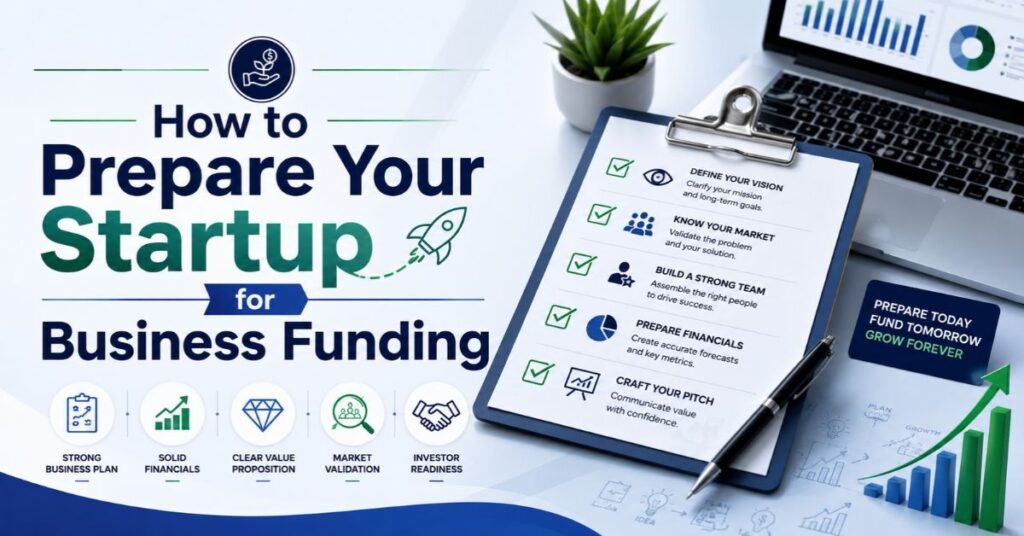
Pack before you reach the airport. The same rule applies to funding. Lenders and investors see many requests. Clean and clear files stand out. This is how to prepare a business for funding.
Preparation raises your odds and speeds up talks. It also shows you respect the other side’s time. Gather your papers first. Then your funding application moves smoothly from start to finish.
Create a Clear Business Plan and Financial Forecast
A strong business plan is short and honest. It says what you sell and who buys it. It explains how you earn money. It names rivals and shows why you win. Keep it to a few pages. Add startup financial forecasting for at least 12 months with a simple growth path and dates. Together these pieces form your startup funding plan. A reader should grasp your idea in five minutes. Use plain words and clear numbers.
Organize Financial Statements and Business Records
Lenders love tidy numbers. Prepare your profit and loss statements, your balance sheet, and your cash flow statements. Together they make up your financial statements. Add tax returns and bank statements. This step shows how to prepare financial documents for lenders. Messy books raise doubts. Clean books build trust. Update your records monthly so nothing piles up. Store them in one shared folder. You will thank yourself when a lender asks for files on short notice.
Define Your Funding Goals and Required Capital
Don’t say, “I need money to grow.” Say exactly how much and why. For example, “We seek $100,000 for inventory, two hires, and marketing over 12 months.” That sentence shows a plan. Your capital requirements should match the cost table you built earlier. Specific asks earn serious replies. A fuzzy ask earns a polite no. Also state the funding type you prefer and why. This sharpens your startup funding strategy and speeds up every conversation.
Explain How Funding Will Support Business Growth
Show the chain from money to results. Funding buys inventory. Inventory fills orders. Orders raise revenue. Revenue repays the loan or rewards investors. This is how to secure funding for business growth. Add a rough estimate of return on investment. Even a simple figure helps a reader see the value. For example, $20,000 in ads that brings $60,000 in profit yields a threefold return. Link each dollar to a clear result.
Prepare for Investor Questions and Due Diligence
Investors dig deep before they commit. Expect questions about market size, unit economics, your team, use of funds, and exit plans. This review is called financial due diligence. Build a document room with your plan, statements, contracts, and customer data. Practice short, honest answers. If you don’t know something, say so and promise to follow up. Honesty builds more trust than polish. Good prep also helps you evaluate investor expectations and spot a poor fit early.
How to Choose the Right Startup Funding Option
The fastest offer often costs the most. Speed feels good in a crisis. Yet total cost matters more. This is how to choose the right business funding option. Slow down and compare.
Use a three-question test. What will the money cost? What do you give up? What could go wrong? Write the answers for each offer. These business funding risks and benefits become clear on paper.
Compare Interest Rates, Fees, and Repayment Terms
A low headline rate can hide extra charges. Ask for the full yearly cost, often called APR. Add origination fees, late fees, and early repayment penalties. These financing fees shape the true price. This is business financing costs in the real world. Put each offer in a table and compare totals side by side. Study interest rates and repayment terms before you sign. Reading a contract is a skill. Practice it before you need it.
Understand Equity Dilution and Investor Expectations
Equity dilution means your share shrinks when new owners join. Say an investor puts $200,000 into a company worth $800,000 before the deal. The company is now worth $1,000,000. The investor owns 20%. You own 80%. Each later round shrinks your slice again. Read the board rights and exit terms too. Know what investor expectations apply before you agree. A fair deal leaves you motivated and in control of daily choices.
Check Funding Eligibility and Potential Risks
Check whether you qualify before you apply. Review funding eligibility requirements such as business age, revenue, and credit score. Strong business funding eligibility saves you from rejection letters. Rules differ by country and lender. So check local guidance first. Also look for personal guarantees and strict loan rules. Match the term to the need. Use short loans for short-term cash gaps. Use longer ones for big assets. Smart financial risk management starts before you sign.
Evaluate Funding Options Based on Your Business Stage
Return to the stage table above. At the idea stage, use savings and small grants. At early traction, consider angels or small loans. At scale, look at venture money or bank credit. This approach supports legitimate startup funding options that fit your real needs. It also keeps you from chasing money too early. Ask yourself one question each quarter. Does my current funding still match my stage? If not, adjust the plan.
How to Navigate Business Growth at Every Startup Stage
What helps on day one may hurt in year three. Needs change as a company grows. A new founder needs proof. A mature firm needs systems. The startup ecosystem offers help at each step.
Match your tools, goals, and money to your stage. This section gives a simple path from first idea to new markets. It also shows how business growth milestones guide each move.
See Also: Best Wireless Presentation Clickers: 7 Top Picks for Every Presenter
Idea Validation and Market Research
Test the idea before you spend big. This is idea validation. Talk to 20 possible buyers. Run a short survey. Sell a small version first. If people pay, you have proof. If they shrug, change course early. Careful market research costs little and saves a lot. Proof of demand also makes later startup fundraising easier. Many founders skip this step and regret it. Don’t be one of them.
Early Traction and First Customer Acquisition
Now you need real customers. Track where each one comes from. Measure how many stay. Watch your unit economics, which means profit per customer. This is where early customer acquisition begins. Spend small and learn fast. A clear customer acquisition cost gives investors confidence. Ask early buyers what they love and what annoys them. Their answers guide your product and your next ad.
Building Repeatable Revenue and Sustainable Operations
Repeatable revenue means sales you can predict. You find a channel that works and then run it again. Add simple systems for billing, support, and hiring. Watch retention closely. Happy customers who return lower your costs. This stage often shows product-market fit. Buyers want your product and tell friends. For example, a meal-kit firm that keeps 70% of subscribers each month has a base to build on. Stable operations make later growth less stressful.
Scaling Your Business and Expanding Into New Markets
Scaling means more of everything. You hire more people and build better systems. You may open new sites or enter new regions. This stage needs business expansion funding and sound business expansion planning. Growth can drain cash even when sales rise. Plan for it. This is the heart of scaling a startup and how to scale a small business. Use business expansion capital with care. Test each new market in a small way first.
How Digital Tools and Marketing Support Business Growth
Digital tools stretch every dollar. They reach customers, cut routine work, and give you data. Used well, they lift business operating efficiency.
Pick the goal first. Then choose the tool. This keeps technology spending lean. Smart choices also support financial planning for business expansion.
Build a Strong Online Presence
Your website is your shop window. Make it clear and fast. Add real photos, honest reviews, and simple contact details. Keep your social profiles active. Visitors want proof you are real. Trust signals matter. A strong presence also helps when lenders or investors look you up. They will. Use one consistent name, logo, and tone everywhere. That consistency makes a small firm look solid and ready for customer acquisition strategy work.
Improve Search Engine Visibility With SEO
Search engines send free visitors. This is the power of search engine optimization. Write helpful pages that answer real questions. Use the words your buyers type. Add clear titles and fast pages. Local shops should list their business in map services. Global shops should write for several regions. Results take months. Still, they last longer than most paid ads. Think of SEO as planting a tree. You wait a while. Then it gives shade for years.
Use Analytics to Measure Business Performance
Data shows what works. Use business analytics to track visitors, sales rate, and customer value. Check numbers every week. Look for patterns and not single days. Say a campaign brings traffic but no sales. Pause it. Move the money elsewhere. This is how to measure business growth with calm eyes. It also sharpens business performance tracking and protects working capital. Share a simple dashboard with your team so everyone sees the same truth.
Automate Repetitive Tasks and Workflows
Machines excel at boring work. Automate email replies, invoices, and booking reminders. A small team can save many hours each week. Those hours go to selling and service. Automation also cuts errors. It is one of the easiest ways to improve business operating efficiency. Start with one task that eats the most time. Fix that first. Then move to the next. Slow, steady automation beats a messy all-at-once rollout.
Key Business Growth Metrics Every Startup Should Track
Numbers tell the truth that feelings hide. A busy week can still lose money. Metrics reveal the real story. They also show lenders that you run a tight ship.
The table below lists the core measures. Each one answers a single clear question. Use it as your starter dashboard for how to track business performance metrics.
| Metric | Simple formula | Why it matters |
| Customer acquisition cost | Marketing spend ÷ new customers | Shows cost of winning a buyer |
| Customer lifetime value | Average profit per customer × time they stay | Shows long-term worth of a buyer |
| Gross margin | (Revenue − direct costs) ÷ revenue | Shows how much each sale keeps |
| Churn rate | Lost customers ÷ starting customers | Shows how fast buyers leave |
| Runway | Cash ÷ monthly burn | Shows months until cash ends |
“Revenue is vanity, profit is sanity, but cash is king.” This old business saying still rings true.
Customer Acquisition Cost and Customer Lifetime Value
Customer acquisition cost tells you what a new buyer costs. Customer lifetime value tells you what that buyer is worth over time. Compare them. Many advisers cite a rule of thumb of 3 to 1, meaning lifetime value should be about three times acquisition cost. Treat it as a guide and not a law. If you pay $50 to win a buyer who brings $200 in profit, you are in good shape. How to calculate customer acquisition cost is simple. Divide marketing spend by new customers.
Revenue Growth and Profit Margins
Track monthly revenue and compare it with last month. That is your growth rate. Then look at profit margins. Gross margin shows what is left after direct costs. Net margin shows what remains after all costs. For example, if you earn $10,000 and spend $7,000 on direct costs, gross margin is 30%. Rising sales with falling margins is a warning. It means growth may be costing more than it earns. Check both numbers together.
Customer Retention and Conversion Rates
Retention shows how many buyers stay. Churn shows how many leave. A leaky bucket needs fixing before you pour in more water. Conversion rate shows how many visitors become buyers. If 2 out of 100 visitors buy, your rate is 2%. Small gains here have large effects. Lifting that rate to 3% raises sales by half with no extra ad spend. Track repeat purchase rate too. Loyal buyers cost less to serve.
Cash Flow and Return on Investment
Profit on paper doesn’t pay bills. Cash does. Watch your burn rate, which is the cash you spend each month. Divide your cash by that number to find runway. Strong business cash flow management gives you time to react. Also track return on investment. If you spend $10,000 and earn $25,000 in profit, your return is 150%. Use this figure to choose where the next dollar goes. It supports smarter working capital management.
Is Growth Navigate Legitimate and Reliable?
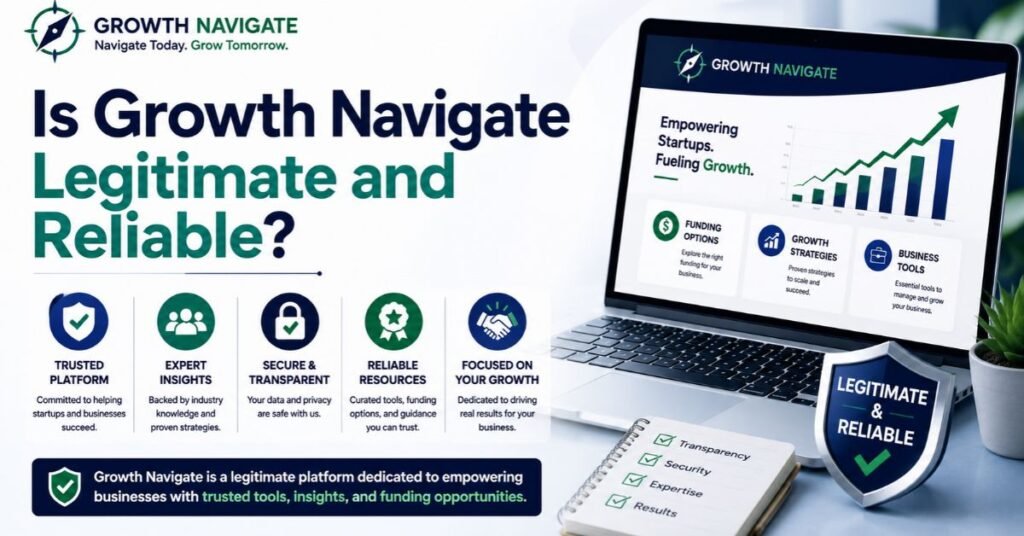
A name alone proves nothing. Neither does a slick website. This guide can’t confirm every claim made by every site with this name. So treat the question as a checklist. Apply it to any provider.
This is the heart of funding provider legitimacy. The aim is not to give a verdict. The aim is to teach you how to evaluate funding providers yourself. Verify first and share data later.
Verify the Official Website and Company Information
Start with the basics. Check the domain age and the contact page. Look for a real address and a working phone number. Search public records for company registration details. Many countries run free online company registers. Also check that names match across the site, contracts, and payment pages. Mismatches are a warning. Search the company name with words like “complaint” or “review.” Read both praise and criticism with care.
Check Funding Claims and Service Descriptions
Ask who really lends or invests. Ask for the answer in writing. Request license numbers and past client contacts. Also check funding adviser credentials. A real adviser shares qualifications openly. Treat any promise of guaranteed funding claims with caution. This is how to verify business funding services step by step. Compare what the website says with what the contract says. If the two differ, trust the contract and ask questions before you move on.
Review Fees, Contracts, and Refund Policies
Read the funding agreement line by line. Look for commissions, upfront fees, and exit costs. Ask what happens if you don’t win approval. Find the refund policies before you pay. If a clause confuses you, ask a lawyer. The U.S. Federal Trade Commission shares scam-spotting tips at consumer.ftc.gov. Use similar guidance from your own country. Never sign under pressure. A fair provider gives you time to read and think.
See Also: Fentomagazine.com Review: Features, Content, Guest Posts, and Safety Guide (2026)
Warning Signs to Watch for Before Paying a Funding Adviser
Some signs should stop you at once. This list helps with how to avoid startup funding scams and spotting business loan scams.
| Red flag | Why it matters |
| Guaranteed approval | No honest lender can promise it |
| Large upfront fees | Real lenders often take costs from the loan |
| Pressure to sign today | Scammers hate time to think |
| Vague or missing contract | You can’t enforce what you can’t read |
| Requests for passwords or bank logins | Puts your private financial data at risk |
| Unclear company details | Hard to trace if things go wrong |
Case study (illustrative example): A café owner paid $2,000 to a “guaranteed funding” adviser. Nothing happened and no refund came. A quick registry check would have shown that the firm didn’t exist. One hour of research could have saved the fee.
Can Any Funding Adviser Guarantee Business Financing?
No. Lenders and investors make their own decisions. An honest adviser can improve your preparation, your documents, and your pitch. That help has real value. Yet no adviser controls the final answer. Any promise of sure approval, especially with a big upfront fee, is a red flag. Walk away and look for providers who explain risks openly. Real experts speak in probabilities and not promises.
Common Startup Growth and Funding Mistakes to Avoid
Good money plus a weak plan makes a short story. Many founders raise cash and then waste it. They hire too fast. They rent a fancy office. They launch five products at once. Revenue lags and cash burns away.
Learn from those errors. Each mistake below is common and avoidable. Spot them early and you protect your sustainable business growth.
Investing in Tools Before Identifying Business Needs
A shiny app on a dusty shelf helps no one. Many founders buy software first and ask questions later. They pay for ten tools and use two. Name the problem before you pick a fix. Test with free trials. Cancel what you don’t use. This habit keeps startup business tools lean and useful. It also protects cash for the things that matter, like customers and product quality.
Raising Too Much or Too Little Capital
Raise too much and you waste money or give away too much equity. Raise too little and you run dry before you prove your case. Both hurt. Use your cost table and add a buffer of about 15%. Then match the amount to a clear plan. This is how to calculate startup funding needs with care. Review the number each quarter. If results change, adjust the ask before you approach lenders again.
Choosing Funding Without Comparing the Terms
Founders in a hurry often take the first offer. That can cost thousands. Always weigh at least three offers. Compare total cost, ownership impact, speed, and risk. Put them in a simple table. Read every clause. Ask about financing fees and early repayment penalties. A short delay to compare terms is cheap. A bad contract lasts for years.
Scaling Before Establishing Product-Market Fit
Scaling too soon is like pouring water into a cracked pot. Warning signs include low retention, heavy discounts, and high churn. If buyers don’t return, fix the product first. Strong product-market fit shows up as steady repeat sales and word-of-mouth. Then you can grow with confidence. Until then, keep spending low and learning high. Patience here saves your startup capital for the moment it counts.
Ignoring Cash Flow and Business Performance Metrics
Weak forecasts and skipped reviews hide problems until it’s late. A firm can show profit and still run out of cash. Review your numbers monthly. Update your financial forecasting as facts change. This is how to improve financial planning over time. Set alerts for low cash. Keep a simple dashboard. Good business cash flow management gives you options. Poor tracking leaves you with panic.
A Practical 90-Day Business Growth Plan
Ninety days is long enough to learn and short enough to stay focused. A short plan beats a vague yearly dream. This is a ready-made startup growth planning framework.
The table below shows the three phases. Follow it step by step. Adjust the details to fit your firm.
| Phase | Focus | Key output |
| Days 1–30 | Analyze and prioritize | One problem, one number, one date |
| Days 31–60 | Test and measure | Weekly results log |
| Days 61–90 | Evaluate and refine | Updated plan and funding decision |
Days 1–30: Analyze Your Business and Identify Priorities
Spend the first month on facts. Review sales reports, customer feedback, and cash balance. Name one problem in one sentence. Then set a number and a date. For example, “Raise checkout rate from 1% to 2% by day 60.” List your time, skills, tools, and money. This audit shows whether you need outside capital at all. Share the plan with your team so everyone pulls in the same direction.
Days 31–60: Test Growth Strategies and Measure Results
Now run one small test at a time. If checkout confuses buyers, fix one page. Don’t rebuild the site. Log results every week. Compare them with your target. Small steps give fast answers and protect cash. Think of it as dipping a toe before you jump in. If a test fails, write down why. That note becomes a lesson. Then try the next idea.
Days 61–90: Evaluate Performance and Refine Your Plan
Review the full 60 days of data. Scale what worked. Drop what didn’t. Check your return on investment for each test. Then decide if you need outside money. If you do, you now hold strong numbers for your funding application. Update your business growth milestones for the next quarter. Repeat the cycle. Calm, steady loops build a firm that grows without panic.
Who Can Benefit From Growth Navigate Strategies?
Different businesses share one need. They all need honest numbers. A startup needs proof. A shop needs stock. An older firm needs steady expansion.
Pick the group that matches you. Then adapt the ideas. Every business can use clear goals, tight cash control, and careful business growth strategies.
Early-Stage Startups and First-Time Founders
New founders must prove demand and stretch every dollar. Focus on testing, learning, and low costs. Use savings, small grants, or angels at first. A solid plan and clean books earn trust. Funding for entrepreneurs gets easier once you show early proof. Join local founder groups and online communities. The wider startup ecosystem offers mentors, events, and free advice. These links often lead to your first customers and your first investors.
E-Commerce Businesses
Online stores need cash before they earn it. They buy products and then wait for sales. Good financing for inventory and hiring prevents empty shelves and burned-out teams. Watch ad spend closely. Many stores use short loans or revenue-based deals to bridge gaps. Keep a tight grip on working capital management. Track return rates, shipping costs, and repeat buyers. These numbers decide whether growth adds profit or only adds work.
Service-Based Businesses
Agencies, consultants, and contractors sell time and skill. They need cash for staff, tools, and marketing. Growth often hits a ceiling when the team is full. Funding for hiring or equipment can lift that ceiling. Track billable hours and client payments to keep business cash flow management healthy. Late invoices hurt most. Send bills fast and follow up politely. Consider deposits for large projects.
Established Small and Medium-Sized Businesses
Older firms may want to open new sites or buy a rival. They may chase new markets. Because they have history, they often qualify for small business financing on better terms. Use business expansion capital with care. A bold move needs careful financial projections. Lenders will ask for them. Good financial planning for business expansion also includes backup plans. Ask what happens if sales fall 20%. Strong answers win approval.
Frequently Asked Questions
What Is Growth Navigate?
Growth Navigate is a name used online for startup tools, growth advice, and funding-related services. Different websites may use similar names. Always check the official site and company details before you rely on any claim. Confirm services, fees, and contact information in writing before you share any financial data.
What Are Growth Navigate Startup Tools?
These tools usually help with planning, marketing, finance tracking, and teamwork. They aim to save time and improve decisions. Their value depends on your habits. Test any tool with a free trial first. Then check that it fits your real needs and your budget.
What Is Growth Navigate Funding?
It is a growth-focused way of finding capital. You set goals, calculate capital requirements, and match them with suitable business financing options. It is a method and not a guarantee of money. Always confirm what any provider with this name actually offers before you proceed.
Is Growth Navigate Funding a Grant or a Loan?
It depends on the provider and the product. Grants usually need no repayment. Loans do. Equity deals trade ownership for cash. Ask for the exact product name and the written terms. Never assume. A clear funding agreement tells you which type you receive.
Does Growth Navigate Offer Direct Startup Funding?
Only the official website and written contracts can answer this. Some firms lend directly. Others only introduce you to lenders or investors. Ask who supplies the money and who holds legal responsibility. If nobody can tell you clearly, walk away and look elsewhere.
Can a Funding Adviser Guarantee Loan or Investment Approval?
No. No honest adviser can promise approval. Lenders and investors make their own choices. An adviser can improve your preparation and your pitch. That help is useful. But a guarantee is a red flag, especially when it comes with a large upfront fee.
How Can Startups Choose the Best Funding Option?
Start with your goal and your numbers. Compare total cost, ownership impact, speed, and risk. Match the term to the need. Use short funding for short needs. Read every contract. Compare at least three offers. Then pick the one that supports your plan without crushing your cash flow.
How Can Businesses Measure Growth Effectively?
Pick a few key numbers and track them monthly. Good choices include revenue, profit, customer count, cost per customer, and cash balance. Compare them with your targets. Review business growth milestones regularly. Adjust when results fall short. Simple tracking beats complex dashboards you never read.
Is Growth Navigate the Same as the Growth Navigator Program?
Not necessarily. Similar names often belong to different groups. Check the owner, purpose, audience, and fees of each one on its own official website. Look at company registers too. Don’t assume a link between the two until you see proof in writing.
Conclusion
Smart funding starts with a clear goal. Know your capital requirements. Compare startup funding options and weigh the cost of each one. Prepare your financial records and your business plan. Then verify every provider before you share data or sign anything. That mix of planning and caution protects your business.
Your next step is small. Open a blank page today and write your goal, your number, and your timeline. Then use the cost table above to find your funding need. Once you see the real figure, every choice gets easier. Grow with care and keep your eyes open. Sustainable business growth comes from good decisions made one step at a time.