

BD268XZ Explained: Meaning, Uses, Applications, and What to Know
Picture a shop that ships a million parcels each month. Every parcel needs a name that no other parcel shares. That name is often an alphanumeric code. A string like BD268XZ shows the idea well. Two letters come first. Three digits follow. Two more letters close the string. It looks small. Yet it explains how digital identification codes keep giant systems tidy. You’ll get BD268XZ explained in plain words here.
Here’s a quick note before we start. No public standard lists BD268XZ as an official term. So treat it as a sample string that shows how a unique identifier works. You’ll also see another odd string in related searches. It’s the f6k-zop3.2.03.5 model. The same caution applies to it. Trusted sources such as RFC 9562 back the general facts you’ll read. You’ll learn the BD268XZ meaning, the BD268XZ uses, the risks, and the checks that protect you.
What Is BD268XZ? Meaning and Possible Purpose
What is BD268XZ? It’s a seven-character label with a clear pattern. The BD268XZ code points to one item inside a system. That item might be an order, a login session, or a sensor. Think of a passport number. It names one person and nobody else. The BD268XZ identifier works the same way. Its strength comes from being the only one of its kind. Good technical identification depends on that single rule. A label that repeats is a label that fails.
What does BD268XZ mean? The honest answer is simple. The BD268XZ meaning isn’t fixed by any official source. The letters don’t spell a word. The digits don’t hide a message. Treat the string as a sample alphanumeric code. Real teams might use a similar string as a product identification code or a system reference code. The table below shows what such a label can name.
| Item Named | Example Use | Why the Label Helps |
| Database record | Customer order | Finds the row fast |
| User session | Login visit | Supports session tracking |
| Transaction | Card payment | Prevents double charges |
| IoT device | Smart meter | Separates one device from millions |
| API request | Mobile app call | Speeds up debugging |
What Is BD268XZ Used For?
What is BD268XZ used for? In the sample view, BD268XZ uses cover records, sessions, requests, and devices. A store may tag every order with one code. A support agent then types the code and sees the whole story at once. A bank may tag every payment the same way. That tag stops double charges. Each use follows one pattern. The code names a thing. The system links data to the name.
You meet this idea every day. Your delivery tracking number is one case. Your booking reference is another. Software hides the same trick behind the screen. These software identifiers support database records and digital information management. They also help teams sort, filter, and join data with less guesswork. Staff spend less time hunting. Customers wait less too.
How Does BD268XZ Work?
How does BD268XZ work? It follows a short life cycle. Engineers define a format. A tool generates the code. The system connects it to data. A database stores it. Staff then track it over time. Each stage builds on the last. Think of a relay race. A dropped baton early on ruins the finish.
This flow sits inside the wider software architecture of an app. Data moves left to right. Updates travel back along the same path. The BD268XZ system therefore needs care at every step. The BD268XZ technical information below covers each stage in turn.
| Stage | Question It Answers |
| Define → | What shape does the code take? |
| Generate → | How does each new code appear? |
| Connect → | Which item does it name? |
| Store → | Where does it live safely? |
| Track | How do we follow it over time? |
Understanding the Structure of BD268XZ
BD268XZ technical details start with the pattern. Two letters come first. Three digits sit in the middle. Two letters finish the string. That layout gives 26 × 26 × 10 × 10 × 10 × 26 × 26 combinations. The total is about 457 million when you use uppercase letters only. Learning this layout is the first step in Understanding alphanumeric identifiers. A clear format also helps with code classification. People can read it, say it aloud, and spot typing errors fast. A fixed length makes code validation easy too. A simple rule can reject any string that breaks the pattern.
How Identifiers Are Generated and Assigned
Next comes the hard part. How does a system pick each new code? It has three common choices. Random generation makes codes hard to guess. A counter simply adds one each time. A hash function turns input data into a fixed code. Each method has trade-offs. Counters sort easily. Yet outsiders can guess the next value. Hashes always return the same output for the same input. They can also collide. Strong unique identifier design checks that a new value doesn’t already exist. The system then assigns the code the moment the item appears.
Connecting BD268XZ to Databases and Digital Records
A code means little alone. Picture a coat check ticket. It matters because it matches one coat. In the same way, the BD268XZ database link matches one row of facts. The system ties the label to a user, an order, or a device. That tie turns a plain string into a handle for database records. It also supports API integration because separate tools can refer to the same item. Without that shared name, teams waste hours matching records by hand.
How Data Is Stored, Tracked, and Updated
Storage is where design meets reality. The database keeps the code in a column with a rule that blocks repeats. An index on that column makes lookups quick. Backups protect the data. Logs record each change. Updates keep the same code but change the details around it. This steady care protects data integrity. It also gives auditors a clear trail. Good data organization keeps related fields close together. That choice decides how fast the system feels later.
Key Applications of BD268XZ in Digital Systems
Software needs a name for almost everything. That’s why BD268XZ applications reach so many fields. Databases, APIs, security tools, clouds, and AI pipelines all use similar labels. Each field treats the code a little differently. The goal stays the same. One clear name must point to one clear thing.
The Possible applications of BD268XZ below are examples. They aren’t confirmed uses of this exact string. They show how any code of this type behaves. Read each one with that view in mind. You’ll see the same pattern repeat.
BD268XZ in Database Management
Databases lean on identifiers more than any other tool. Each row needs a record ID so the engine can find it fast. Imagine an online store with millions of orders. Each order gets a code. Support staff type it and see the full story. A unique constraint stops two rows from sharing one code. Indexing keeps searches quick during a sales rush. This is the core of BD268XZ database work. It shows why database records need clean names.
BD268XZ in APIs and Backend Systems
Every tap in an app sends a request. Each request can carry its own code. That code is an API request ID. It supports API integration across many services. When something breaks, engineers search the code and see the whole path. Teams fix bugs faster. Customers wait less. Backend systems also stay easier to debug and maintain. One shared label ties every service log to the same event.
BD268XZ in Cybersecurity and Access Management
Security teams need to know who did what and when. A session ID marks each login visit. Logs tie every action to that code. This helps teams trace attacks. It also supports access control because permissions link to known sessions. Still, a code is never a lock. The OWASP guide on insecure direct object references explains why every request needs a permission check. A security assessment should test that rule first.
BD268XZ in Cloud Computing
Clouds run on countless tiny parts. Virtual machines start and stop all day. Files move between storage zones. Each part needs a name. Cloud tools use codes to track them all. These labels help teams audit costs and spot waste. They also tie network traffic to the right owner. This is BD268XZ digital technology at work. Small labels keep big platforms neat.
BD268XZ in AI and Automation
AI work produces mountains of files and tests. Without labels the pile turns into chaos. Teams tag datasets with codes. They tag each test run too. Each trained model gets a tag as well. A BD268XZ model tag, for example, could name one trained model. That supports model version control. Teams can then roll back to a good version in minutes. A version identifier plays the same role in software releases. Labels also fuel automated data management across busy pipelines.
Potential Benefits of BD268XZ
Good labels pay off every day. They save time and cut mistakes. They also give teams a shared language. The gains look small at first. Over months they add up to real savings.
Four benefits stand out. They cover order, growth, traceability, and speed. Each one depends on design rather than on the string itself. A careful team gets the gains. A careless team doesn’t.
Improved Data Organization and Management
Messy data wastes hours. Clear codes bring order. Each item gets a name and a place. Teams find records without guessing. Structured labels also let tools sort, filter, and join tables with ease. Reports become cleaner. Audits run faster. New staff learn the system quicker because every item follows the same naming rule. That consistency is the heart of strong data organization.
Scalability and System Efficiency
Growth should feel exciting and not scary. A solid identifier plan supports scaling as traffic rises. Teams add servers without renaming old data. Still, format limits matter. A seven-character code holds about 457 million values at most. That’s plenty for many apps. A giant platform may need a longer format. Efficiency also improves when staff stop hunting for records. Every saved minute adds up across a whole company.
Data Tracking and Traceability
Traceability means you can follow an item from start to finish. A single code makes that possible. Support staff trace a late parcel in seconds. Finance teams trace a payment across systems. During audits, logs tied to one code tell a clear story. Regulators get proof instead of guesses. That clarity extends the BD268XZ uses into compliance work too.
See Also: TheTechyx.com Review 2026: Features, Safety, Legitimacy, and Website Overview
Potential Performance Improvements
Speed gains are possible. They aren’t automatic. With sound indexing, lookups stay fast. Fully random codes can scatter writes across an index. Time-ordered formats such as UUIDv7 reduce that problem. You can read the details in RFC 9562 and the ULID specification. The table compares common choices.
| Identifier Type | Length | Order | Guessability | Best For |
| BD268XZ-style code | 7 characters | None | Low to medium | Small systems and human-friendly labels |
| Auto-increment number | Varies | Sequential | High | Simple single-database apps |
| UUIDv4 | 36 characters | Random | Very low | General unique IDs |
| UUIDv7 | 36 characters | Time-ordered | Low | Large databases that need speed |
| ULID | 26 characters | Time-ordered | Low | Sortable and compact IDs |
Challenges and Limitations of BD268XZ
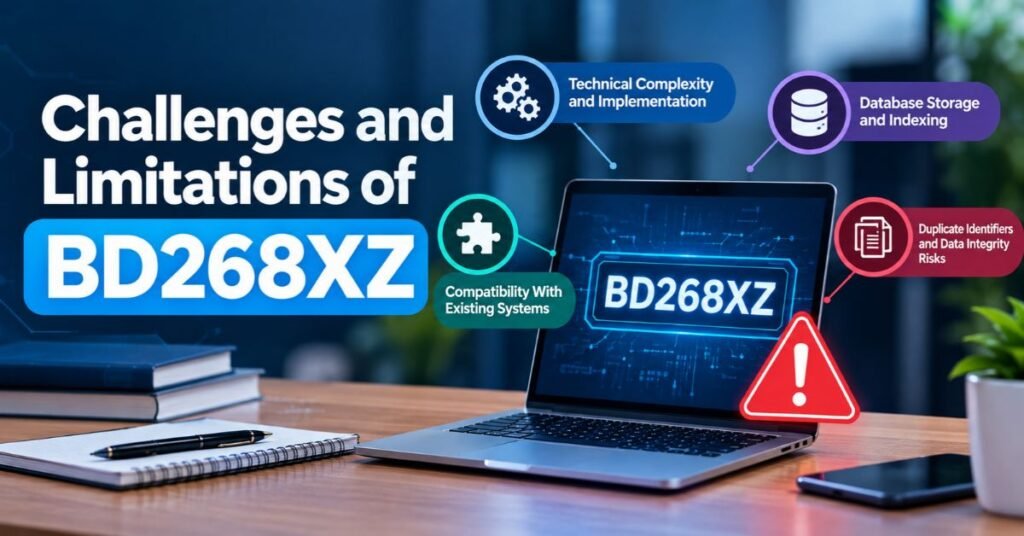
No tool is perfect. Identifier plans can fail in quiet ways. A bad choice may hide for years. Then one busy day it breaks something important.
Four problems appear again and again. They involve setup, storage, old systems, and repeats. None is fatal. Each one has a fix.
Technical Complexity and Implementation
Setup takes thought. Teams must pick a format and a generator. They must also decide who may create codes. Changing a format after launch is hard. Every table and service may need edits. Write clear rules first. Then test the plan with sample data. A small pilot reveals problems before they reach real customers. Documents help too. Good technical documentation keeps everyone on the same page.
Database Storage and Indexing
Every code takes space. Every index takes more. At large scale those bytes add up. Long strings cost more than short numbers. Random codes can also hurt index order. That slows busy writes on big tables. Measure before you commit. Test indexing under real loads. Time-ordered formats often cut the cost. Careful storage planning keeps bills and delays under control.
Compatibility With Existing Systems
Old software rarely welcomes new rules. A legacy tool may expect plain numbers. It may reject letters. These gaps shape BD268XZ system compatibility. Teams may need adapters or small rewrites. Map every tool that touches the code. List each field that stores it. Test every handoff. A staged rollout lowers risk because old and new formats can run side by side. System identification codes from different vendors may also clash. Check each one early.
Duplicate Identifiers and Data Integrity Risks
Repeats are the enemy. Two items with one code break trust. Short random formats collide more easily than long ones. The birthday paradox explains why. With about 457 million possible codes, a 50 percent chance of a collision appears after roughly 25,000 random picks. That surprises many people. Duplicates then corrupt reports and payments. A database rule that rejects repeats is the safest guard. Longer formats cut the risk further. Sound data integrity needs both.
Is BD268XZ Secure and Reliable?
Here, BD268XZ security and reliability depend on design. The honest answer is “it depends.” A code alone is neither safe nor unsafe. A well-built system can use short codes safely. A careless one can leak data even with long codes.
Safety comes in layers. Strong generation, strict checks, and steady watching all matter. No single piece does the job. The three sections below show how to judge a real setup.
Data Protection and Access Control Considerations
Protection starts with permissions. Every request must prove who sent it. The server then checks the right to see that record. This holds even when the caller knows the code. Encryption and backups add more cover. Logs record each view and edit. Short codes still work under these rules. The code only names the item. Access control decides who may open it.
Potential Security Risks
Several traps catch teams again and again. Guessable codes let attackers scan for records. At 1,000 guesses per second, a scan of 457 million values takes about five days. Codes in web addresses may leak through browser history. Weak random sources create patterns. Attackers exploit patterns fast. Many breaches start with missing permission checks rather than weak codes. A regular security assessment catches these gaps. Rate limits slow guessing attacks.
How to Evaluate the Reliability of BD268XZ
Trust but verify. Digital code verification starts with tests. Run collision tests on large samples. Load-test the generator at peak traffic. Review the random source. Confirm that the database rejects repeats. These reliability checks also cover logs. Identifier verification means turning each question into a pass or fail result. That’s How to verify a technical code in practice. The table turns the checks into action.
| Check | Question to Ask | Pass Sign |
| Collision test | Do repeats appear in millions of samples? | Zero repeats |
| Load test | Does generation stay fast at peak? | Stable speed |
| Random source | Is it cryptographically secure? | Yes |
| Database rule | Does it reject duplicates? | Yes |
| Audit logs | Are changes recorded? | Complete trail |
Best Practices for Using BD268XZ in Digital Systems
Good habits beat clever tricks. A few simple rules prevent most trouble. Teams that follow them enjoy smooth systems. Teams that skip them fight fires.
Five habits are worth building. The table sums them up. Share it with your team. Review it at the start of each project.
| Habit | What to Do | What It Prevents |
| Consistent format | Use one pattern everywhere | Parsing errors |
| Proper indexing | Index lookup columns | Slow queries |
| Duplicate checks | Add unique constraints | Corrupt data |
| Security controls | Verify permissions on each request | Data leaks |
| Regular monitoring | Watch speed and errors | Hidden decay |
Maintain a Consistent Identifier Format
Consistency saves headaches. Pick one pattern and write the rule in a shared guide. Add checks that reject bad input. Imagine mixing uppercase and lowercase across tools. Matches would fail without warning. One clear format removes that risk. It also helps people read the code aloud over the phone. Keep software version naming separate from record codes so nobody confuses the two.
Implement Proper Database Indexing
An index works like a book’s index page. It points straight to the answer. Without one the engine reads every row. That crawls on large tables. Add an index on the code column. Check query plans from time to time. Drop unused indexes. Each extra one slows writes. Measure speed before and after every change to confirm the gain.
See Also: Trwho.com Review: Technology Features, Security, Privacy, and Online Safety
Prevent Duplicate Records
Stop repeats at the door. Add a unique constraint in the database. Let the engine reject a clash on its own. Retry safely when one happens. Don’t trust application code alone. Two servers may pick the same value at once. The database sees both and blocks one. That final guard protects your data even during traffic spikes or rare bugs.
Apply Appropriate Security Controls
A hard-to-guess code is a bonus. It’s never a lock. Check who asks for a record on every request. Use a cryptographically secure source for random values. Avoid private meaning inside the code. Keep sensitive details out of web addresses. Apply rate limits to stop guessing. Layered controls keep each record visible only to the right people.
Monitor System Performance
Healthy systems still need checkups. Track lookup times and error rates. Watch storage growth. Set alerts for sudden spikes. Review dashboards weekly. Watch for rising collision counts too. A small trend today becomes a crisis next year. Regular monitoring also proves that your design still fits your traffic as the business changes.
How to Verify What BD268XZ Actually Means
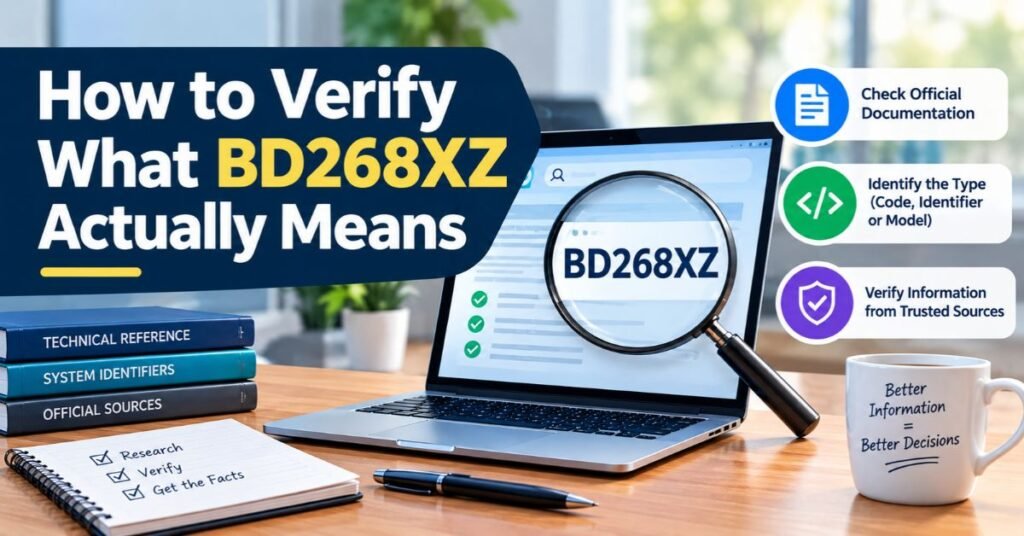
Strange strings fool people every day. A forum post may call BD268XZ a product. Another may call it a chip. Neither claim proves anything. So you need How to verify an unfamiliar technical term as a habit. It starts with one question. Who published this claim? A named vendor or standards body carries weight. An anonymous page doesn’t.
Next, look at the context around the string. This is How to identify BD268XZ in the wild. Check the page where you found it. Look for a vendor name or a version number. Seek Official documentation for BD268XZ first. If none exists, say so plainly. The same steps work for the f6k-zop3.2.03.5 model and any similar string. Strong information accuracy beats a quick answer.
Check Official Documentation and Technical References
Start with official technical sources. These include vendor manuals, standards bodies such as the IETF, and product datasheets. Search the exact string in quotes. Then check whether the source names the string directly.
A page that only repeats the string proves nothing. Good technical documentation lists the owner, the version, and the date. Model documentation also shows who maintains it. If you find no such page, treat the term as unverified. That’s a valid and useful result.
Identify Whether BD268XZ Is a Code, Identifier, or Product Name
Is BD268XZ a code or a model? Without official proof it’s best read as a code. Is BD268XZ a software identifier? It can act as one when a system uses it to name a record or session. A model claim needs a maker and a datasheet. Technical model identification relies on that proof.
Technical model numbers usually follow a maker’s own scheme. They often show a product line and a revision. A model designation or a technical reference number belongs to the maker. An identifier instead names one unique item. Model number identification therefore starts with the maker and never with the string. The table shows the Difference between a model number and an identifier.
| Feature | Model Number | Identifier |
| What it names | A product type | One unique item |
| Who sets it | The maker | The system |
| Can it repeat? | Yes, many units share it | Never |
| Example | A laptop series label | An order code |
Distinguish Verified Information From Speculation
Speculation spreads fast around odd strings. Take the f6k-zop3.2.03.5 model as a case. What is the f6k-zop3.2.03.5 model? It looks like a model-style label with dots and a version-like tail. What does f6k-zop3.2.03.5 represent? Nothing is confirmed. So pages about f6k-zop3.2.03.5 meaning, f6k-zop3.2.03.5 explained, f6k-zop3.2.03.5 specifications, and f6k-zop3.2.03.5 technical details deserve doubt unless they cite a maker. Specs without a source are guesses. Compare any f6k-zop3.2.03.5 model details, model version information, and technical model specifications against a maker’s datasheet. That’s product model verification. Then follow the steps below.
- Copy the exact string.
- Find who published each claim.
- Look for a vendor datasheet or a standard.
- Compare at least two independent sources.
- Mark the claim as verified or unverified.
The Future of BD268XZ in Technology

Tomorrow’s systems will hold far more data. Billions of devices will talk nonstop. AI will create endless files and models. All of it needs names. Identifier design will matter more and not less.
Expect longer formats and smarter generators. Expect tighter links with security and automation. Treat these points as possibilities and not promises. Nobody can predict the exact path. Still, the push toward better labeling looks firm.
Potential Applications in Cloud Computing
Cloud use keeps rising. More firms run across many regions and vendors. Each resource needs a stable name that survives moves and upgrades. Future tools will likely lean harder on clear identifiers. They will help teams track spending, security, and ownership. Standard formats such as UUIDv7 already point that way. They combine uniqueness with sortable time order. Better naming may also speed up audits.
Possible Uses in AI and Automation
AI pipelines grow more complex each year. Teams juggle datasets, prompts, tests, and models. Stable labels keep the mess under control. Regulators may soon ask which data trained which model. Clear codes make honest answers possible. Automated tools can follow each artifact from creation to retirement. A BD268XZ model style tag could serve here too.
Integration With Blockchain and IoT Systems
A blockchain transaction ID is a hash that names one transfer forever. Firms may link their own codes to those public hashes. That link can aid audits and supply chain proof. IoT platforms need names too. A factory may track thousands of machines. A city may track streetlights. Short codes print on stickers for field workers. Longer secure keys handle the actual device login. Treat blockchain as an option. Many apps work fine without it.
Why Should Businesses Understand BD268XZ?
Small naming mistakes cost real money. A duplicate invoice number may trigger a double payment. A missing order code may delay a refund for weeks. Leaders who grasp identifiers avoid these traps. They ask better questions. They approve better designs. They also spot weak claims about strange terms before those claims reach a budget.
Consider a hypothetical case study. A fictional shop called Maple Row sells home goods. It once used plain counters for orders. Staff often mixed up two similar orders. After a switch to structured codes with duplicate checks, support lookups got shorter. Refund errors fell. The story is invented. It shows the kind of gains teams may hope for. A line commonly credited to Phil Karlton sums up the challenge: “There are only two hard things in Computer Science: cache invalidation and naming things.” Keep that in mind.
See Also: 20xBusiness.com Review: Features, Credibility, Ownership, and Safety
Common Misconceptions About BD268XZ
Myths spread fast around technical terms. They confuse readers and mislead buyers. A short reality check clears the air. Three questions cover the most common doubts.
Keep one rule in mind. Judge any identifier by its design and not its looks. Ask how it’s made, stored, and protected. Those facts matter far more than the pattern of letters.
Is BD268XZ Just a Random Code?
Not quite. A random-looking string can follow strict rules. BD268XZ follows a clear pattern of letters and digits. Its purpose is to name one item. The way a system makes it matters too. A generator may use random numbers or a hash function. Rules set the length and the allowed characters. So the code is a planned label. Still, the string alone carries no special power.
Does BD268XZ Have a Confirmed Practical Application?
The idea has plenty. Codes of this type serve databases, APIs, security logs, cloud tools, and AI pipelines. Yet this exact string has no confirmed use. Every parcel, ticket, and session you touch depends on a similar label. So the practical value of the concept is real. The value of this specific string stays unproven until an official source says otherwise.
Is BD268XZ a Verified Technology Standard?
No. No public standards body lists it. Real standards include RFC 9562 for UUIDs and the ULID specification. Those documents name authors, versions, and rules. BD268XZ has none of that. Treat it as an example or a naming convention. Check any claim against a source you can open and read.
Frequently Asked Questions
What Does BD268XZ Mean?
What does BD268XZ mean? It has no official dictionary meaning. It works as a sample alphanumeric code that shows how a label names one item. The pattern is two letters, three digits, and two letters. Real systems use many similar patterns. The label matters more than the exact letters.
What Is BD268XZ Used For?
What is BD268XZ used for? A code like this names records, sessions, requests, devices, and files. The BD268XZ uses include fast search, error tracing, and audits. Anywhere a system must tell two items apart, an identifier helps. That’s the whole idea.
Is BD268XZ a Software Tool or Technical Identifier?
It’s a technical identifier concept. It isn’t a software tool. You can’t download it or run it. It works as a label inside other software. Databases, APIs, and cloud platforms store and use such software identifiers every day.
Can BD268XZ Be Used in Database Systems?
Yes. A database can store it as a text column. Add a unique rule and an index. Then lookups stay quick. Check size limits first. A seven-character format suits small and mid-size tables. Very large systems should consider longer formats such as UUIDv7 or ULID.
Is BD268XZ an Officially Recognized Technology Standard?
No. No public standards body lists BD268XZ. Treat it as an example or a naming convention. Real standards come with authors, versions, and public documents. Check any claim against such sources before you rely on it.
Conclusion
You now have the big picture. A simple label gives every item a clear name. The steps are easy to follow. Define the format. Generate the code. Link it to data. Store it with an index. Track it over time. Each step supports data integrity, speed, and trust. Just as important, you know how to test a strange string. Ask who published the claim. Look for official documents. Mark anything unproven as unverified.
Good identifiers help in every field. Databases, APIs, clouds, AI tools, and IoT networks all rely on them. Challenges exist. Smart habits tame them. Use consistent formats, strict duplicate rules, and strong access checks. If you plan a new system, start with your identifier design today. Then test it, watch it, and improve it as you grow.