
Newstown CraigScott Capital: Background, Regulatory History, Risks, and Investor Guide (2026)
Newstown CraigScott Capital is a search phrase and not a registered firm. It echoes Craig Scott Capital LLC, a former New York broker-dealer. No public record links the word “Newstown” to that firm.
Did an offer land in your inbox under this name? Pause before you send any money. A quick brokerage firm verification can save you a lot of pain.
Craig Scott Capital LLC closed in 2015, and FINRA expelled it in 2017. This guide covers its regulatory history, the risks, and easy checks you can run yourself.
What Is Newstown CraigScott Capital?
You may have seen the name Newstown CraigScott Capital in a search result or an offer. It sounds like a real firm. Yet no registered financial firm uses that exact name in the public records. This Newstown CraigScott Capital review sticks to what you can check yourself.
The documented firm behind the phrase is Craig Scott Capital LLC. It was a New York broker-dealer that closed years ago. Below, you’ll find its Craig Scott Capital background, its Craig Scott Capital regulatory history, and a clear way to run your own brokerage firm verification. Everything here is educational. It isn’t investment or legal advice.
Understanding the Newstown CraigScott Capital Name
Start with the word “Newstown.” It appears in no registration record. The FINRA BrokerCheck report for the firm lists no alternate business names. No SEC or FINRA document in the public file uses it either. Nobody has documented where the word came from. Any story about its origin is a guess. The spelling “CraigScott” as one word is just how people type the name. The legal business name is Craig Scott Capital, LLC.
Craig Scott Capital, LLC: Historical Company Background
Craig Scott Capital LLC was a former brokerage firm based in Uniondale, New York. It became a registered broker-dealer in January 2012. Its CRD number 155924 and SEC registration number 8-68751 identify it in the records. It worked as an introducing broker. That means it dealt with customers while a clearing firm, COR Clearing LLC, held the accounts, cash, and securities. The table below shows the key identity details.
| Detail | Record |
| Legal name | Craig Scott Capital, LLC |
| Type | Registered New York broker-dealer |
| Identifiers | CRD number 155924; SEC 8-68751 |
| Location | Uniondale, New York |
| Leaders on record | Craig Scott Taddonio; Brent Morgan Porges |
| Clearing firm | COR Clearing LLC |
| Status | Former firm; no longer registered |
Is Newstown CraigScott Capital the Same as Craig Scott Capital?
The records don’t say so. Only “Craig Scott Capital, LLC” appears in the regulatory documents. FINRA BrokerCheck reports no successor firm, merger, or new name. So the longer name stays unexplained. If someone offers you services under it, that person owes you proof. They should show a matching broker-dealer registration. Nobody can borrow the old firm’s history to look established. This point matters for Newstown CraigScott Capital legitimacy. A name alone proves nothing.
Why the Name Appears Differently Across Online Sources
Search results disagree about this name. One page says no legitimate firm uses it. Another calls it an established wealth manager. Others link it to the old brokerage and its regulatory record. The pages describing a modern business give no registration number. They point to no regulator filing either. Confident writing isn’t evidence. The pages worth trusting link to original SEC, FINRA, or FINRA BrokerCheck documents. Use those first. Treat everything else as unverified.
Executive Summary: Key Facts Investors Should Know
Here is the short version. No verified entity uses the name Newstown CraigScott Capital. The documented firm is Craig Scott Capital LLC. It stopped doing business at the end of 2015. FINRA expelled it in 2017. This summary answers the question “is Craig Scott Capital still in business?” The answer is no.
The next three sections break the facts into identity, status, and risk. Read them in order if you’re new to the topic. Skip to the one you need if you’re short on time. Each fact comes from a public record you can open yourself.
Company Identity and Historical Background
The firm formed in New York and registered as a broker-dealer in January 2012. Its CRD number 155924 and SEC registration number 8-68751 never changed. It sold securities through cold-calling. It cleared trades through COR Clearing LLC. BrokerCheck lists seven business lines. They include over-the-counter equities, corporate debt, mutual funds, government securities, real estate syndication, options, and private placements. The firm shut down in 2015. The Craig Scott Capital ceased operations date on BrokerCheck is December 31, 2015.
Regulatory Status and Important Investor Considerations
The Craig Scott Capital registration status is “no longer registered.” BrokerCheck shows registration from January 20, 2012 to September 7, 2017. It lists ten regulatory disclosure events and six arbitration awards against the firm. All ten regulatory events are final. The SEC administrative order came in April 2016. The FINRA default decision followed in 2017. Both are public. Neither tells you that anyone runs the firm today.
Key Risks and Verification Steps
The biggest risk is financial firm name confusion and impersonation. A scammer can borrow a real firm’s history to look credible. Protect yourself with three quick checks. First, get the exact legal business name in writing. Second, search the name and number on FINRA BrokerCheck yourself. Third, confirm the current registration status. If any step fails, stop. Don’t send money until the gap closes. This simple routine is the core of brokerage firm verification.
The History and Current Status of Craig Scott Capital
The Craig Scott Capital LLC story is short. A New York firm opened in the early 2010s. Regulators found problems. The firm closed. Then FINRA finished its case without the firm even answering. That’s the whole arc.
Only regulatory documents support this history. Websites that add colorful details often skip the sources. This section sticks to the record. It also separates what happened then from what is true now.
Company Background and Brokerage Operations
The firm was an introducing broker. It talked to customers and took orders. COR Clearing LLC held the money and securities. That setup is common and generally sound for custody of investor assets. FINRA’s decision also records that the sales force relied on cold calls to find customers. The records don’t give client numbers or revenue. So this article leaves them out. When the facts stop, the story should stop too.
Major Developments in the Firm’s History
The timeline moves fast after 2014. FINRA fined the firm for trade reporting violations in 2014 and 2015. In autumn 2015, FINRA suspended its membership for unpaid arbitration fees. More suspensions followed for missed reports. The firm filed to withdraw in December 2015. It closed on December 31. The SEC settled its case in April 2016. FINRA expelled the firm in 2017. Customer arbitration awards ran from 2015 to 2020.
What Happened to Craig Scott Capital?
The firm closed before FINRA decided its main case. That didn’t end the matter. FINRA’s by-laws let it file a complaint within two years after a membership is cancelled. FINRA did so in December 2015 and filed a corrected complaint in January 2016. The firm never answered. The case went forward by default. FINRA expelled it and imposed no monetary penalties. The hearing officer explained why. The firm was already out of business. BrokerCheck reports no successor firm.
Historical Registration Versus Current Regulatory Status
A record proves a firm existed. It doesn’t prove anyone operates under that name today. That distinction drives every check you run. The table below keeps the two ideas apart.
| Question | What the record shows |
| Registration period | January 20, 2012 to September 7, 2017 |
| Ceased business | December 31, 2015 |
| Today’s status | Not registered |
| Disclosure events | 10 regulatory; 6 arbitration awards |
A firm that isn’t registered generally can’t act as a broker-dealer. So an active sales pitch from an unregistered name is itself a warning.
Craig Scott Capital Regulatory Records and Disciplinary History
The Craig Scott Capital regulatory history comes from two regulators and one database. FINRA and the SEC each issued findings. FINRA BrokerCheck gathers the results in one place. You can read the main documents yourself.
Why read the originals? Because summaries drift. A blog post can turn an allegation into a fact in one sentence. The source documents don’t do that. This section names the document behind each claim so you can verify it.
What FINRA Does and Why Its Records Matter
FINRA (Financial Industry Regulatory Authority) is the self-regulatory body for U.S. broker-dealers. It admits member firms and examines them. It brings FINRA disciplinary proceedings and runs an arbitration forum for customer claims. It also maintains the Central Registration Depository behind BrokerCheck. These records matter because they’re dated and attributed. Marketing copy rarely is. You can read the FINRA ruling in the default decision for Craig Scott Capital.
The SEC’s Role in Securities Regulation
The U.S. Securities and Exchange Commission (SEC) is the federal regulator. It can bring SEC administrative orders against firms and people. In this case it worked beside FINRA. Its April 2016 order credited FINRA’s help. Together, the two bodies enforce securities industry regulations and securities regulation rules. If you want plain-language guidance as an investor, visit the SEC’s Investor.gov. It explains how to check a professional’s background.
See Also: Stay Updated Always TXEPC (2026): Complete Guide to Tracking Important Updates
Documented Regulatory Findings and Disciplinary Actions
FINRA found excessive trading and churning in customer accounts handled by three registered representatives. It found failure to supervise and deficient supervisory procedures. It found false statements to FINRA. The firm had denied recording customer calls. The decision found it had bought recording equipment. It also found do-not-call violations. The sales force made 1,330 calls to 1,038 listed numbers in three months of 2014. The SEC found customer record safeguards failed. The firm let more than 4,000 faxes flow to outside email addresses. It also failed on business communications retention. Later, FINRA barred the principals and a broker in a separate case. You can read the panel decision for details.
Regulatory Timeline and Key Events
Here is the Craig Scott Capital disciplinary record in date order. Each row names its source.
| Date | Event | Source |
| Jan 20, 2012 | Registration begins | BrokerCheck |
| Jun 2014 | Censure and $12,500 fine (trade-reporting data) | BrokerCheck |
| Mar 2015 | Censure and $7,500 fine (95 reports) | BrokerCheck |
| Oct 2015 | Suspension for unpaid arbitration fees | BrokerCheck |
| Dec 31, 2015 | Firm ceased business | BrokerCheck |
| Jan 28, 2016 | Membership cancelled (unpaid fees of $103,867.52) | BrokerCheck |
| Apr 12, 2016 | SEC settlement with $100,000 penalty | SEC order |
| Jul 31, 2017 | Panel decision on the principals | FINRA |
| Sep 7, 2017 | Expulsion becomes final | BrokerCheck |
How to Interpret Regulatory Records Accurately
Read three things before you judge a record. First, a FINRA default decision means the firm didn’t answer the complaint. FINRA treated the allegations as admitted. It also relied on evidence from its enforcement staff. Second, no fine isn’t kindness. The hearing officer imposed none because the firm had closed. Third, findings about a firm aren’t findings about every worker. Individuals carry their own records. Reading carefully keeps you fair and accurate.
Allegations, Settlements, and Final Disciplinary Findings Explained
Four terms often get mixed up. An allegation is a claim nobody has proven. A settlement ends a case and often involves no admission. A finding is a decision-maker’s conclusion. A final disciplinary action is a closed matter. The table matches each term to this case.
| Term | Meaning | Example here |
| Allegation | Unproven claim | Complaint totals of $5 million in commissions and $9 million in losses |
| Settlement | Agreed outcome | The SEC’s April 2016 order |
| Finding | Decision-maker’s conclusion | Excessive trading and churning |
| Final action | Closed matter | The expulsion, final Sept 7, 2017 |
BrokerCheck marks all ten regulatory events for this firm as final.
Investor Complaints and Common Brokerage Misconduct Allegations
Craig Scott Capital investor complaints reached FINRA’s arbitration forum. Customers can bring claims there against a broker-dealer. BrokerCheck lists six awards between May 2015 and February 2020. The summary says the awards ranged from $50,000 to about $252,000. They total roughly $974,000. The report doesn’t say whether anyone collected.
BrokerCheck lists the claims each customer made. They include churning, unsuitability, unauthorized trading, misrepresentation, and failure to supervise. It doesn’t say which claims won. So each part below states whether an item is a finding or only a claim. That label keeps you from mixing the two.
Unsuitable Investment Recommendations
A recommendation must fit your goals and finances. Regulators call this suitability. It also has a volume side. Even good products can become unsuitable investment recommendations when a broker trades too often. In this case, FINRA found that kind of quantitative problem through excessive trading. Other suitability claims appear only in arbitration filings. Treat them as claims. No separate finding exists beyond the trading violations.
Excessive Trading and Account Churning
Excessive trading in brokerage accounts happens when a broker controls the account and trades too much for the customer’s needs. People ask “what is churning in stock trading?” Churning is the harsher form. It adds intent to defraud or reckless disregard for the customer. Investment account churning earns the broker commissions while the customer carries the costs. FINRA found both excessive trading and churning at Craig Scott Capital. That makes this one of the firm’s best-documented problems.
Unauthorized Trading Activity
Unauthorized trading allegations mean a broker placed trades without your approval. The trades fall outside a documented discretionary arrangement. Trade confirmations and monthly statements usually reveal it. For this firm, the issue shows up among arbitration claims. It isn’t among the findings in the documents reviewed. So you should call it an allegation. Check your own statements every month. Call your firm fast if you see a trade you didn’t approve.
Misrepresentation and Inadequate Disclosure
Customer misrepresentation claims involve misstated risks, fees, or liquidity. Be careful here. The false statements FINRA found were made to the regulator and not to customers. Customer-facing misrepresentation appears only as a claim in several arbitration filings. Written risk disclosures are your best defense. Read them before you buy anything. Ask for the fee schedule in writing too. Clear paper makes later disputes easier to settle.
General Industry Allegations Versus Documented Company Findings
Not every complaint equals a finding. The table sorts each category by its real status for this firm.
| Category | Status |
| Excessive trading and churning | FINRA finding (default) |
| Failure to supervise | FINRA finding |
| Customer record safeguards; communications retention | SEC settled findings |
| Do-not-call violations | FINRA finding |
| False statements to FINRA | FINRA finding |
| Unauthorized trading | Alleged in arbitration only |
| Misrepresentation to customers | Alleged in arbitration only |
Risks of High-Commission Brokerage Models
Earning commissions isn’t misconduct. Many honest brokers work this way. Still, the model creates a conflict that regulators watch. FINRA’s decision noted that the firm was a primary beneficiary of the trading in question. That’s the heart of high-commission brokerage risks.
You can manage the risk if you understand it. Ask how your broker gets paid. Read your statements. Compare costs to results. The next four parts explain the main pressure points.
Conflicts of Interest and Incentive Misalignment
When a broker earns more from more activity, the pull runs toward action. That doesn’t make any single broker dishonest. It does mean you should know the pay structure. It explains why advice might lean toward trading instead of patience. Think of a mechanic paid per repair. Most are honest. You’d still want a second opinion on a long repair list. Broker misconduct often grows where this conflict goes unchecked.
See Also: Geometry Learn V3: Features, Uses, Safety, and Best Alternatives (2026 Guide)
Hidden Fees, Commissions, and Trading Costs
Brokerage fees and commissions hide in more places than the commission line. Commissions and markups can sit inside the price you pay. Markdowns do the same when you sell. Margin interest and account fees add more. FINRA counted these costs together when it judged the trading levels. You should do the same. Add everything up before you decide whether an account makes sense. Total cost beats any single fee.
Frequent Trading and Account Turnover
Two numbers help you spot trouble. Customer account turnover compares yearly purchases to the account’s average value. The cost-to-equity ratio compares total costs to that value. Here’s a hypothetical example. You hold $100,000. Your broker buys $500,000 in securities over a year. You pay $20,000 in commissions, markups, and fees. Turnover is 5. Cost-to-equity is 20 percent. Your account must gain 20 percent before you see profit. FINRA says no single test defines excessive trading. These figures are factors and not hard lines. Heavy customer investment losses often follow this pattern.
How Broker Compensation Can Affect Investment Decisions
Two U.S. rules help you here. Since June 2020, brokers must give retail customers a Form CRS relationship summary. It explains services, fees, and conflicts in plain words. Brokers must also follow Regulation Best Interest when they recommend something to you. That rule requires them to act in your best interest. Read the summary before you open an account. Then ask direct questions about pay. Good brokers answer without dodging.
Is Newstown CraigScott Capital Legitimate?
The short answer is no verified firm uses this exact name. Newstown CraigScott Capital legitimacy can’t be confirmed from any registration record. The documented firm, Craig Scott Capital LLC, isn’t registered and FINRA expelled it. This article doesn’t judge anyone’s intentions.
Anyone asking for your money under this name should show a matching registration. None appears in the records reviewed. Legitimacy isn’t opinion. You can test it. The six parts below show how.
What Legitimacy Means for a Brokerage Firm
“Legitimate” isn’t an official category. So break it into parts you can check. The firm must be registered where required. Its identity must match the register. Its custody and fees must be clear. Its status must be current. This is the heart of brokerage firm legitimacy checks. Registration helps but doesn’t settle everything. A registered firm can still carry serious disclosures. Look at the whole picture.
How to Verify Broker Registration and Licensing
Start with broker registration verification. Type the FINRA BrokerCheck address into your browser yourself. Search the firm by name and by number. For Craig Scott Capital CRD 155924, the result reads “no longer registered.” Check broker licensing status for individual brokers as well. New registrations can appear at any time. So run your own search. Never rely on a link someone sent you.
How to Confirm the Exact Legal Business Name
A registration belongs to a legal entity and not a brand. A firm may use a trading name. The register then lists it in a “doing business as” field. For Craig Scott Capital, that field just repeats the firm’s own name. Match the name, number, and address on the register to what you were given. A different address with different details doesn’t match. The record shows a Uniondale, New York address. Any mismatch deserves questions.
How to Review Regulatory Records and Disclosures
Read the original documents. Don’t stop at the summary. For this firm, that means the SEC order and the FINRA decision. Also open each regulatory disclosure event on BrokerCheck. Note whether it’s pending, final, or on appeal. Then read what each one was about. A late filing differs from a finding about sales practices. This habit turns a financial firm background check into real insight. It takes minutes and protects you for years.
How to Verify Custody Arrangements and Asset Protection
Ask who holds your money. People often wonder “who holds money in a brokerage account?” Here, COR Clearing LLC held customer assets. That split is common and generally sound. The selling firm doesn’t touch your funds. Ask for a named custodian. Expect statements straight from that custodian. Check that the firm belongs to the Securities Investor Protection Corporation (SIPC). SIPC generally protects up to $500,000 including $250,000 for cash. It doesn’t cover bad advice or market losses. Confirm limits at sipc.org.
What to Do If Registration Information Cannot Be Verified
Pause. Don’t transfer money. Ask the firm for its registration or CRD number in writing. Then check it yourself with the regulator. If the number doesn’t match a register entry, call your state securities regulators. If you already sent money, move fast. Contact your bank and file a report. Our resources section below lists the right agencies. Quick action can limit the damage.
How to Research a Brokerage Firm Before Investing
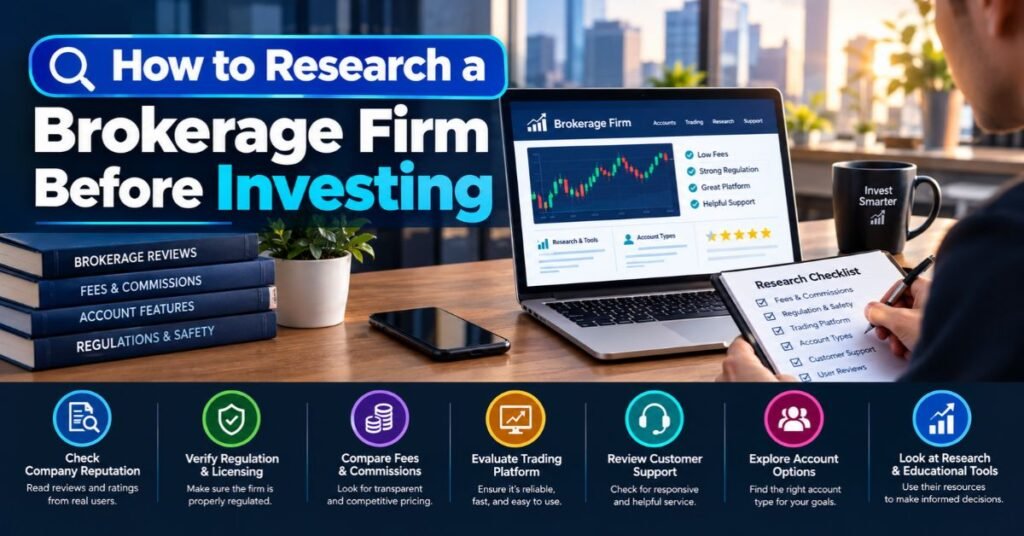
A registration check is only step one. You also need a full routine. Use the same routine for every firm. That way you never rely on gut feeling alone.
Think of seven questions. Who is the firm? Is it registered? What are its disclosures? What do complaints show? What will it cost you? Who holds your assets? Do the first six answers support a decision? The next seven parts walk through them.
Check the Firm’s Legal Identity and Regulatory Status
Match three things: legal name, registration number, and address. Then confirm the brokerage firm regulatory status shows “registered” today. Use the regulator’s own site. For the old firm, it shows a closed record. A match on all three points builds trust. A mismatch on any point should stop you cold. Write down what you find. Notes help if you later need to report a problem.
Review Broker and Investment Adviser Backgrounds
Many people work as both brokers and advisers. So search both databases. Use BrokerCheck for brokers and the SEC’s Investment Adviser Public Disclosure (IAPD) for advisers. That’s the idea behind investment adviser verification. People often ask about FINRA BrokerCheck vs SEC IAPD. They overlap but cover different registrations. Check your state regulator too if the firm is state-registered.
Examine Fees, Commissions, and Compensation Structures
Read Form CRS, the account agreement, and the fee schedule. Then see how costs show up on a trade confirmation. Ask for an annual cost estimate in dollars. Dollars are harder to blur than percentages. This step supports financial services transparency. A firm that explains its pay clearly respects you. A firm that dodges shows its hand.
Understand Who Holds Your Investment Assets
Your statements should come straight from the custodian. Don’t accept statements only from the firm selling to you. Ask for the custody of investor assets details in writing. Treat any request to send funds to the firm itself or a third party as a red flag. Good customer asset custody keeps selling and holding apart. That split protects you if something goes wrong.
See Also: Milohacherry Coin (MLC) Explained: Features, Rewards, Risks, and Legitimacy
Verify Contact Details Through Independent Sources
Use the phone number and address from the regulator’s record. Don’t use contacts from an email, ad, or text. If someone calls you first, hang up. Then call back on the registered number. This takes two minutes. It stops many impersonation scams cold. Remember that BrokerCheck itself warns about impostors linking to it from fake sites.
Review Account Agreements and Risk Disclosures
Read the whole account agreement before you sign. Look for fee language and dispute clauses. Many agreements require brokerage dispute resolution through arbitration. Know that before you open the account. Read the written risk disclosures for each product too. Ask how you could lose money. A clear answer shows honesty. A vague answer should slow you down.
Ask Essential Questions Before Opening an Account
Good questions reveal a lot. The table lists six and what a clear answer sounds like.
| Question | A clear answer |
| How are you paid on this recommendation? | A specific description such as commission or markup |
| What will this cost me each year? | A dollar estimate in writing |
| Who holds my money and securities? | A named custodian |
| What are the risks? | Specific ways you could lose money |
| Do you have disciplinary disclosures? | An answer matching BrokerCheck |
| Is this suitable for my goals? | Reasoning tied to your finances |
Brokerage Fraud Warning Signs Investors Should Never Ignore
Financial fraud warning signs look similar across cases. Scammers copy real firms and repeat the same pitches. If you know the patterns, you can spot them early. This section supports investment fraud prevention.
You don’t need to be an expert. You just need to pause. Most scams depend on speed. A short delay often defeats them. The seven signs below deserve your attention every time.
Promises of Guaranteed or Unrealistic Returns
Real investments carry risk. No honest seller can guarantee high returns without it. Regulators in the U.S. and UK warn about this pitch again and again. If someone promises you “no risk” and big gains, walk away. Ask yourself why a seller would hand you free money. The answer is almost always that they wouldn’t.
High-Pressure Sales Tactics
Lines like “limited spots” or “the price moves tomorrow” push you to skip checks. A legitimate firm gives you time. It also gives you written information. Pressure is a tool and not a sign of a great deal. If you feel rushed, say you’ll call back. Then do your brokerage firm verification before you speak again.
Unclear Fees and Commission Structures
Ask for your total cost in dollars. If the answer is “it depends,” slow down. Commissions and markups can pile up quietly. A firm that hides them isn’t helping you. Clear pricing is a basic sign of financial services transparency. Without it, you can’t compare options or spot churn.
Missing or Unverifiable Registration Details
Watch for a number that doesn’t resolve. Watch for a name that doesn’t match the register. Be wary of any claim that the firm “doesn’t need to be registered.” Each of these should end the talk until someone clears it up. This is how you identify an unregistered investment firm. Proof of registration should be easy to give. If it isn’t, ask why.
Vague Investment Explanations and Misleading Claims
You should understand how a product works and how the seller earns money. If the explanation stays vague or hides behind jargon, that’s a warning. Ask for plain words. Ask for the risks in writing. A confident seller with nothing to hide welcomes questions. A seller with something to hide gets defensive.
Unsolicited Investment Offers
Cold calls and surprise messages deserve extra care. Cold-calling isn’t illegal by itself. Sellers must still respect do-not-call lists. FINRA’s decision records that this firm placed 1,330 calls to listed numbers in three months. When someone contacts you first, treat the offer as unverified. Check the sender’s registration yourself. Never use the contact details they gave you.
Requests to Transfer Money Without Proper Verification
Be wary of requests to wire money to personal or third-party accounts. Cryptocurrency and gift card payments should alarm you. So should any plea to move cash to a “secure account.” These are classic investment fraud prevention red flags. Insist on a named, verifiable custodian first. Verify it independently before you send a cent.
See Also: Highlights of Nummazaki: Japan’s Hidden Coastal Paradise (2026 Guide)
Traditional Brokerage Firms vs. Modern Wealth Management

How a firm earns money shapes the advice it gives. So it helps to know the two main models. Neither label protects you by itself. What matters is which conflicts exist and how clearly the firm explains them.
Many firms now blend both models. A single person may hold both a broker and an adviser registration. That’s why you should check both registers. The next four parts explain the models and show you how to compare them.
How Traditional Brokerage Models Work
Traditional brokerages earn money per transaction. They charge commissions and markups. Under Regulation Best Interest, their recommendations must serve your best interest. This model can suit you if you buy and hold and trade rarely. It can also tempt a broker to encourage more trades. That’s the risk Craig Scott Capital shows in sharp relief. Know the pay structure first.
How Modern Financial Advisory Models Work
Fee-based advisers usually charge a percentage of assets or a flat fee. They owe you a fiduciary duty under the Investment Advisers Act. Robo-advisers and low-cost index investing extend this approach. Conflicts remain though. An adviser paid on assets has a reason to gather and keep assets. So ask about every fee. No model is free of conflicts.
Differences in Fees, Fiduciary Duties, and Transparency
The table lines up the key differences.
| Feature | Traditional brokerage | Fee-based advisory |
| How paid | Commissions and markups | Percentage of assets or flat fee |
| Standard of conduct | Regulation Best Interest | Fiduciary duty |
| Main conflict | Encouraging trades or products | Gathering and keeping assets |
| Cost visibility | Shown per trade | Shown as a recurring fee |
| Often suits | Occasional trading; buy-and-hold | Ongoing planning and management |
How to Compare Brokerage and Advisory Services
Compare costs in dollars for the same account size. Then compare the duty each firm owes you. Ask both firms what conflicts they have. Look up each person on BrokerCheck and IAPD. A person can hold both licenses and wear two hats. Ask which hat they’re wearing when they advise you. The answer tells you which rules apply.
Lessons Investors Can Learn From the Craig Scott Capital Case
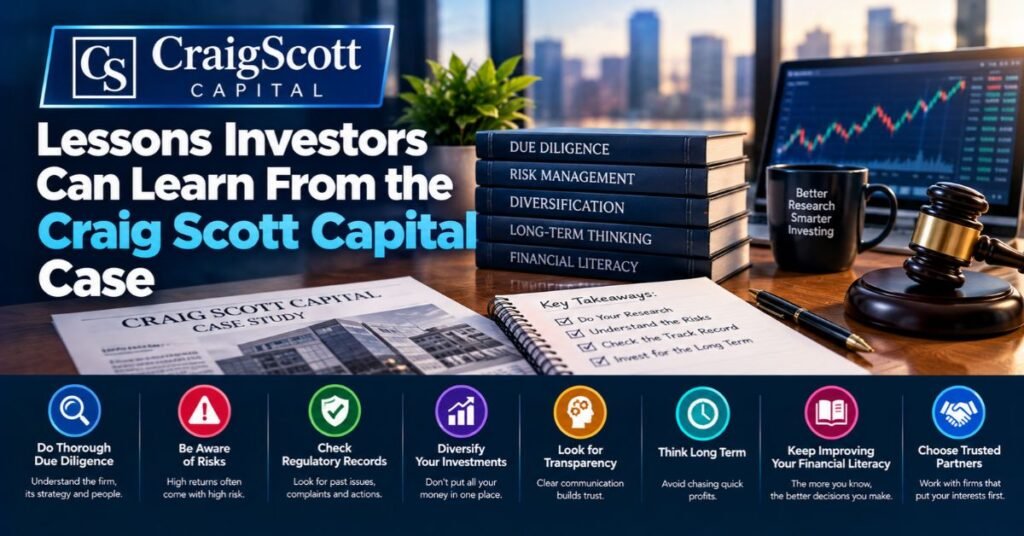
These lessons are interpretation. They rest on the documented record. They aren’t new findings. Use them as habits and not as verdicts about any person.
The story offers practical takeaways. Firms with weak compliance can hurt customers. Regulators depend on honest answers. And you must check, then check again. The four parts below turn the record into simple rules.
Why Regulatory Compliance Matters More Than Marketing
The SEC found the firm had written procedures. Yet they had blanks and named no responsible supervisor. They didn’t match how the firm worked. That is brokerage compliance in name only. Policies on paper don’t equal policies in practice. When you read a firm’s disclosures, look for signs of real follow-through. Good brokerage compliance history shows steady habits and not slogans.
How Transparency Builds Investor Trust
FINRA found the firm gave false answers about call recordings. Investigators rely on honest replies. A firm that misleads them is hard to judge from outside. Give heavy weight to any final finding about candor. Honest firms answer regulators and customers plainly. That honesty is the base of financial services transparency.
Why Independent Research Is Essential
Contradictory web pages about this name show the danger of secondary sources. Go to the originals whenever you can. Your own independent regulatory verification beats any summary. That includes this article. Check each claim against the regulators’ records. Also repeat checks over time. Some items became reportable while the firm still operated. A check is only a snapshot.
How Long-Term Investment Discipline Helps Manage Risk
A calm, steady plan protects you from the pull of constant trading. Low turnover and known costs leave less room for conflicts to grow. Write down your goals before you talk to any broker. Compare every recommendation to that plan. If a suggestion doesn’t fit, say no. Patience isn’t glamorous. It’s often effective.
Investor Protection Resources and Regulatory Databases (2026)
Good investor protection resources exist for free. Most people never use them. That’s a shame because each tool takes minutes. The table below sums up the main ones.
Type each address into your browser yourself. Don’t follow links from emails, ads, or messages. These investor protection rules in the United States and abroad only help if you use the real sites.
| Tool | What it checks | Region |
| FINRA BrokerCheck | Brokers and brokerage firms | U.S. |
| SEC IAPD | Investment advisers | U.S. |
| State securities regulators | Firms doing business in your state | U.S. |
| FINRA Awards Online | Arbitration award text | U.S. |
| SIPC | Membership and limits | U.S. |
| FCA Register | Authorised firms | UK |
FINRA BrokerCheck for Broker and Firm Backgrounds
FINRA BrokerCheck covers current and former registered firms and many former brokers. Its data comes from FINRA’s central database and generally appears the next business day. For a former firm like Craig Scott Capital, it shows the registration period and remaining disclosures. This is how you check FINRA BrokerCheck records and research a broker’s disciplinary history. Open the summary first. Then read each event.
SEC Investment Adviser Public Disclosure and Investor Resources
The SEC’s IAPD site lists registered advisers and their records. Use it when your contact might be an adviser. The SEC’s Investor.gov explains how to check a professional’s background and spot fraud. It also takes tips and complaints. Use both when you want to verify an investment adviser. Together they give a fuller picture than one source alone.
State Securities Regulators and Licensing Checks
Your state securities regulators can help you research brokers and advisers in your state. Many also handle complaints about sales practices. They’re a good first call when something feels wrong. State checks catch firms that only register locally. They also know local scams. A quick call can save you a lot of grief.
FCA Register for Relevant UK-Regulated Firms
UK readers should start with the Financial Conduct Authority (FCA) and its FCA Register. It lists authorised firms. The FCA also keeps a Warning List of unauthorised firms and clones. Clones copy a real firm’s details. Make sure the phone number and website you were given match the register. A U.S.-only firm like Craig Scott Capital wouldn’t appear there. For compensation if an authorised UK firm fails, check the Financial Services Compensation Scheme limits.
How to Report Suspected Investment Fraud or Misconduct
Stop sending money first. Keep every record such as statements, emails, texts, and call notes. Ask your bank right away whether it can stop or recall a payment. Then file investment fraud reporting with the right bodies. In the U.S., use your state regulator, the SEC, and FINRA.
The FTC and the FBI’s Internet Crime Complaint Center also take reports. In the UK, Report Fraud replaced Action Fraud on 4 December 2025. Use reportfraud.police.uk or call 0300 123 2040. Scottish residents should contact Police Scotland on 101. Claims against U.S. brokers often go to FINRA arbitration. Time limits apply, including a six-year rule. Speak to a securities attorney soon. Recovery isn’t guaranteed.
See Also: Hosted Event PBLGamevent: How Gaming Events Are Organized in 2026
Investor Due Diligence Checklist
A good investor due diligence checklist turns advice into action. Print it. Tick each step. Don’t skip any. Most losses start when someone skips one.
Each short part below covers one moment in your investing journey. Use them as written or adapt them. Either way, keep the habit.
Before Opening a Brokerage Account
Get the firm’s exact legal name and CRD or registration number. Look it up on BrokerCheck yourself. Confirm the register shows the firm as currently registered. Read Form CRS and the account agreement. Get the fee schedule in writing. These five steps cover how to verify a brokerage firm before investing. They take less than an hour. They can save you years of regret.
Before Purchasing an Investment
Understand how the product works and how it can lose money. Ask how easily you can sell it and what selling costs. Treat past performance with skepticism and not as a promise. Compare at least one alternative. Ask what the seller earns if you buy. A fair seller answers these questions without fuss.
Before Hiring a Financial Adviser
Check the person’s record on BrokerCheck or the adviser database. Ask how they’re paid. Request written disclosures. Ask whether they act as a fiduciary or under Regulation Best Interest and in what role. Confirm their broker licensing status is current. A good adviser welcomes this review. It shows you take your money seriously.
Before Transferring Money or Assets
Confirm who will hold the assets. Read the transfer paperwork in full. Check the receiving account details through the regulator’s contact information. Ask about transfer fees and timing. This answers what investors should check before transferring money. Never wire funds on a rushed call. A short delay costs you nothing.
Before Responding to an Unsolicited Investment Offer
Don’t act on the first contact. Hang up and call back on the registered number. Check the sender’s registration independently. Refuse any pressure to decide now. Report suspicious approaches to the regulator. This routine shows how to protect money from investment scams. It works because scammers hate delay.
Frequently Asked Questions
What Is Newstown CraigScott Capital?
It’s a search phrase and not a registered firm. The documented entity is Craig Scott Capital LLC, a former New York broker-dealer. No source reviewed ties the word “Newstown” to it. So treat any offer using the full name as unverified until you check it yourself.
Why Are People Searching for Newstown CraigScott Capital in 2026?
The old firm’s records remain public. Many pages repeat the longer name too. Together these keep the phrase alive in search results. Nobody has documented why “Newstown” got attached. Curious readers and cautious investors both land on the topic.
Is Newstown CraigScott Capital a Verified Brokerage Firm?
No registration or regulatory record for such a firm appears in the materials reviewed. New registrations can appear at any time though. So run your own search. Don’t rely on a website’s claim. Verification means a match on name, number, address, and status.
Is Craig Scott Capital Still Registered?
No. BrokerCheck shows registration from January 20, 2012 to September 7, 2017. It lists December 31, 2015 as the date the firm ceased business. So Craig Scott Capital registration status is “no longer registered.” This also answers “why was Craig Scott Capital expelled from FINRA”: excessive trading, churning, and false statements to FINRA.
Why Are Regulatory Records Important for Investors?
They’re dated and come from regulators. You can check them. Reviews and ads can’t match that. Still, read each event’s status. Some entries are allegations and not findings. That’s the key difference between allegations and regulatory findings.
Can Online Reviews Replace Official Regulatory Checks?
No. Reviews are opinions. They can be outdated or unreliable. Regulatory records show what regulators reported. They aren’t complete either. Use both. Start with the records. Then read reviews as a second layer.
How Can Investors Verify Whether a Brokerage Firm Is Legitimate?
Get the exact legal name and registration number. Look both up with the regulator. Confirm that identity, address, and status match. Then read the disclosures. This is the simplest way to verify a financial company online and check a brokerage firm’s registration.
Where Can Investors Check a Broker’s Disciplinary History?
In the U.S., use BrokerCheck for brokers and firms. Use the SEC’s IAPD for advisers. Add your state regulator. In the UK, use the FCA Register. Each site shows FINRA disciplinary actions or similar records. Check more than one for a full view.
What Should Investors Do If They Suspect Brokerage Misconduct?
Stop sending money. Save all records. Call your bank. Report the matter to your state regulator, the SEC, and FINRA. Consider a securities attorney. Act quickly because time limits apply. Recovery isn’t guaranteed.
Final Verdict
The record supports a narrow conclusion. Craig Scott Capital LLC was a New York broker-dealer. It closed at the end of 2015. FINRA expelled it in 2017 for excessive trading, churning, and false statements to the regulator. The SEC settled a separate case in 2016. “Newstown” has no documented link to any of this. So the full story of Newstown CraigScott Capital is mostly a story about a name.
Take one habit from this guide. Verify first. Look up the exact name and number on BrokerCheck yourself. Report anything that doesn’t check out. If you were a customer of the old firm, the resources above show where to find your records. This article is educational and isn’t financial or legal advice. A securities attorney or licensed adviser can help with your own situation.