Pun Intended Meaning Explained Clearly: 15+ Examples & Uses
You’ve heard someone crack a joke and then quickly add, “pun intended.” But what does that little phrase actually mean, and why do people say it? If you’ve ever paused mid-text or mid-conversation wondering whether you used it right, you’re not alone.
This guide has the pun intended meaning explained clearly, in plain English, with real examples you can actually use. Whether you’re writing party invites, captioning a photo, sending a witty text, or just want to sound sharper in conversation, this article gives you the full picture pun intended, of course.
By the end, you’ll know exactly when to say it, when to skip it, and how it’s different from “no pun intended.” You’ll also get 15+ ready-to-use examples for cards, social media, and everyday chats. Let’s get into it.
What Does “Pun Intended” Mean?
Before you can use a phrase well, you need to understand what does pun intended mean at its core. This section gives you the short version and then digs into why people bother saying it at all, since the pun intended meaning explained clearly here isn’t always obvious to new English speakers.
Simple Definition of Pun Intended
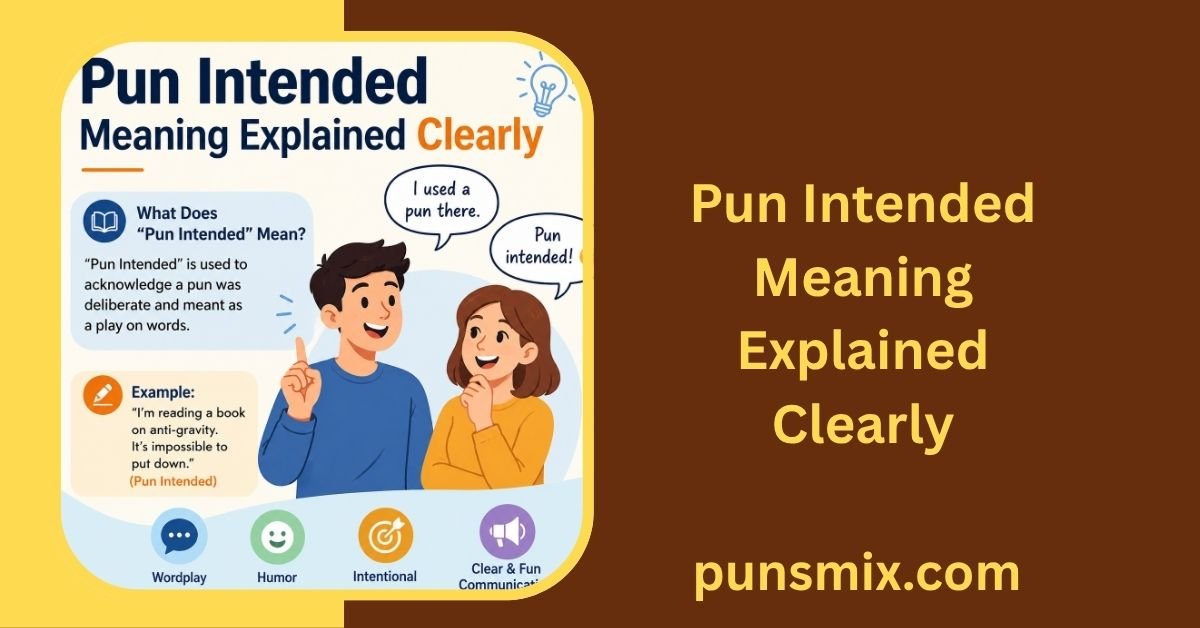
In simple terms, “pun intended” is a short phrase people add right after making a wordplay joke. It tells the listener or reader, “Yes, I meant to do that this double meaning was on purpose.” That’s really the whole pun intended definition in one sentence.
Here’s why this matters: puns can sound like accidents. A word with two meanings might slip out and make someone laugh, but the speaker didn’t plan it. Adding “pun intended” removes that confusion. It’s a small verbal wink that says, “I’m clever on purpose, not by accident.”
Why People Add “Pun Intended” to a Sentence
People use this phrase for a few clear reasons, and understanding them is part of getting the pun intended meaning in English exactly right. Below is a simple list of the most common motives behind it.
- To claim credit for a clever line
- To make sure the joke lands and isn’t missed
- To add humor after a serious statement
- To soften an awkward or blunt comment
- To show off quick thinking in conversation
- To signal playfulness in a text or caption
- To avoid sounding like the wordplay was a mistake
- To invite the listener to smile or groan
- To bond with someone over shared humor
- To mark a joke in writing where tone is hard to read
What Is a Pun? Understanding the Wordplay Behind It
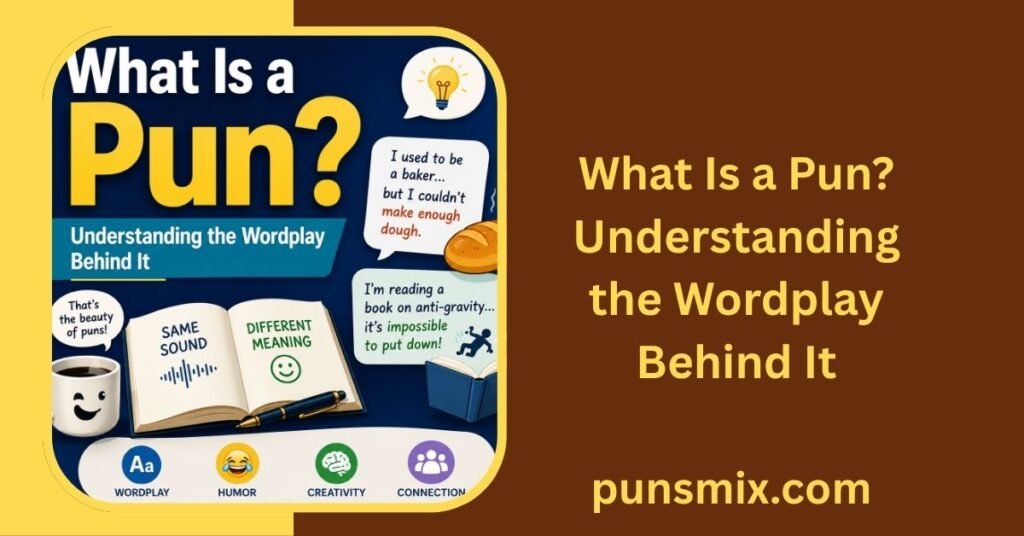
To fully grasp the pun intended meaning explained clearly, it helps to step back and understand what a pun actually is. A pun is a form of wordplay that uses a word’s double meaning, or two words that sound alike, to create a joke. This section covers the main types and how the humor actually works.
Common Types of Puns
Puns come in several forms, and knowing the types makes it easier to spot intentional wordplay wherever you see it. Here’s a breakdown of the most common categories.
- Homophonic puns words that sound the same but mean different things
- Homographic puns words spelled the same but with different meanings
- Compound puns jokes that stack two or more puns together
- Visual puns wordplay shown through an image or design
- Recursive puns a pun that only makes sense after a first pun is understood
- Idiom-based puns twisting a common saying for a new meaning
- Name puns playing on a person’s or brand’s name
- Number puns using numbers that sound like words, like “gr8” for “great”
How Wordplay Creates Multiple Meanings
A pun works because language is full of overlap. Many English words share sounds or spellings while pointing to totally different ideas, and that overlap is where double meaning humor lives. When a speaker picks a word that fits two contexts at once, the brain has to process both, and that split-second double-take is what makes people laugh or groan.
This is also why clever wordplay feels satisfying. It rewards the listener for catching the trick. The better the fit between the two meanings, the stronger the pun and the more likely someone is to say “pun intended” right after landing it.
See Also: Hilarious Quiz Questions and Answers: 200+ Funny Trivia Questions
Pun Intended Meaning and Examples
Now that you understand the basics, let’s look at the pun intended meaning and examples in real, everyday use. This section shows how the phrase shows up in spoken English, written English, and casual daily conversation.
Pun Intended in Everyday Sentences
Here’s how “pun intended” naturally slots into normal, casual talk. These are the kinds of lines you might hear at dinner, at work, or in a group chat.
- I’m on a roll today, pun intended
- This bakery job is really rising to the occasion, pun intended
- My gardening hobby has really grown on me, pun intended
- That electrician really lit up the room, pun intended
- We’re all just winging it here, pun intended
- This diet has me feeling grate, pun intended
- Her baking career is really taking the cake, pun intended
- The fisherman had a reel good day, pun intended
- I’m feeling a bit deflated after that gym class, pun intended
- Our road trip really drove us apart, pun intended
Pun Intended in Written English
In writing, the phrase often shows up in parentheses or after a comma, since tone is harder to read on a page. Below are examples you might find in captions, emails, or blog posts.
- The bakery’s grand opening was a piece of cake (pun intended)
- Our new mattress line lets you rest easy (pun intended)
- The plumber’s business is really flowing well (pun intended)
- This article about clocks is running out of time (pun intended)
- The bee-keeping startup is really buzzing (pun intended)
- Our coffee shop’s profits are perking up (pun intended)
- The library’s new app really turned the page (pun intended)
- Her photography business finally came into focus (pun intended)
- The bakery’s social media post said business was rising nicely (pun intended)
- This home security company has us covered (pun intended)
Pun Intended in Spoken English
Spoken use tends to be quicker and more casual, often tacked on right after the joke lands out loud. These examples show the natural rhythm of speech.
- That’s a lot to swallow, pun intended
- Nice catch, pun intended
- We’re really cooking now, pun intended
- Talk about a shocking result, pun intended
- That joke really struck a chord, pun intended
- You nailed it, pun intended
- This meeting is dragging on, pun intended
- That’s music to my ears, pun intended
- We’re barking up the right tree, pun intended
- Looks like we’re back on track, pun intended
15+ Clear Examples of “Pun Intended”
Here’s a bigger combined list you can borrow directly for texts, captions, or casual chats. Each line already includes the phrase so you can see the full pun intended meaning explained clearly in context.
- I knead more time to bake this, pun intended
- This gym really has us pumped, pun intended
- That comedian’s set was a real riot, pun intended
- Just 27 and still crushing it, pun intended
- This umbrella shop is under a lot of pressure, pun intended
- We’re not board with this game night, pun intended
- Her yoga class really stretches the truth, pun intended
- This bread recipe is on a roll, pun intended
- Time flies when you’re a clockmaker, pun intended
- That painter really nailed the color scheme, pun intended
- I’m feeling a bit crabby at the seafood counter, pun intended
- This candle store really lights up the mall, pun intended
- Our internet plan is picking up speed, pun intended
- That farmer really knows how to grow a business, pun intended
- This math teacher always adds up, pun intended
- We’re really shining at the lightbulb factory, pun intended
- Her law career is finally settling down, pun intended
How to Use “Pun Intended” Correctly
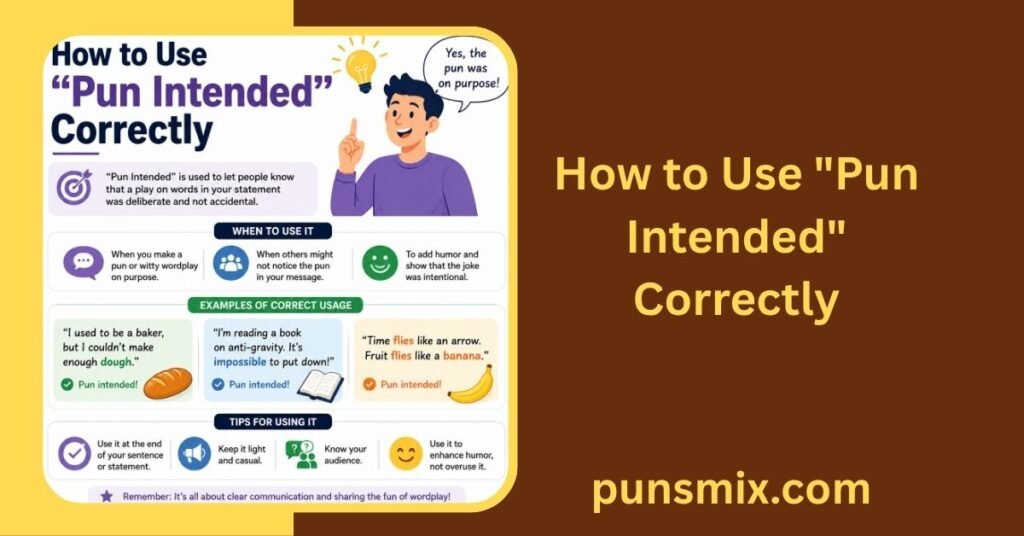
Knowing the phrase is one thing; using it well is another. This section covers exactly how to use pun intended so it always lands right, instead of falling flat.
Where to Place “Pun Intended”
Placement matters more than most people realize. Here’s where the phrase usually goes for the best effect.
- Right after the punny word or phrase
- At the very end of the sentence
- In parentheses when writing
- After a comma in casual speech
- As a short standalone tag, like its own mini-sentence
- Rarely at the start, unless you’re warning of a pun ahead
When “Pun Intended” Makes Sense
Some moments call for the phrase more than others. Use it when the situation fits one of these patterns.
- The pun is subtle and might be missed
- You want to add humor to a serious topic
- You’re writing where tone can’t be heard
- The joke is a little corny and needs a wink
- You want to keep the mood light and casual
- You’re building rapport through shared humor
When to Avoid Using “Pun Intended”
There are also times this phrase does more harm than good. Skip it in these situations.
- The pun is already obvious to everyone
- The setting is formal or serious, like a eulogy
- You’ve already used it several times in the same conversation
- The joke needs no explanation to land
- You’re speaking to an audience unfamiliar with the idiom
- It would interrupt an otherwise professional tone
See Also: 340+ Cheesy Birthday Puns That Are Funny, Cute & Clever
Pun Intended vs. No Pun Intended: What’s the Difference?
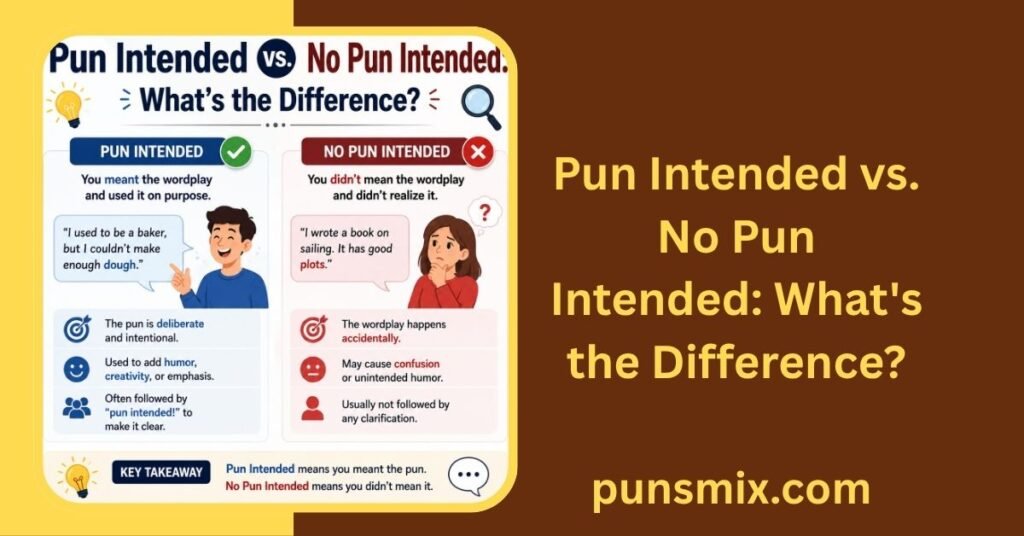
These two phrases sound almost identical, but they signal opposite things. Getting the pun intended vs no pun intended distinction right will save you from confusing your reader or listener.
What “Pun Intended” Signals
“Pun intended” tells your audience the wordplay was planned. You saw the double meaning coming, and you chose it on purpose. It signals confidence and a bit of humor, almost like taking a bow after a small joke.
What “No Pun Intended” Signals
“No pun intended” does the opposite. It tells your audience that a double meaning appeared by accident, and you want to clarify you weren’t trying to be funny. It’s often used to avoid seeming insensitive, especially around serious topics where an accidental pun might feel out of place.
Quick Comparison of Pun Intended and No Pun Intended
Here’s a simple side-by-side table showing the difference between pun intended and no pun intended at a glance.
| Pun | Meaning/Twist |
| “This bakery is really rising, pun intended” | Wordplay was planned; speaker owns the joke |
| “The stock market really crashed, no pun intended” | Wordplay was accidental; speaker distances from the joke |
| “That’s a shocking result, pun intended” | Confirms intentional wordplay for emphasis |
| “I broke my leg on the ski trip, no pun intended” | Clarifies no humor was meant around an injury |
| “This bread is really on a roll, pun intended” | Signals playful confidence in the joke |
| “The funeral home business is booming, no pun intended” | Softens a sensitive or awkward double meaning |
No Pun Intended Meaning and Examples
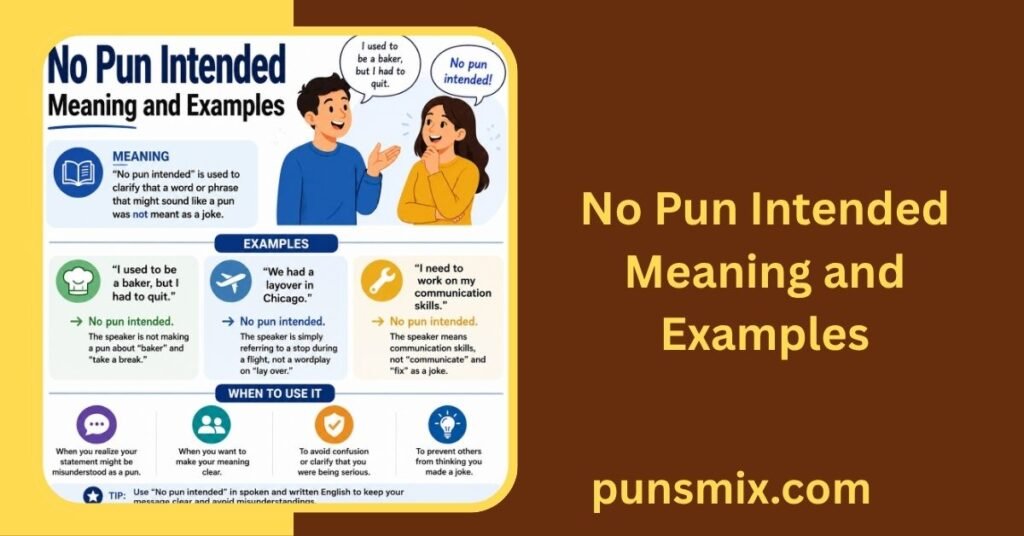
Now let’s flip the coin and look closely at the no pun intended meaning on its own, since it’s just as common as its counterpart in everyday English.
What Does “No Pun Intended” Mean?
“No pun intended” is a disclaimer. The speaker noticed a double meaning right after saying it, but wants to make clear it wasn’t planned as a joke. It’s often used around sensitive topics like illness, death, or accidents, where a joke might feel inappropriate even if it wasn’t meant as one.
No Pun Intended Examples in Sentences
Here are natural examples showing how the phrase gets used in daily speech and writing.
- The traffic really came to a standstill, no pun intended
- Her cooking career hit a rough patch, no pun intended
- The company’s sales really tanked last quarter, no pun intended
- His back surgery really set him straight, no pun intended
- The bakery’s oven finally gave out, no pun intended
- That storm really swept through town, no pun intended
- The dentist’s schedule is packed to the teeth, no pun intended
- Our flight got grounded due to weather, no pun intended
- The funeral director’s business is thriving, no pun intended
- This diet plan really starved for results, no pun intended
Can a Pun Be Unintentional?
Yes, puns absolutely can happen by accident. Language naturally overlaps, so a completely ordinary sentence can accidentally create a double meaning nobody planned. When that happens, “no pun intended” is the phrase people reach for to clarify their words weren’t chosen for a joke, especially in serious or professional settings.
Is Saying “Pun Intended” Rude or Clever?
This phrase sits in a gray area some people find it charming, others find it annoying. Whether it comes across as rude or clever mostly depends on timing, tone, and how often you use it.
See Also: 320+ Electricity Puns That Will Shock You With Laughter ⚡
Appropriate Situations to Use It
Some settings are a natural fit for this kind of playful language. Here’s where it tends to work well.
- Casual conversations with friends or family
- Social media captions and comments
- Birthday cards and greeting cards
- Light workplace banter, in the right company
- Text messages and group chats
- Blog posts and casual marketing copy
Using Pun Intended in Formal Writing
In formal writing, this phrase should be used sparingly, if at all. Academic papers, business reports, and official communication usually call for a serious tone, and adding a pun tag can undercut credibility. If a pun slips into formal writing by accident, it’s often better to simply rewrite the sentence rather than flag it with “pun intended.”
Common Mistakes and Overuse
Overusing this phrase is one of the fastest ways to make it feel tired. Watch out for these common mistakes.
- Saying it after every single joke in a conversation
- Using it when the pun is already obvious
- Adding it to jokes that aren’t really puns at all
- Repeating it multiple times in one short message
- Using it in settings that call for a serious tone
- Explaining the joke further after already flagging it
Pun Intended Meaning in Different Languages
English isn’t the only language with playful wordplay, and it helps to see how the pun intended meaning explained clearly translates, or doesn’t quite translate, elsewhere.
Pun Intended Meaning in Spanish
In Spanish, there isn’t one exact fixed phrase that matches “pun intended” word for word. Speakers often say something close to “el juego de palabras es intencional,” which roughly means “the play on words is intentional.” The idea carries across languages even when the exact wording shifts.
Pun Intended Meaning in Farsi
In Farsi, wordplay is common in poetry and everyday speech, but there isn’t a single direct equivalent phrase either. Speakers typically describe the joke as intentional using surrounding context rather than a fixed tag like English speakers do, since the culture around flagging jokes verbally works a bit differently.
Similar Expressions in Other Languages
Many languages have their own way of pointing out planned wordplay, even without a single matching phrase. Here are a few patterns found across different languages.
- Saying “that was on purpose” right after a joke
- Using a wink or hand gesture instead of words
- Adding a laughing tone of voice to mark the joke
- Repeating the punny word with emphasis
- Using a local idiom that means “I meant that”
- Following the joke with a knowing pause
Pun Intended Meaning: Synonyms and Related Expressions
If you want to mix things up, there are other ways to flag intentional wordplay besides the standard phrase. This section covers pun intended synonym options and related terms worth knowing.
Alternatives to “Pun Intended”
Here’s a list of phrases you can swap in when you want some variety.
- See what I did there?
- If you know, you know
- I couldn’t resist
- Yes, that was on purpose
- Wordplay fully intended
- I had to
- Sorry, not sorry
- That one was too easy
- Had to sneak that in
- Couldn’t help myself
- Guilty as charged
- That joke wrote itself
Pun Meaning and Related Wordplay Terms
Beyond “pun intended” itself, there’s a whole vocabulary around wordplay worth knowing. Here are related terms you’ll often see alongside it.
- Double entendre a phrase with two meanings, often one cheeky
- Wordplay the general skill of playing with language for effect
- Homophone words that sound alike but differ in meaning
- Malapropism a mistaken word used in place of a similar-sounding one
- Spoonerism swapped sounds between two words for comic effect
- Idiom a fixed phrase with a meaning beyond its literal words
- Rhetorical device any technique used to make language more persuasive or memorable
Tips for Using Pun Intended the Right Way
A few quick, practical habits will help you use this phrase naturally instead of forcing it into every joke you make.
Timing Tips
- Say it immediately after the punny word, not several sentences later
- Keep your tone light so the phrase doesn’t sound sarcastic by accident
- Use a short pause before it for comic effect in speech
- Save it for jokes that genuinely might be missed
Writing Tips
- Place it in parentheses for a clean, readable look
- Keep the surrounding sentence short so the joke isn’t buried
- Avoid using it more than once or twice per post or caption
- Match the phrase’s tone to your overall writing style
Social Tips
- Read the room before dropping a pun in a serious chat
- Save your best pun for the moment it will land hardest
- Let others make puns too instead of hogging the spotlight
- Use it sparingly with new audiences until you know their humor
Frequently Asked Questions
What does “pun intended” mean simply?
It means a wordplay joke was made on purpose, not by accident. The speaker is letting you know they saw the double meaning coming and chose it deliberately.
Is “no pun intended” the opposite of “pun intended”?
Yes. “No pun intended” clarifies that a double meaning was accidental, while “pun intended” confirms the wordplay was planned from the start.
Where did the phrase “pun intended” come from?
It grew out of everyday English speech as a natural way to flag wordplay, since puns can easily be mistaken for slips of the tongue. There’s no single documented origin point, but it’s been common in casual English for generations.
What does pun intended mean example?
A simple example is: “This bakery is really rising in popularity, pun intended.” The phrase confirms the “rising” wordplay tied to bread was chosen on purpose.
What does the term pun mean?
A pun is a joke that plays on a word’s multiple meanings, or on two different words that sound alike, to create humor or a clever twist.
What does “intended” mean in simple terms?
“Intended” simply means planned or meant on purpose. It’s the opposite of accidental, which is exactly why it pairs so naturally with “pun” in this phrase.
What does pun not intended mean in urban dictionary?
Informal sources like urban dictionary generally treat “pun not intended” the same way as “no pun intended” a casual way to say a double meaning slipped out by accident, not as a planned joke.
Conclusion
At the end of the day, the pun intended meaning explained clearly is simple: it’s a small phrase that lets you own your wordplay instead of letting it slide by unnoticed. Whether you’re texting a friend, writing a birthday card, or captioning a photo, knowing when and how to use it makes your humor land better.
And once you understand “no pun intended” too, you’ve got both sides of this playful little phrase covered. Use it with confidence, keep it light, and don’t be afraid to have a little fun with words pun intended.