Truzio Explained: Features, Business Benefits, and Digital Transformation in 2026
Search the name and you get two very different stories. One story shows a small ERP software provider in Hyderabad. The other shows a grand AI platform that does everything. This guide sorts fact from noise.
It covers what public sources say, how enterprise resource planning software works in general, and what nobody can confirm yet. Public sources reviewed in 2026 shaped every claim here. The Truzio Explained transformation story turns out to be smaller and more interesting than the hype suggests.
What Is Truzio Explained? An Overview of the Platform
Two pictures compete when you look up Truzio. Business directories describe Truzio Technologies, an IT firm and ERP software provider in Hyderabad, India. Blog posts describe a giant AI, IoT, and analytics platform. Company pages back only the first picture. Crunchbase lists ERP solutions, mobile apps, IT services, and business process outsourcing. LinkedIn centers on an open-source enterprise resource planning platform. That is the Truzio company profile this guide follows.
Honest labels help you read the facts. Documented means the company’s own pages or several listings agree. Directory-reported means one data aggregator says so. Unconfirmed means the facts conflict or can’t be checked. The table below applies those labels to the Truzio company background.
| Detail | What sources say | Label |
| Company | Truzio Technologies India Private Limited | Directory-reported |
| Services | Truzio ERP, mobile apps, Truzio IT services, outsourcing | Documented |
| Location | Truzio Hyderabad office in Madhapur, Telangana | Documented |
| Founded | 2012 per Inc42 and February 2017 per a corporate listing | Conflicting |
| Products | Truzio ERP and the UzzMe platform | Documented |
| KES | KES knowledge enhancement system | Directory-reported |
| Status | Tracxn says inactive and another listing says active | Unconfirmed |
Truzio as a Digital Transformation Solution
Is an ERP a digital transformation solution? Yes, though a narrow one. Think of it as one tool in a big toolbox. An ERP suite moves sales, stock, and accounts from scattered spreadsheets into shared records. That counts as business process digitization. LinkedIn lists business transformation as a practice area for the company, next to ERP, mobile, data analytics, testing, and staffing. The all-in-one AI platform from the blogs lacks any support. No company document backs it. Treat digital transformation solutions as a goal and treat the ERP as one route to it.
Core Purpose and Key Objectives of Truzio
The purpose looks simple. Truzio helps firms adopt and run business management software plus related IT. LinkedIn describes consulting, technology, outsourcing, and support aimed at business outcomes. A second strand is the UzzMe platform. IndiaMART describes it as a place where customers find vendors and reach them by chat or call. Keep in mind that these are self-descriptions. They show what the company says it does. They don’t prove how well it does it. That gap is why vendor verification matters so much.
What Truzio Is and Is Not
Start with what the evidence does not show. No source documents Truzio as an AI, IoT, blockchain, or smart-city platform. No source confirms it as a market leader. No source proves it currently operates. It also has no link to Truxio or TRUX Inc. Still, missing evidence isn’t proof of absence. A feature may exist without public notes. This is a Truzio company status question more than a product question. Many unverified software claims online repeat each other, so one blog post citing another proves nothing.
Truzio and Other Businesses Using the Same Name
Lookalike names cause real mix-ups. Truxio is a trucking firm that turned its own fleet tools into Truxio trucking software for carriers with roughly 5 to 50 trucks. TRUX Inc. is a Boston platform linking truckers, contractors, and material producers. Neither appears related to Truzio Technologies. You can run a company registration verification in three places. Check the company’s LinkedIn page. Check the record for Truzio Technologies India Private Limited on India’s Ministry of Corporate Affairs site. Then visit the truzio.in domain, though its current content is unconfirmed.
How Does Truzio Work? Understanding Its Core Architecture
Picture a restaurant kitchen. The pantry holds ingredients. Recipes guide the cooks. The head chef watches every plate. A pass window sends food to the dining room. An ERP has the same four parts. Here is an honest note. Nobody has published a Truzio design. This section describes general ERP system architecture, so you can use it as a question guide for any vendor.
The table below shows the four layers. Real products blur the lines between them. Still, the model helps you ask sharp questions. What is the foundation? Who runs the routines? Where do the reports come from? How does it connect outward? Use these questions during ERP software evaluation. They work for Truzio ERP and for any rival. Good vendors answer them in plain words with clear business software documentation.
| Layer | Role | Typical ERP example |
| Data | Stores shared records | Customer, item, and supplier files |
| Process | Runs rules and steps | Order approval and invoicing |
| Intelligence | Reports and analyzes | Sales and stock dashboards |
| Integration | Links other systems | Payment service or web store |
Data Layer: Managing Business Information
Every ERP stands on its data. The base holds master data management records, meaning one clean file per customer, product, and supplier. When sales and accounts read the same customer file, mismatches shrink. A shared business database makes this possible. Without it, no amount of automation fixes the disagreement. Truzio’s module list implies data for sales, accounts, warehouse, and HR. However, no source confirms one shared database. Ask the vendor directly. The answer shows how well centralized business records really work inside the product.
Process Layer: Automating Business Workflows
Here the system moves work along. Take the order-to-cash workflow. Someone enters an order. Stock gets reserved. An invoice appears. Payment gets recorded against it. Automated order processing moves the order through each step with approvals where needed. Nobody retypes it into three tools. That is workflow automation in plain form. Public sources don’t say which automations Truzio ERP ships with. Since setup shapes the result, a demo with your own process tells you more than any feature list.
Intelligence Layer: Analytics and Decision Support
Standard reports tell you what happened. They show sales by region, stock on hand, and overdue invoices. Business intelligence goes further. It spots trends and sometimes forecasts demand. Vendors often blur these two things. Data analytics sits on Truzio’s LinkedIn list as a service line. That makes it one of the data analytics services the firm offers. No forecasting or AI feature appears in any product description. Ask to see a live dashboard and check how fresh the numbers are.
Integration Layer: Connecting Business Systems
Few firms run on one system. Most need the ERP to talk to a web store, a bank feed, or an old program. Software APIs are agreed ways for programs to swap data. Good ERP integration capabilities save months of custom work. Enterprise system interoperability is the real test of any product. Truzio hasn’t published its options in anything found. So make it your first question. What connects out of the box? What needs custom code? Clear answers show a mature ERP system integration approach.
Key Features and Capabilities of Truzio
Public sources describe a focused set of ERP modules. Tracxn lists sales management software, a customer relationship management (CRM) tool, accounting management software, a warehouse management system, and human resource management software. Together they cover sales and inventory management and financial data management. These Truzio business solutions sit beside services such as consulting and support. Anything beyond this list lacks documentation. That includes automation depth, live dashboards, and hosting.
The table below separates support from silence. Use it as a quick reference. Notice how many cells in the right column stay empty. That reflects limited product documentation, not proof of missing features. Think of it as a to-do list for your first call with the company. A vendor with strong enterprise software solutions should fill these gaps within minutes. Slow or vague answers tell you something too.
| Capability | What sources support | Not documented |
| Process automation | Sales, accounts, warehouse, HR modules | Which workflows run automatically |
| Real-time analytics | Data analytics as a service | Dashboards and data freshness |
| Cloud scalability | Nothing specific | Hosting model and limits |
| Customer experience | CRM module and UzzMe | Personalization tools |
| Integration | Nothing specific | Supported systems and API access |
Business Process Automation
Think of business process automation as a tireless assistant. It creates an invoice from an approved order. It adjusts stock when goods ship. It flags a late payment before anyone forgets. That cuts re-keying and leaves a record of who did what. Modules like Truzio’s sales, accounts, and warehouse tools usually cover these jobs. The depth depends on setup, so results differ between firms. Truzio’s own automation features remain undocumented. Treat any big claim about business workflow management as unverified until you see a demo.
Real-Time Data Analytics and Reporting
“Real time” rarely means instant. It usually means current enough to act on. A manager sees today’s stock during the day. She doesn’t wait for a month-end report. That is real-time business reporting at work. It feeds data-driven decision-making because fresh numbers let people fix problems sooner. For Truzio, analytics appears as a service. Whether the ERP includes dashboards stays unconfirmed. Ask how often the data refreshes. Hourly may be plenty for you. Minute-by-minute may be overkill.
Cloud-Based Scalability
The growth argument for cloud-based ERP is easy to grasp. You add capacity as demand rises. You skip buying servers up front. Costs then arrive as a steady bill instead of one big purchase. That trade suits some firms and hurts others. It depends on how fast you grow. It also depends on how predictable your workload is. Software scalability matters most for fast-growing teams. Nothing found says how Truzio’s ERP is hosted or how it scales. Treat cloud hosting as an open question.
Customer Experience Optimization
A customer relationship management system gives staff one view of each buyer. They see orders, payments, and past chats in one place. That speeds up answers and cuts errors. This supports improved customer service. The UzzMe platform adds another angle by linking customers with vendors. Yet no source documents personalization or recommendation features for either tool. A CRM only helps when people keep records current. Stale data makes a shiny tool useless. Pick habits first and features second.
Enterprise System Integration
Integration matters most when you already run other software. Before you sign, ask four things. Which systems connect without custom work? Does the product offer an API? How will your old data move over? Who pays for each step? Strong ERP integration capabilities shrink risk. Weak ones push cost onto you. Truzio hasn’t published answers we could find. So ask the company in writing. Good software compatibility saves headaches long after launch day.
Technologies Behind Truzio-Style Digital Transformation Solutions
Only one technology fact is documented. Truzio’s Facebook page calls its ERP license-free and built on open-source technology. LinkedIn also mentions an open-source ERP platform. None of the sources name the underlying engine. So the core of Truzio ERP stays a bit of a mystery. Anyone building Truzio-style digital transformation solutions should start by asking which open-source base sits under the product and which version runs today.
Open source means the code is open to inspect and change. License fees are often low or zero. Yet other costs remain. Setup, hosting, training, and support all take money. Open-source licensing costs may look tiny while the full bill grows. Treat “license-free” as the company’s own wording. Confirm what it covers before you trust it as a total-cost claim. Good open-source ERP software can serve you well. It just needs a clear plan for who supports it.
Artificial Intelligence and Machine Learning
Business AI usually does one of three things. It forecasts demand. It flags odd transactions. It helps with routine tasks. Machine learning is the method behind many of these tools. Models learn patterns from your own data. No AI or machine learning feature is documented for Truzio. That doesn’t rule it out. It just means you shouldn’t assume it. If a salesperson promises AI, ask for a live demo using your sample data. Good data matters more than flashy labels.
Cloud Computing and Cloud Infrastructure
Your software can live in three places. A vendor can host it. You can host it on your own or rented servers. Or you can mix both. Open-source ERP can run any of these ways. That’s why “Does it run in the cloud?” needs a precise answer. Cloud infrastructure deployment shapes cost, speed, and control. It also affects data residency and recovery plans. Truzio’s hosting model isn’t documented. Ask for details on ERP deployment models early.
Internet of Things (IoT) Connectivity
IoT means connected devices such as sensors and trackers. They send live data to business systems. A cold-chain truck might report temperature every minute. A factory machine might report wear. These uses matter most in manufacturing and logistics. A typical office business gains less. No IoT feature is documented for Truzio. So don’t pay extra for a promise that lacks proof. If you need device data, ask which devices connect and how.
Cybersecurity and Data Protection
Two basics protect most business software. Encryption scrambles data so thieves can’t read it. Identity and access management controls who sees or changes what. Good enterprise application security uses both. It also adds cybersecurity controls such as strong passwords and patching. No security certification or framework appears in public sources for Truzio. That leaves ERP data security as an open question. The security section later in this guide lists what to ask for.
Why Digital Transformation Matters for Businesses in 2026
Digital change isn’t a single purchase. It’s a string of small shifts in process, data, and habits. A sound digital transformation strategy starts with a problem and not a product. “Our stock counts are wrong” is a good start. “We need AI” is not. This guide cites no statistics here. Whether change matters more in 2026 is a judgment call. Still, many firms feel pressure from several sides at once.
The pressure is global. A small trader in Hyderabad, a shop in Houston, and a workshop in Hamburg all face rising costs and picky customers. Each wants faster answers with fewer errors. Business process optimization helps all three. Good enterprise technology adoption also needs patience. Software alone never fixes a messy process. People and habits decide the outcome. Use the four pressures below as a checklist for your own firm.
Increasing Market Competition
Smaller firms now compete with bigger rivals who run tighter systems. The gap shows up in speed and accuracy. A rival quotes in minutes while you need a day. A rival ships the right item while you ship a wrong one. Over time that gap hits margins. This is where operational efficiency turns from a buzzword into survival. Better internal tools won’t make you big overnight. They will make you steadier, and customers notice steady.
The Need for Real-Time Business Decisions
Managers once waited for month-end reports. Now they want today’s numbers. In practice most firms need “near real time,” refreshed on a schedule. A daily update may beat a costly live feed. The right choice depends on the decision. Pricing a hot item needs fresh data. Planning next quarter’s hiring doesn’t. Match the speed of your data to the speed of the choice. That keeps faster reporting useful and affordable.
Growing Business Data and Analytics Demands
Sales channels, payment tools, devices, and spreadsheets all create data. The trouble isn’t the volume. It’s the scatter. Picture the same customer in four places with four different phone numbers. Which one is right? This is a data integration problem. Clear definitions help. So does one trusted source for each record. Solid data management turns a pile of facts into something you can use.
Automation and Operational Efficiency
Manual work slows down as volume grows. Errors creep in. Staff spend nights fixing what a system could handle. Still, automation isn’t always a must. A firm with a few dozen orders a week may not need an ERP at all. Here is a simple test. Where does manual work cause mistakes or delays today? Start there. This keeps reduced manual data entry a real goal and not a slogan.
Business Benefits of Truzio-Style Solutions
In this guide, “Truzio-style” means ERP-based platforms like those Truzio Technologies provides. The term covers the whole category. It doesn’t claim any special power for one vendor. Think of it as shorthand for ERP solutions for businesses that tie sales, stock, accounts, and people together. Keep that definition in mind as you read the benefits below.
These benefits are general and conditional. No documented Truzio-specific results turned up in any source. So read each one as “what such systems can offer when done well.” A good result needs clean data, trained staff, and a clear plan. Good ERP implementation can pay off. A rushed one can waste money. Weigh both sides before you commit.
Improved Operational Efficiency
The biggest gain is less re-entry and fewer mismatches. Sales stops promising goods the warehouse doesn’t have. That’s improved inventory accuracy in action. Staff spend less time reconciling and more time serving customers. Gains depend on clean data and real use. If people keep side spreadsheets, the benefit fades fast. Strong warehouse and inventory control also helps here. Measure the change against a baseline so you know what you really gained.
Faster and Smarter Decision-Making
When departments share records, fewer meetings turn into fights over whose numbers are right. Reports pull from one source. Answers arrive sooner. That lifts data-driven decision-making across the firm. Yet the speed-up comes from setup and not from the software alone. A messy system still gives messy answers. Define your key reports before launch. Then check them monthly. Quick answers only help when they’re correct.
See Also: Mastering Your Health: The Ultimate Guide to Supplement Management
Reduced Operating Costs
Cost has many parts. Licenses, setup, customization, hosting, training, and support all count. Software implementation costs often surprise first-time buyers. Open source can cut the license line. The other lines remain. Total cost can end up near that of commercial tools. Truzio’s pricing isn’t published anywhere found. So request a written quote that covers ERP pricing and support. Compare it with at least two other options. That’s how you manage operational cost with eyes open.
Enhanced Customer Experience
Imagine a support agent who sees a customer’s orders and payments on one screen. She answers fast and gets it right. That’s the quiet power of consistent records. It leads to improved customer service without fancy tools. The catch is upkeep. Records must stay current or the benefit vanishes. Train staff to log every call and order. Small habits like that make a CRM worth its price.
Greater Business Agility and Scalability
Modular systems let you add functions over time. You might start with sales and accounts. Later you add HR or warehouse tools. This supports business scalability because you avoid a full replacement. But heavy customization can erode the gain. Each change adds work during upgrades. Keep tweaks small and documented. Good ERP customization and maintenance plans protect your agility for years.
Industry Applications of Truzio-Style Business Solutions
Tracxn describes Truzio as serving several verticals. Its module list is generic and not tied to one trade. So the answer to “Who can use it?” is simple. Any firm that needs core ERP functions might. The notes below are general. They show how enterprise software solutions of this kind fit different sectors. They don’t describe real Truzio deployments.
No sector-specific Truzio project turned up in public sources. One database lists several named clients. Those links couldn’t be confirmed, so this guide names none of them. That is a good example of conflicting company information and thin proof. Ask any vendor for references you can call. Real customers will tell you more than a logo list ever will.
Healthcare and Healthcare Administration
Hospitals and clinics use ERP for buying, supplies, finance, and staffing. Patient records and clinical work usually sit in specialized health systems. So an ERP supports the back office and not the bedside. Privacy rules around health data make data privacy compliance especially important. Ask where data is stored and who can see it. Also ask how the vendor handles disaster recovery planning. A hospital can’t wait days for a restore.
Banking and Financial Services
Banks, insurers, and lenders use ERP mostly for internal finance. That means accounting, purchasing, and audit trails. Core banking, trading, and claims run on separate specialist products. Compliance reporting often decides the fit. Strong financial data management and clear logs matter more than flashy dashboards. A regulator will ask who changed what and when. Choose tools that answer in seconds.
Retail and E-Commerce
Retailers fight stock errors across stores and online channels. A shopper buys the last item twice. Nobody likes that. An ERP can tie inventory tracking, orders, and customer files together. Yet it must connect to the sales channels you actually use. Check links to your web store and payment tools first. Good sales and inventory management keeps shelves honest and customers happy.
Manufacturing and Industrial Operations
Factories need production plans, bills of materials, and purchasing. This is where ERP depth varies most. Some products handle simple builds well but stumble on complex ones. Don’t trust a feature list alone. Ask for a demo using your own process. Bring a real work order and watch it run. That test reveals more about ERP software capabilities than a brochure ever will.
Logistics and Supply Chain Management
ERPs handle warehouse records and shipment files well. Specialist tools often go deeper on dispatch and live tracking. Truxio’s fleet software for small carriers is one such specialist product. It is an unrelated company, though. For a mixed setup you may pair an ERP with a tracking tool. Then data integration between them becomes the key issue. Plan that link before you buy either one.
Practical Example: Digital Transformation Using a Truzio-Style Model
A small wholesale distributor makes a good test case. It stands in for countless real firms. The goal is to show how an ERP-type system changes daily work. Follow the before-and-after picture and match it to your own business. You may spot your own pain points in it.
The distributor takes orders by email and phone. Staff copy them into a spreadsheet. Another tool handles invoices. The warehouse works from a printed pick list. Stock counts drift. Sales sometimes sells goods that aren’t on the shelf. Month-end means pulling numbers from three places. The table below sums up the shift. Notice how each fix ties to a shared record.
| Area | Before | After |
| Orders | Emails copied by hand | One record from entry |
| Stock | Spreadsheet drift | Reserved automatically |
| Invoices | Retyped in other software | Built from the order |
| Reports | Three sources, manual match | One source |
Business Challenges Before Implementation
Life before the change is slow and error-prone. An email arrives. Someone retypes it. A second person retypes it again for the invoice. A third prints a pick list. Each handoff adds risk. Stock numbers slip out of date by lunchtime. Customers get wrong promises. Month-end takes days of manual matching. Staff feel tired and blame each other. Nothing here is rare. It’s the usual state of a growing firm without business workflow management tools.
Changes After Implementation
After the change, each order becomes one record from the first minute. The system reserves stock on its own. The warehouse sees the same order that sales sees. The invoice comes from the order and nobody retypes it. Finance and operations read the same figures. None of this happens by magic. The firm must first clean customer and product data. It must decide who approves what. It must train staff. For a while it runs old and new processes side by side. That overlap costs effort but cuts risk. This is software migration done with care.
See Also: Money BetterThisWorld: A Complete Guide to Smarter Money Management in 2026
Key Performance Indicators and Measurable Results
Because the story is hypothetical, no result is claimed. A real project would measure outcomes against a baseline taken before launch. The table lists five good starting measures. Capture each one before the change. Then check them monthly. Without a baseline you can’t prove progress. You can only guess. Numbers also help you spot trouble early, such as staff who skip the system.
| KPI | What it tells you |
| Order-to-invoice time | Speed of the sales flow |
| Stock count accuracy | Trust in inventory data |
| Month-end close time | Finance workload |
| Order fulfillment time | Warehouse speed |
| Corrections after entry | Data quality |
Common Challenges in Digital Transformation Projects
Trouble rarely comes from the software itself. It comes from data, people, and scope. A tool can be perfect and still fail. Poor data kills good reports. Unready staff kill good tools. A huge scope kills good plans. Knowing this up front is half the battle. Many implementation risks are predictable.
This guide cites no failure-rate statistics because no reliable source was verified. Claims such as “most projects fail” travel widely without proof. Skip them. Focus on the real causes instead. The four challenges below show up again and again. Each one has practical fixes. Planning for them early costs far less than repairing them later.
Integrating Legacy Systems
Old systems bring odd data formats, duplicate customers, and undocumented tweaks. Few people remember why a field exists. Firms usually choose among three paths. They can replace the old system. They can connect it to the new one. Or they can retire it in phases. Legacy system integration takes patience. The right choice depends on how critical the old tool is and how well anyone understands it. Running both for a while lowers risk but raises workload.
Employee Resistance and Training Needs
Resistance rarely looks like open refusal. It looks like shadow spreadsheets, quiet workarounds, and late entries. Common causes include extra work up front, unclear personal benefit, and fear about job changes. These technology adoption challenges hit data quality first. Talk with staff early. Show them what improves for them. Good employee training turns doubters into helpers. Ignore the issue and the system slowly fills with bad data.
Data Security and Privacy Risks
Migration creates exposure that daily work doesn’t. Temporary copies of data pile up. Broad access gets granted to save time. Settings get misconfigured under pressure. Each is a door left open. Lock down copies and delete them when done. Grant access by role. Review settings after launch. Treat ERP data security as a project task from day one and not an afterthought. Ongoing controls appear in the security section below.
Implementation Costs and Resource Constraints
Budgets get tight fast. Licenses are only one line. Setup, hosting, training, and staff time add up. Small teams feel the strain most because people juggle daily jobs and project work. A phased rollout helps. Start with one module and spread cost over time. Plan for ERP customization and maintenance too. These costs return every year. A firm that budgets only for launch day will struggle later.
Best Practices for Implementing Digital Transformation Solutions
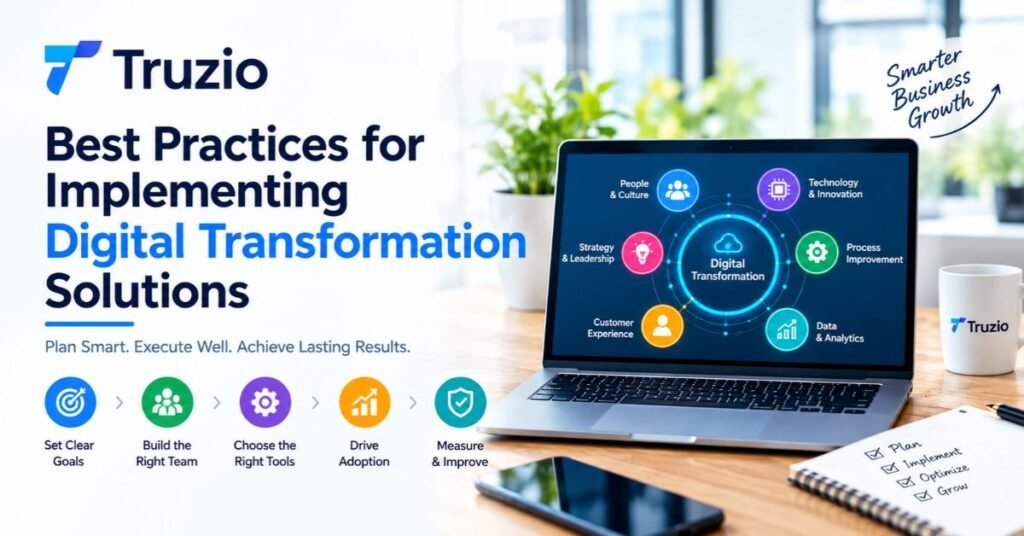
A good roadmap doesn’t need to be fancy. It needs to be clear. A simple ERP implementation roadmap lists goals, steps, owners, and dates. Four habits cover most of the value. They work for any vendor. They suit small teams and large ones. Use them as a checklist before you start.
Truzio’s own implementation method isn’t documented. So these tips are general practice and not a description of how the company works. Ask any vendor to walk you through their process. Good vendors can explain phases, roles, and handover steps in plain words. Clear answers suggest real experience. Foggy ones suggest guesswork.
Set Clear Business Goals and Success Metrics
Name one specific problem. Maybe stock counts are off. Maybe month-end takes too long. Then decide how you’ll know it’s fixed. “Modernize operations” is too vague to steer any choice. A sharp goal guides module picks, budgets, and training. It also gives your digital business strategy a target. Write it on one page. Share it with everyone involved. People work better when they know the finish line.
Prioritize High-Impact Business Processes
Start small. Pick one or two modules that fix the problem you named. Expand later. A phased rollout limits disruption. It also gives you time to fix mistakes before the whole firm relies on the system. Sales and accounts are a common first pair. Warehouse and HR can follow. This approach supports process improvement without a risky big-bang launch.
Train Employees and Manage Organizational Change
Train by role. Use real examples from your own work. Pick a few pilot users before launch. They become the go-to helpers. That eases adoption better than any manual. Good organizational change management also means listening. Ask what slows people down. Fix small annoyances fast. Staff who feel heard will use the system. Staff who feel ignored will find workarounds.
Monitor Performance and Optimize Continuously
Launch day isn’t the finish line. Track a short list of measures and review them monthly at first. Good ones include time from order to invoice, stock accuracy, the share of transactions actually entered in the system, and the number of data corrections. Watch for drift. Adjust settings and training when numbers slip. Steady review keeps business process management healthy long after go-live.
See Also: Bobbilou05 in the Digital World: Meaning, Identity & Online Presence (2026)
Security, Privacy, and Governance in Digital Business Systems
No Truzio security practice or certification appears in public sources. So this section explains what to look for in any ERP. Think of security as a lock, a camera, and a spare key. The lock controls entry. The camera records who came in. The spare key lets you recover after trouble. A good system has all three. Ask any vendor to show each one.
Governance means the rules and duties around those tools. Who approves access? Who reviews logs? Who signs off on changes? Without answers, even strong tools fail. Governance turns enterprise data protection from a feature into a habit. Write the rules down. Review them yearly. Let every team lead know their part. Clear ownership prevents most slip-ups.
Data Access Controls and User Permissions
Role-based access control gives each person only what the job needs. A clerk sees orders. A manager sees reports. Only finance sees payroll. Tight access permissions limit damage from mistakes and bad actors. Audit logs and monitoring add a record of who did what and when. Review the logs on a schedule. Remove access fast when someone leaves. These simple steps stop many common problems.
Regulatory Compliance and Data Privacy
Laws differ by country. The GDPR applies in Europe. India has its own data-protection rules. Others apply elsewhere. Data privacy compliance depends on where you and your customers live. Data residency may require storing data in a given country. Ask where the vendor keeps your records. Also ask how they handle regulatory compliance requests. Check current rules with a qualified adviser. Laws change often, so yesterday’s advice may not hold.
Risk Management and Security Monitoring
Plan for bad days. Data backup and recovery terms matter most. How often are backups made? How fast can you restore? Open-source software still needs patches, so someone must apply them. Ask for breach-notification terms in writing. Ask for independent proof too. An ISO/IEC 27001 certificate or a SOC 2 report beats a verbal promise. Regular software security audits add comfort. Trust but verify.
Is Truzio Right for Your Business?
Start with the basics. Is the company running and reachable today? Given the status conflict and the unclear website, that step comes before any product review. Confirm current business operating status first. Call the number. Send an email. Check the registry. If nobody replies, the rest doesn’t matter. Many buyers skip this step and regret it later. A quick check can save months.
This guide doesn’t judge whether Truzio is legitimate or high quality. Public evidence can’t support a verdict either way. The checks below help you reach your own. That is basic ERP vendor due diligence. It also means looking for ERP customer reviews. None were found for Truzio, so you must gather your own through reference calls. Ask for two or three current clients and speak with them directly.
Business Needs and Organizational Readiness
Ask yourself three things. Do you have enough orders and processes to justify an ERP? Do you need the documented modules such as sales, CRM, accounts, warehouse, and HR? Who will maintain and fix the system? Small teams often lack in-house IT. That gap can sink a project. Readiness also includes data quality and staff time. Be honest about both. A modest tool used well beats a grand tool ignored.
Factors to Evaluate Before Choosing a Platform
Compare categories and not only brands. The table below shows three common routes. Also weigh budget, comfort with open source, and data residency needs. Include hosting and support in your price and not only licenses. A cheap license can hide a costly setup. Good ERP software evaluation compares full costs across three years. Ask each vendor for the same quote format so numbers line up.
| Option | Typically suits | Watch out for |
| Packaged commercial ERP | Firms wanting a supported product | Subscription costs and less flexibility |
| Open-source ERP with a partner | Firms wanting flexibility and lower license fees | Reliance on the partner and update duties |
| Custom-built system | Unusual processes | Cost, time, and long-term upkeep |
Questions to Ask Before Implementation
Put the following checks to the company directly. The table works as a vendor verification script. Print it and take notes during the call. Written answers beat spoken ones. Compare replies from every vendor you talk to. Good partners answer plainly and welcome follow-ups. Defensive replies are a warning sign. Strong software vendor support shows in how they respond right now.
| Question | Why it matters |
| Are you taking new customers today? | Confirms operating status |
| Which ERP platform and version do you use? | Shows the technical base |
| Where and how is it hosted? | Affects cost and control |
| What is the pricing model, including support? | Reveals total cost |
| What are your support terms and response times? | Sets expectations |
| Can I speak with current customers? | Provides real feedback |
| Which security practices and certifications do you hold? | Proves protection |
| How can I export my data if I leave? | Prevents lock-in |
Limitations and Considerations of Truzio-Style Platforms
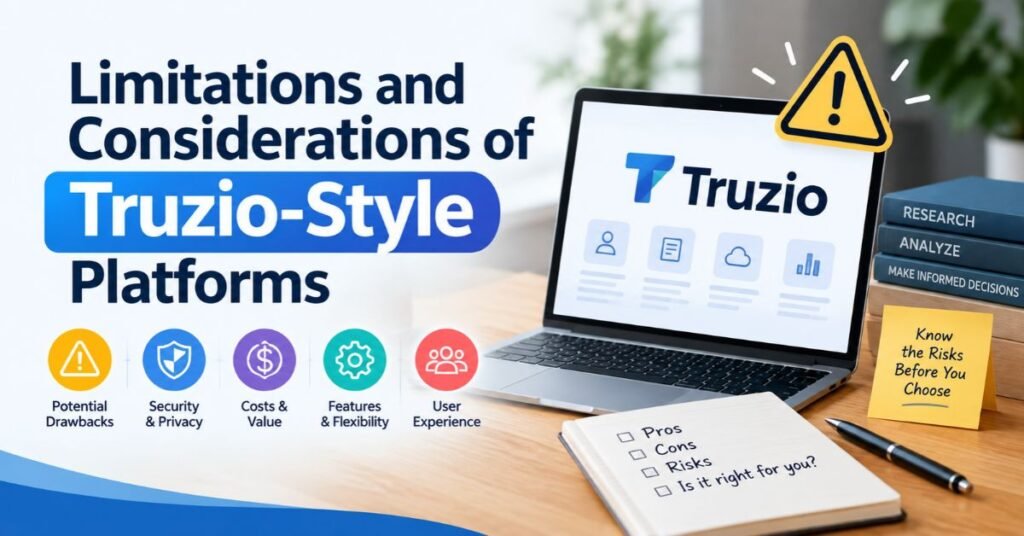
Two kinds of limits matter. The first kind applies to any ERP. Setup takes real effort. Output depends on data quality, since poor data in means poor reports out. Old tools can be hard to connect. The system also needs tuning as the business changes. These are standard ERP software limitations. They don’t mean a product is bad. They mean you should plan well.
The second kind concerns the evidence on Truzio itself. Public documentation is thin. Most details come from directories and profiles. Sources conflict on whether the company is active. The website’s current state is unconfirmed. Tracxn’s latest employee count was about 25 as of July 2024, which hints at a small team, though that figure is unverified. No independent user reviews or ratings turned up. So this guide can’t speak to customer satisfaction either way. Treat these gaps as questions to settle, not as verdicts.
See Also: Droven.io Best Tech Tools for Developers: Ultimate Guide for 2026
Integration and Compatibility Limitations
Connecting older tools is often harder than expected. File formats differ. Fields don’t match. Old programs may lack any API. Truzio’s integration options aren’t published, so software compatibility is unknown. Ask for a list of supported systems. Then test your own most important link in a trial. A short pilot can expose problems before you sign. Enterprise system interoperability should never be a surprise after launch.
Learning Curve and Adoption Challenges
Every new system has a learning curve. Staff need time to find their way. Setup takes effort, and the final quality mirrors that effort. Data cleanup alone can take weeks. Expect a dip in speed at first. Then expect a climb. Plan for ongoing tuning as the business changes. Good training and patient managers shorten the dip. Skipping them lengthens it.
Scalability, Maintenance, and Total Cost of Ownership
Think beyond year one. Updates, support, hosting, and fixes all continue. Someone must own each task. With open source, that someone may be you or a partner. “License-free” can still add up to a real bill. A fair view of total cost of ownership counts everything across three to five years. Check vendor support agreements closely. Ask what happens if the vendor closes. A source-code copy and a data export plan give you an exit.
Digital Transformation Trends Shaping Business in 2026
The terms below come up often in enterprise software talks. This guide describes them and doesn’t measure adoption. No 2026 statistics are cited. Think of the trends as weather and not as orders. They show which way the wind blows. You don’t need to chase every one. Pick those that fit your real problems.
How do these trends affect an ERP buyer? Mostly through questions to ask. Does the product include assistants? Can it connect to automation tools? Can you adjust screens without a developer? Can it handle live data when needed? Each answer shapes your digital transformation strategy. Ask vendors about roadmaps too. A product that stands still may fall behind quickly.
AI-Driven Business Operations
AI assistants now draft text, flag odd transactions, and forecast demand. They save time on routine work. Yet their output depends on data quality. Humans must still check results, especially where money or compliance is involved. A wrong forecast can cost real cash. Start with low-risk uses. Measure the gains. Then expand step by step. Smart buyers treat AI as a helper and not as a boss.
Hyperautomation and Intelligent Workflows
Hyperautomation links several tools to automate a process end to end. It may combine robotic process automation, AI, and workflow engines. Robotic process automation copies routine clicks and keystrokes. The big caution is simple. Automating a broken process just makes it fail faster. Fix the process first. Then automate it. This approach supports business process optimization and avoids costly rework.
Low-Code and No-Code Development Platforms
Low-code tools let people build or adjust apps with visual screens and little programming. For ERP users they speed up small changes. A manager might add a field in an afternoon. The trade-off is control. Apps built outside IT’s view can bypass security and data rules. Set clear guardrails. Keep a register of what exists. That keeps speed and safety in balance.
Real-Time Data Processing and Predictive Analytics
Real-time systems handle data as events occur and not in scheduled batches. Predictive analytics uses past data to guess what comes next. Both add cost and complexity. They pay off only where a decision truly needs up-to-the-minute facts. A delivery fleet may need them. A small office may not. Ask what decision you want to speed up. Then buy only the speed you need.
The Future of Smart Business Platforms Beyond 2026
This section is an informed outlook and not established fact. Business software seems likely to add more embedded AI. It also seems likely to grow more modular, so firms can swap parts instead of replacing everything. Expectations around data governance may tighten as AI use spreads. How fast any of this happens is uncertain. Treat each prediction as a guess and plan with some flexibility.
For Truzio itself, no one can say. The outlook depends on basics. A confirmed operating status would help. So would a working website and current product documentation. Without these, any forecast is guesswork. If you’re a buyer, wait for proof before betting on a roadmap. If you’re a reader of blog posts, stay skeptical of bold promises. Evidence beats excitement every time.
Frequently Asked Questions
What Is Truzio Used For?
Public profiles describe Truzio Technologies as a provider of Truzio ERP, IT services, mobile apps, and business process outsourcing. Businesses use ERP of this kind to manage sales, accounts, stock, and staff records in one place. The UzzMe platform serves a different need by connecting customers with vendors. Confirm current details with the company directly.
Is Truzio a Business Software Platform?
Yes, in a narrow sense. Public sources describe an ERP product and related services built on open-source technology. Blog claims about a large AI, IoT, or analytics platform have no company documentation behind them. Treat those claims as unconfirmed. Ask the vendor for current product documents before you rely on any feature.
How Can Truzio-Style Solutions Help Businesses?
ERP-style tools can give you shared records, less re-entry, faster reports, and clearer stock counts. Staff stop retyping the same data and start working from one source. These gains are conditional. They depend on clean data, good training, and careful setup. No Truzio-specific results are documented, so measure your own outcomes.
Which Industries Can Benefit From Digital Transformation?
Healthcare, banking, retail, manufacturing, and logistics all use ERP-type tools. Each sector has its own caveats. Hospitals need strict privacy. Banks need audit trails. Retailers need channel links. Factories need production depth. Logistics firms often need specialist tracking tools. Match the tool to your sector’s real workflow.
What Should Businesses Verify Before Using Truzio?
Check that the company is operating and reachable. Confirm the registration record, the ERP platform and version, hosting, pricing, support terms, security proof, and data export options. Speak with current customers. Visit the official website yourself, since its present content is unconfirmed. Document every answer in writing before you sign anything.
Final Thoughts
Truzio most likely means Truzio Technologies, an ERP and IT services firm in Hyderabad. Its status is disputed across sources. Product details are thin. Many blog claims about AI and smart platforms lack any support. Still, the Truzio explained story holds real value. It shows how to read a vendor’s footprint, separate fact from hype, and ask smart questions.
Your next step is simple. Verify first and evaluate second. Confirm the company exists, check its registration, and request current documents. Then judge whether its Truzio business solutions fit your needs. The advice on ERP, security, and rollout applies to any platform you consider. Do the homework now and you’ll sleep better after launch.