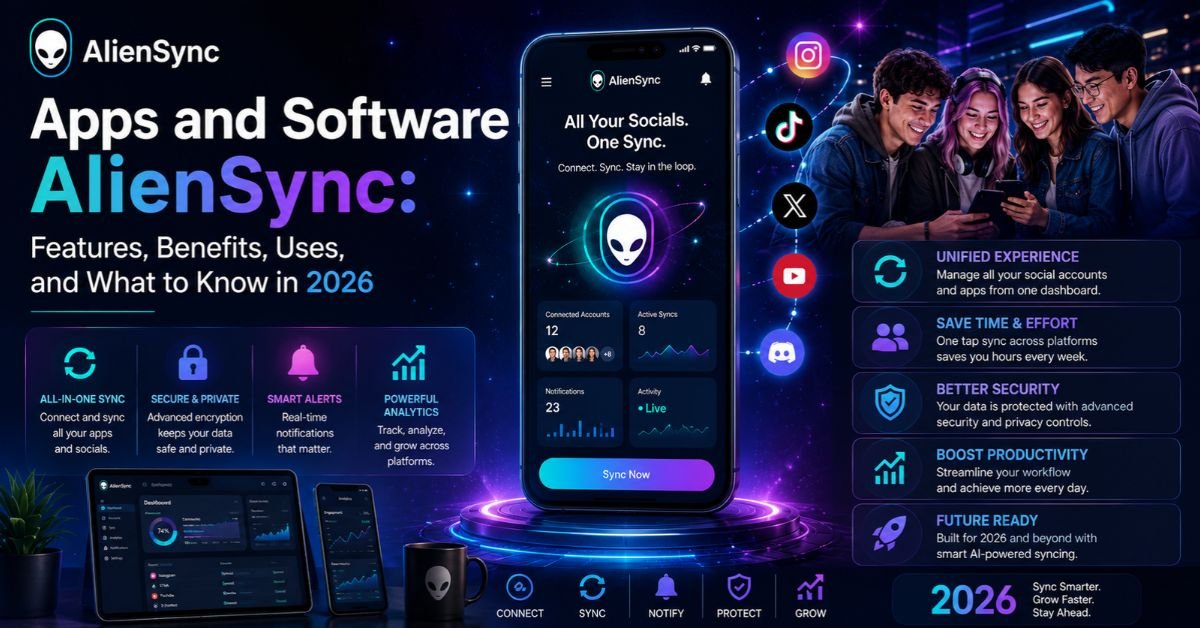
Apps and Software AlienSync: Features, Benefits, Uses, and What to Know in 2026
Picture your Monday morning. A new lead lands in your CRM. Your email tool doesn’t know about it. Your team chat stays silent. Your task board sits empty. You copy the same details by hand into four places. It’s slow and boring. It also invites mistakes.
That daily mess explains why people search for Apps and software AlienSync. The name points to a tool that links your apps and moves data between them. This guide explains what the AlienSync platform claims to do. It also shows what you can verify today and how to judge any software automation platform before you spend a cent.
What Is Apps and Software AlienSync?
Apps and software AlienSync is described online as a software synchronization layer. It sits between your tools and keeps them in step. Think of it as a postal worker for your business applications. One app changes a record. The tool then carries that change to the other apps. In short, it works as an app integration platform for connected applications.
This type of product has a name in the trade: integration platform as a service (iPaaS). Well-known players include Zapier, Make, n8n, and Workato. They have public pricing pages and large review counts. The picture is different for AlienSync. Articles describe it, but proof is thin. The table below shows what you can and can’t confirm right now.
| Proof Point | Established Tools | AlienSync (as of this writing) |
| Official company website with named owner | Yes | Not confirmed |
| Public pricing information | Yes | Not found |
| Independent software reviews on G2 or Capterra | Thousands | None located |
| Customer case studies with real names | Yes | None located |
| App store or marketplace listing | Yes | Not confirmed |
That gap doesn’t prove the tool is fake. Young B2B products often launch with little paperwork. Still, it means you should treat every claim with care. This is where software product verification starts. Ask before you trust. A real vendor will answer.
What Is the Purpose of Apps and Software AlienSync?
The main goal is simple. It aims to end the copy-and-paste grind. A good data synchronization software tool removes data duplication across your stack. It also cuts the delay between a change in one app and the news reaching another. Fewer hands touch the data. As a result, fewer errors creep in. That’s the heart of reducing manual data entry.
Here’s a quick example. A shop closes a sale in its CRM. Without sync, the warehouse hears about it hours later. With automated data transfer, the order reaches the warehouse in moments. Finance also gets its invoice trigger. This kind of real-time information sharing between apps keeps teams on the same page. It also supports better business workflow management because nobody waits on a message.
Key Features of Apps and Software AlienSync
Public pages about apps and software AlienSync repeat a familiar feature list. The list covers sync, a dashboard, rules, access control, and open connections. Nearly every mature workflow automation tools vendor offers the same bundle. So the list alone doesn’t set a product apart. You’ll learn more from how well each piece works.
Reliability matters more than the brochure. A pretty screen means little if syncs fail in silence. So when you read the features below, ask one question each time. Can the vendor prove it? Features that look great on paper sometimes crumble under real traffic. Careful buyers test before they commit.
Real-Time Data Synchronization
Real-time data synchronization means a change in one app shows up elsewhere within moments. This gives you real-time data updates across your connected application data. Two modes exist. One-way data sync copies changes in a single direction. Two-way data synchronization passes changes both ways. The second mode is powerful but riskier. Two people may edit the same record at once. That triggers a clash, so you need clear sync conflict resolution rules. Ask any vendor how it picks a winner. Also check the sync frequency, since some tools update every minute while others wait 15.
Centralized Dashboard and Data Management
A centralized dashboard shows every link in one place. You see connection status, last-sync times, and error alerts. Good workflow monitoring starts here. Instead of hunting through five tools, you glance at one screen. It works like a control tower at an airport. Planes keep landing, and you spot trouble early. As a data management system, the dashboard also helps with digital tool management. You can see which tools are linked and which sit idle. Its value, though, depends on the sync engine underneath.
Workflow Automation and Daily Task Management
Trigger and action automation drives most automated workflows. You set a condition, such as a new lead in the CRM. The tool then runs an action, such as creating a task and pinging a chat channel. Zapier calls these rules Zaps. Make calls them Scenarios. This automated task management style is proven and not new. Good workflow configuration keeps rules simple at first. Add one trigger and one action, and then test. Done well, it adds up to hours saved each week through workflow automation for small businesses.
See Also: Online PlayMyWorld: What It Is, Gaming Features, Latest Updates, and What to Know
User-Friendly Interface and Role-Based Access
Most buyers want software integration without coding. A clean interface with a connector library helps non-technical staff build links on their own. Teams also need guardrails. Role-based access control lets admins decide who can view or edit each link. These role-based permissions stop a new hire from breaking a live workflow. Strong access management also makes audits easier. For growing teams, this part of integration management often matters more than the flashy extras.
Cloud Integration, APIs, and Webhook Support
Not every tool has a ready-made plug. That’s why API integration matters. With custom API connections, a developer can link niche or in-house software. Webhook integration works like a doorbell. One app rings, and the other answers at once. Together, these give strong API connectivity and flexible application connectivity. As cloud-based software, the tool can also handle cloud data synchronization between hosted services. Basic links need no code. Custom work usually does, so plan for some technical help.
Data Security and Access Control
Your sync tool touches customer data protection duties every day. So check its security story first. Look for data encryption in transit and at rest. Ask about security compliance, including GDPR compliance under the EU’s data rules and SOC 2 certification as described by the AICPA. No public security papers for AlienSync turned up in research. Until that changes, avoid feeding it sensitive records. Request a written security overview before any trial begins.
Who Can Use Apps and Software AlienSync?
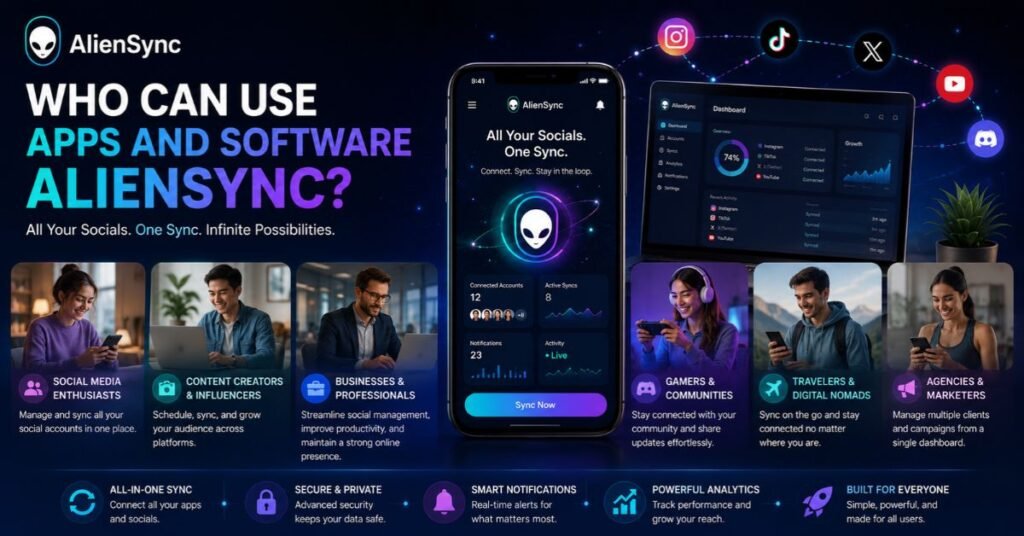
A sync tool fits anyone who runs several apps and hates re-typing. Freelancers who juggle client accounts get quick wins. Small firms with a mixed tech stack benefit too. Marketing teams like connecting CRM and email platforms. Remote crews gain from application integration for remote teams, since everyone sees the same fresh data across time zones. Developers can also use it as a flexible layer instead of building one from scratch.
Some people won’t need it. If you use only one or two apps, a sync layer adds cost without payoff. Large enterprises with deep legacy systems often need heavier tools. And anyone hoping for a free, zero-setup solution will be disappointed. The table below sums it up.
| Group | Fit? | Why |
| Freelancers with many client tools | Good | Saves repeated data entry |
| Small and mid-sized businesses | Good | Links a mixed SaaS applications stack |
| Marketing teams | Good | Handles CRM integration and email syncing |
| Remote teams | Good | Keeps data consistency across time zones |
| Teams with one or two apps | Poor | No real sync need |
| Large legacy-heavy enterprises | Poor | Need deeper custom tooling |
How Does Apps and Software AlienSync Work?
Most platforms in this space follow the same path. You open an account. You link your apps through application connectors. You choose what data moves and in which direction. Then you build rules and watch the results. Described guides say apps and software AlienSync follows this model. That’s normal for the category. It’s also good news, since the learning curve stays gentle.
One tip applies to every tool. Start small and safe. Pick a low-risk workflow first, such as copying new contacts into a spreadsheet. Only after it runs well should you touch anything customer-facing. This habit protects your data consistency while you learn how the tool behaves. Think of it as a driving lesson in an empty parking lot.
See Also: Jerry Speyer and Robert De Niro: What Connects These Two New York Icons?
Initial Setup and Configuration
Setup begins with a plan that fits your app count and team size. Next, set your sync frequency and pick a direction for each link. Start with one-way data sync because it’s far safer. Confirm that your tools pass a software compatibility check before you connect them. A quick test on dummy data will reveal problems early. Then save your settings and write down what each link does. Clear notes save hours later.
Connecting Apps and Managing Data
Now link your tools through the connector library. Map each field carefully. A “Full Name” field in one app may split into two fields in another. Wrong mapping causes data synchronization errors that spread fast. Name each link by source, destination, and condition. This habit makes integration management far easier months later. Good cross-platform integration depends on tidy mapping. Check the first few synced records by hand before you trust the rest.
Creating Automated Workflows
Build your first rule with one trigger and one action. For example, when a form is filled, create a CRM contact. Test it with a fake entry. Once it works, add steps one at a time. Strong integration workflows grow in small, tested layers. Turn on failure alerts for every rule. Silent failures hurt the most, because you only notice them after the damage spreads. Review your automated data movement each week at first.
Benefits of Using Apps and Software AlienSync
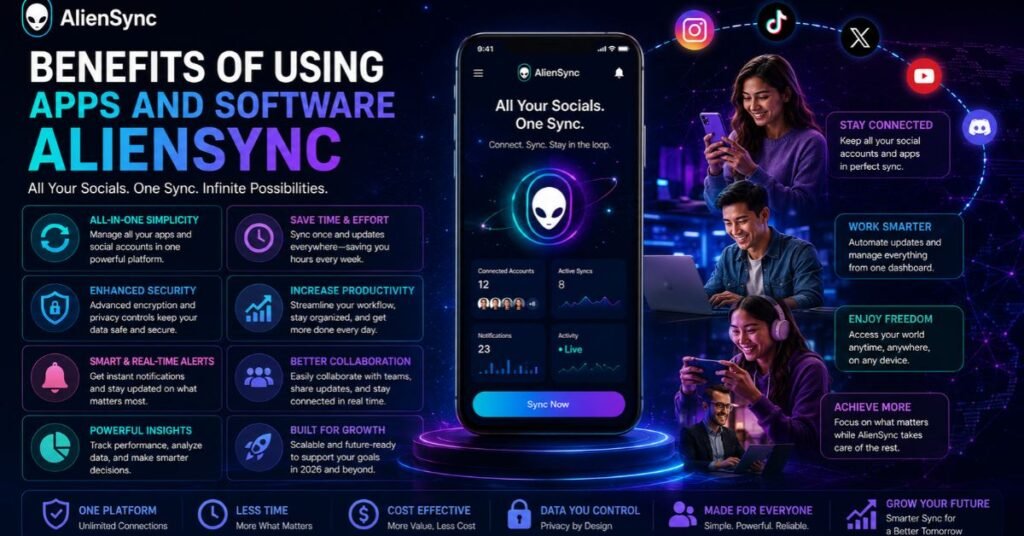
When a sync tool works, the gains are easy to feel. Manual copying drops. Mistakes fall. Teams stop asking each other for updates. A reliable software automation platform quietly handles the boring parts of your day. You then spend that saved time on work that needs a human brain.
These benefits come with a catch. They hold only if the tool proves reliable. A flaky sync can create more mess than it clears. So treat every promised gain as a hypothesis. Test it with your own data before you rely on it. The same advice applies to any business software integration project.
See Also: Meals Included on PaxTravelTweaks: What Meals Are Covered in Your Booking?
Improved Productivity and Time Management
Time savings add up quickly. Say a sales rep spends 20 minutes a day copying lead data between tools. That’s more than 80 hours a year. Automated data transfer can erase most of it. This is a simple illustration and not a measured result. Still, the math shows why managing business workflows efficiently matters. Even small shifts return real hours to your week.
Simplified Data Control and Organization
Scattered data breeds confusion. Which spreadsheet holds the right number? A sync layer pushes you toward one source of truth. Stronger data consistency follows, because every app reads from the same updates. You may also spot overlapping subscriptions and cut them. This is classic managing multiple software platforms work. A tidy software ecosystem costs less and causes fewer headaches.
Better Workflow Coordination
Teams move faster when everyone sees the same facts. A support agent sees the latest order status. A sales lead sees the latest ticket. Nobody waits for a forwarded email. This smoother business workflow management helps remote crews most. People in different time zones stop working from stale data. Better handoffs mean fewer dropped balls.
Apps and Software AlienSync vs. Other Software Platforms
Comparison is your best defense when a vendor’s paperwork is thin. Set the unknown tool beside proven ones. Then check the gaps. The table below compares apps and software AlienSync with three leaders in a fair way. It focuses on features you can check yourself. Visit Zapier pricing, Make pricing, and the n8n site to confirm current numbers, since plans change often.
| Factor | Zapier | Make | n8n | AlienSync (as marketed) |
| Public pricing information | Yes | Yes | Yes | Not confirmed |
| Independent software reviews | Thousands | Thousands | Hundreds | None located |
| Self-hosting | No | No | Yes | Not confirmed |
| Free tier availability | Yes, limited | Yes, limited | Yes | Not confirmed |
| Number of integrations | Very large | Large | Smaller but extensible | Not published |
Each rival has its own flavor. Zapier suits beginners. Make automation appeals to people who like visual, step-by-step builders. N8n workflow automation attracts technical teams that want control. Note that n8n uses a fair-code license and not a classic open-source one. You can read its license terms for details. Workato aims at larger companies. These are your main integration platform alternatives and business software alternatives.
AlienSync vs. Zapier
Zapier is a mature, public, well-reviewed platform with a huge catalog of third-party integrations. AlienSync lacks that visible proof. When comparing AlienSync with Zapier, the gap isn’t about ideas. Both promise to link your apps. The gap is about trust. Zapier shows its prices, its uptime, and its reviews. Until AlienSync does the same, Zapier remains the safer pick for choosing the right integration platform.
AlienSync vs. Traditional Data Management Tools
Older methods include manual exports, shared spreadsheets, and one-off scripts. They cost little upfront. However, they eat staff time and break when someone forgets a step. A sync layer automates the loop and improves data consistency. The trade-off is monthly subscription costs and some setup work. For tiny teams with one or two tools, manual methods may still win. For busier stacks, automation pays off fast.
Apps and Software AlienSync Pricing: What Is Actually Known?
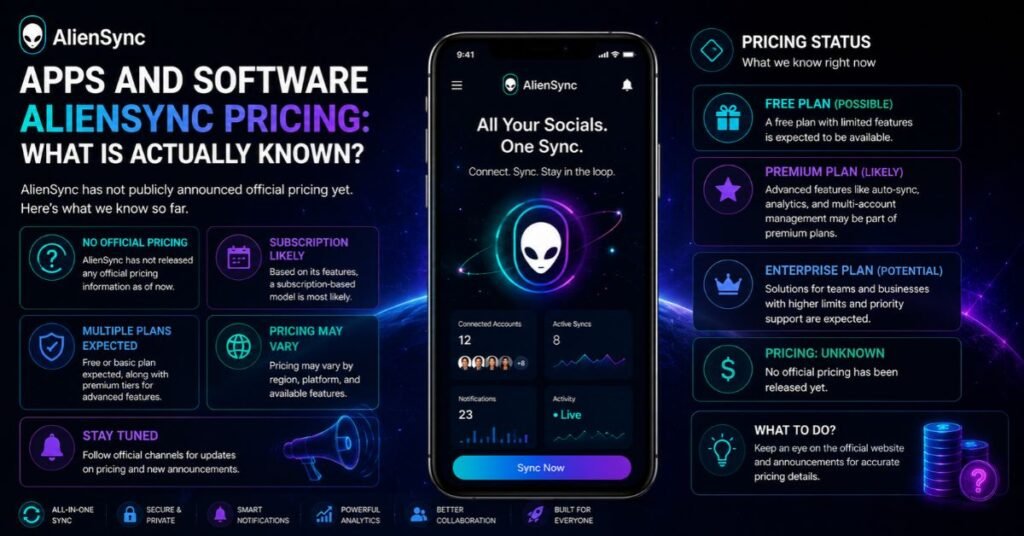
Pages about apps and software AlienSync often say pricing “scales with volume.” That means costs may rise as you add apps or raise your sync frequency. Many platforms in this category work the same way. But no official rate card turned up in research. Without it, you can’t budget with confidence. Treat any specific dollar figure you see online as unverified.
You can still protect yourself. Ask for software pricing plans in writing before you pay. Make sure you know what counts as one “operation” for billing. A single workflow may use five operations per run, and that changes your bill fast. The table below lists the questions worth asking about checking software pricing and subscriptions.
| Question to Ask | Why It Matters |
| What is the written price by tier? | Verbal quotes can change |
| What counts as one sync or operation? | Hidden usage can inflate subscription costs |
| Does workflow complexity cost extra? | Some plans charge per step |
| Is there a free tier, or a trial? | Lets you test before you pay |
| What are the contract and cancellation terms? | Prevents lock-in surprises |
Common Setup Mistakes and Challenges to Avoid
Rollouts of any integration tool trip over the same few stones. The biggest is switching on two-way sync everywhere at once. This multiplies the risk of clashing updates before you grasp the tool’s conflict logic. Another is skipping failure alerts. A quiet failure can corrupt your data for weeks. Vague rule names also hurt. “Sync Contacts” means nothing six months later.
Other errors come from rushing. Some teams connect every tool on day one. Others never audit old links. Unused syncs eat budget and clutter the dashboard. The fix is steady, small steps. Start with your most painful workflow and confirm it runs well. Then expand. This approach is the best way of avoiding data synchronization errors.
See Also: App and Socials AlienSync: What It Is, How It Works, Features, and What to Know
| Mistake | Better Move |
| Two-way sync everywhere at once | Begin with one-way data sync |
| No failure alerts | Turn on alerts for every rule |
| Vague rule names | Name by source, destination, and condition |
| Connecting every tool on day one | Start with your top pain point |
| Never reviewing old links | Audit connections each quarter |
How to Evaluate Apps and Software AlienSync Before Using It
Marketing copy tells you what a vendor wants you to believe. A checklist tells you what’s true. So run any tool through the same simple test. This is the core of how to evaluate software vendors. Begin with vendor verification. Can you find a company name, address, or leadership team? A hidden owner is a red flag. Then look for vendor transparency on pricing, support, and terms.
Next, hunt for outside proof. Search G2 and Capterra for independent software reviews. Ask for named customer case studies you can actually contact. Request uptime information and a security overview that covers data encryption and SOC 2 certification. Strong platform reliability leaves a paper trail. If a vendor can’t meet most of these tests, that isn’t an automatic no. It does mean you carry more risk than you would with an established tool.
| Check | What a Good Answer Looks Like |
| Company identity | Named owner, address, and team |
| Pricing page | Public, dated, and detailed |
| Reviews | Listed on G2 or Capterra |
| Security policy | Covers encryption, GDPR compliance, and audits |
| Trial or demo | Available before payment details |
| References | Real customers you can contact |
Frequently Asked Questions
What Is Apps and Software AlienSync Used For?
People use it to connect their tools and move data between them without manual work. In practice that means syncing contacts, tasks, and updates across apps. It also covers simple rules that run on their own. The goal is how to synchronize data between applications with less effort and fewer errors.
Is Apps and Software AlienSync a Real Product?
Several articles describe a platform under this name. Independent proof is limited, though. No official company site, review-platform listing, or public pricing page was confirmed. That doesn’t prove it’s fake. It does mean you should verify everything yourself, a key step in verifying software company credibility.
Is Apps and Software AlienSync Free to Use?
No confirmed free tier availability exists in public sources. Pricing claims you see online remain unverified. Ask the vendor for a written offer before you assume anything is free. A trial with no card required is a good sign.
Does AlienSync Support Real-Time Data Synchronization?
Descriptions claim it does. Whether it works well is a separate question. Reliability depends on the engine and not the pitch. Ask for uptime information and details on sync conflict resolution before you trust it with critical work.
Do You Need Coding Skills to Use AlienSync?
Basic syncing is usually no-code across this category. Custom API integration and webhook support often need some technical skill. A developer friend or a freelancer can help with those parts. Start with simple links and add custom work later.
Is Apps and Software AlienSync Safe?
Public security details are missing. No evidence of SOC 2 certification or a posted GDPR compliance statement was found. So don’t connect sensitive data yet. Request a written security overview first. Understanding software security policies should come before any signup.
What Are the Alternatives to AlienSync?
Zapier, Make, n8n, and Workato are the best-known options. Zapier is beginner friendly. Make offers visual building. n8n gives technical teams more control. Workato targets larger firms. Each has public pricing and many reviews, which makes them reliable alternatives to AlienSync.
Final Verdict
The need behind apps and software AlienSync is real. Connecting your tools, cutting manual entry, and getting one clear view are worthy goals. A good app integration platform can save you hours each week. It can also lift your data consistency and speed up your team.
The product itself, though, lacks public proof. No verified pricing, reviews, or security papers turned up. So demand vendor transparency before you commit budget or customer data. Run the checklist above. Compare it against proven tools. If AlienSync passes, it deserves a serious look. If not, one of the established integration platform alternatives is the wiser place to start.