

Results SFFareBoxing SportsFanFare: Complete Guide to Boxing Results, Live Updates, and Fight Schedules
Picture this. You wake up in a different time zone and grab your phone. Three headlines name three different winners. Now you’re lost. If you searched for results SFFareBoxing SportsFanFare, you want a clear answer fast. This guide gives you one. You’ll learn how to read boxing results, follow live boxing scores, decode boxing scorecards, and check boxing schedules. Fans in every country can use these tips. Let’s get started.
What Is Results SFFareBoxing SportsFanFare?
This phrase points to boxing match results linked with SportsFanFare coverage. Many fans type it into search engines to find SFFareBoxing results. A keyword alone proves very little, though. It doesn’t show that a page holds official boxing records or a full results service. Think of it like a shop sign. The sign tells you what the shop claims to sell. You still need to step inside and look.
Pages under this topic can take many forms. Some are SportsFanFare boxing results explained articles that teach terms. Others are recaps, previews, or opinion pieces. Each type has a different job. A recap reports boxing fight results. A preview talks about upcoming boxing matches. So always check what the page truly delivers. That habit is the heart of how to check SFFareBoxing results the smart way.
How to Find the Latest SFFareBoxing Boxing Results
Start with the names. Search both fighters plus the word “result” to find the latest boxing results. Then check the publication date. Next, look for the method of victory, the round, and the scores. A good report has all three. If a page only says “Fighter A won,” dig deeper. The table below shows a quick routine for finding latest boxing results and fight updates.
| Step | What to do | Why it matters |
|---|---|---|
| 1 | Search both fighter names | Avoids mixing up similar names |
| 2 | Check the date and time posted | Confirms the page covers fight night results |
| 3 | Find the method and round | Shows how the boxing match outcomes unfolded |
| 4 | Look for scores or stoppage time | Gives the full picture |
| 5 | Compare with a second source | Supports fight result verification |
Time zones can trick you. A big fight may end after midnight in your city. The date on a page may then differ from the date you expect. A fight that ended Saturday night in Las Vegas may show up as Sunday in Pakistan, Australia, or the UK. That’s normal. Always match the fighters and the event name. The date alone can mislead you. This matters most for boxing news and updates shared across borders.
Live Boxing Scores and Fight Updates
Live coverage moves fast. Live boxing scores and boxing fight updates often include round-by-round notes, knockdowns, and breaking news. Fans love this format. You feel part of the action. However, a live post is not a final result. It’s a snapshot. The ring can change in seconds. A boxer who leads after six rounds may still lose. Treat every live note as a work in progress.
Be careful with delays and mistakes. Fast posting leads to typos and wrong names. Many pages also share unofficial scorecards from fans or writers. These are opinions. They don’t replace the judges’ scorecards. Also, a page that talks about SFFareBoxing live updates may not run a live scoring service. Check the site itself before you rely on it. Live commentary is fun. Still, wait for the official boxing announcement before you call it final.
What a Complete Boxing Result Includes
A strong report answers every key question. It names the winner and loser. It lists the date, venue, and weight division. It states the official fight outcome and the method of victory. For a stoppage, it gives the round and the fight stoppage time. For a decision, it lists the boxing judges’ scores. It also names any title on the line. Without these details, a headline leaves you guessing. These details turn a score into one of the best boxing event summaries you can read.
A good report also separates the main event from the undercard bouts. Readers often mix them up. Full boxing undercard results add real value. A prospect may shine early in the night. A veteran may return after a long break. Keep facts apart from opinions too. Saying a boxer “deserved to win” is a view. Naming the announced winner is a fact. The sample table below shows a clean layout for professional boxing results.
| Detail | Example entry |
|---|---|
| Fighters | Fighter A vs. Fighter B |
| Weight division | Middleweight |
| Winner | Fighter A |
| Method | TKO |
| Round and time | Round 8, 1:42 |
| Event position | Main event |
| Title | Vacant title fight |
Common Boxing Result Abbreviations Explained
Reports use short codes to save space. These codes pack a lot of meaning. Learn them once and you’ll read any card with ease. This is the first step in how to read professional boxing results. The table below lists the most common ones. Read each code together with the real scores. The code alone never tells the whole story.
| Code | Meaning | Simple explanation |
|---|---|---|
| KO | Knockout | A boxer can’t beat the referee’s count |
| TKO | Technical knockout | The fight ends by a stoppage |
| UD | Unanimous decision | All three judges pick the same boxer |
| SD | Split decision | Two judges pick one boxer, one picks the other |
| MD | Majority decision | Two judges pick one boxer, one scores a draw |
| DQ | Disqualification | A boxer loses for breaking the rules |
| NC | No contest | No win, loss, or draw is awarded |
| TD | Technical decision | Scorecards decide after an early ending |
| Draw | Even result | Scores finish level |
These labels also help you understand boxing match outcomes at a glance. A fan who knows them can scan a full card in seconds. Next, let’s look at each group in detail.
Knockout (KO) and Technical Knockout (TKO)
A knockout (KO) happens when a boxer can’t continue after a knockdown. The referee counts to ten and the fight ends. A technical knockout (TKO) ends the fight without a full count. A referee stoppage is the most common cause. The corner may also retire its fighter. A doctor may stop the bout for safety. Rules and recording habits vary by region. That is why difference between KO and TKO in boxing is a favorite fan question. In short, a KO follows a count and a TKO follows a stop. Both count as knockout results on a record. Neither label shows who was ahead before the finish.
See Also: 20xBusiness.com Review: Features, Credibility, Ownership, and Safety
Unanimous, Split, and Majority Decisions
When no one scores a finish, the judges decide. A unanimous decision (UD) means all three judges agree. It’s a 3-0 result. A split decision (SD) means two judges pick one boxer and one picks the other. That’s a 2-1 result. A majority decision (MD) means two judges pick one boxer while the third scores a draw. That’s a 2-0-1 result. When you compare unanimous decision vs split decision, remember this. The label shows how the judges voted. It doesn’t show how close the fight felt. A unanimous result can still hide several tight rounds. Always read the actual cards.
Draws, Disqualifications, and No Contests
A draw in boxing means the scores finish level. Nobody wins. A disqualification (DQ) means a boxer loses for a serious rules violation, such as repeated low blows. A no contest (NC) means the bout ends without a winner, loser, or draw. This often follows an accidental foul that stops the fight too early. If the fight goes far enough, many rules use a technical decision (TD) instead. Here’s the key point. A draw is a result. A no contest is not. This is the clearest difference between a draw and no contest you can remember.
How Boxing Scorecards and Scoring Work
Judges score each round on what they see. They look at clean punching first. Landing clean shots beats throwing wild ones. Next comes effective aggression. Moving forward only counts if it leads to real offense. Then they weigh defensive skills. Slipping, blocking, and countering all matter. Finally, they consider ring generalship. That means who controls the pace and the space. This is the core of how judges score a boxing match.
Rules can differ across commissions and countries. Some places use different training for judges. Some allow different scoring notes. So two events may feel a little different. Still, the basics stay close. Understanding the boxing scoring system helps you judge a close boxing decision with a calm mind. It also shows how official boxing scorecards work in the real world. Read on for the details.
Understanding the 10-Point Must System
Most pro fights use the ten-point must system. The winner of a round gets 10 points. The other boxer gets 9 or fewer. Think of a teacher grading a quiz after every round. The better student earns the full mark. The other student drops a point. Even rounds are rare but possible. These boxing round scores add up across the fight. By the final bell, each judge holds a full card. That card becomes the official decision once announced.
Reading Judges’ Scorecards and Final Scores
Let’s try two simple examples. Assume no knockdowns, no deductions, and no even rounds. A 115–113 card over twelve rounds means seven rounds for one boxer and five for the other. A 118–110 card means ten rounds to two. Both cards could belong to a unanimous decision. Yet they show very different margins. This is how to interpret boxing judges’ scores the right way. Look at the numbers. Then check the round-by-round results if they’re available.
Knockdowns and Point Deductions
Knockdown scoring often creates a 10–8 round. The boxer who scores the knockdown gets 10 and the fallen boxer gets 8. Sometimes the round stays 10–9 if the knockdown was minor against the flow. Point deductions also change totals. A referee may take a point for repeated low blows or holding. One missing point can flip a card. So don’t trust simple math alone. Always check for knockdowns and penalties before you judge a score.
SFFareBoxing Fight Schedules and Upcoming Matches

A fixture and a result are not the same thing. A fixture lists a planned bout. A result records what happened. Good boxing schedules show the date, venue, broadcaster, and start time. This is how boxing results and upcoming fixtures differ. Some pages mix both on one screen. Check the label on each line. Then you’ll know which fights are done and which are still ahead.
Worldwide fans face one big hurdle. Time zones. A 10 p.m. main event in New York is early morning in Karachi. Use a time converter before you plan your night. Also check who shows the fight in your country. Broadcast rights differ from place to place. A solid upcoming fight schedule helps you plan. It’s even better when it matches boxing fixtures from the promoter. This is the base of boxing fight schedules and confirmed matches.
Upcoming Fights, Dates, and Venues
A confirmed boxing match has an official announcement. Look for the fight date and venue from the promoter or the broadcaster. Check the card order too. The main event usually comes last. Local start times can shift by an hour or more. So confirm the time near fight week. These steps help you follow upcoming boxing matches without stress. If only a rumor exists, treat it as a rumor. Don’t book a watch party yet.
Why Scheduled Boxing Matches Can Change
Plans change often in boxing. Injuries are the top cause. A fighter may pull out in training. Opponents may change late. Contract disputes and travel problems also play a part. The result may be a postponed boxing match or a cancelled fight. This explains why boxing matches get postponed. Always check the update date on any preview. An old article may describe a bout that never happened. Fresh information beats old hype every time.
See Also: TheJavaSea.me Leaks AIO-TLP371: Risks, Safety, and What Is Verified
Fighter Records, Rankings, and Boxing Statistics
A professional boxing record lists wins, losses, and draws. It’s the first thing most fans check. It’s a useful start. Yet it can’t show opponent quality. An undefeated boxer may have faced soft opposition. A fighter with a few losses may have faced the best in the world. Fighter performance also depends on recent fight history and weight. That’s how you learn how to evaluate a boxer’s recent performances. Look at who they beat and when.
Rankings add another layer. Different groups publish different lists. A boxing contender may rank third in one list and sixth in another. No single list rules them all. That’s why fighter rankings are best read as guides. They show momentum and not final truth. Mix them with fighter records and knockout statistics for a fuller view. Together they give strong boxing statistics to work with.
Understanding Wins, Losses, and Draws
Records use a simple format. A record of 25-2-1 means 25 wins, 2 losses, and 1 draw. Now compare two fighters. One is 20-0 against modest foes. The other is 18-3 against former champions. The second boxer may be tougher. Numbers can’t tell you that alone. Study career progression too. Did the boxer climb in class step by step? Did they move up a weight division and keep winning? Context turns official boxing records into real insight.
What Knockout Percentages Reveal About Fighters
The knockout percentage shows how often a boxer finishes fights. Here’s a quick example. A fighter has 20 wins. Fifteen came by knockout. That’s 75 percent. Some sites divide by wins and others by total fights. Check the method before you compare. A high number signals power. It doesn’t guarantee a stoppage against an elite chin. Style, skill, and durability matter too. Use this stat as a clue. Never use it as a promise.
Major Boxing Events, Championship Results, and Title Fights
Reports should name the exact belt on the line. Four major groups sanction world title fights. They are the WBA, the WBC, the IBF, and the WBO. A boxer may hold one belt and not the others. So “world champion” can mislead. Smart coverage says which title changed hands. This is key for championship boxing results and title changes. Please verify each link before you rely on it, since sites update often.
Title fights come in several types. A vacant title fight happens when no champion holds the belt. An interim championship may be created when the champion can’t defend soon. A title unification bout joins two belts in one fight. Each type carries different weight. A championship title bout can reshape a division. Strong boxing championship results reports explain the stakes. They also cover the boxing fight outcomes and championship implications in plain words.
How Results Affect Championship Titles and Rankings
A big win can lift a contender toward a title shot. That is how boxing results affect rankings. Still, nothing is automatic. Mandatory challenger rules, promoter deals, and injuries can slow things down. A contender may wait many months for a chance. Some move up fast after one huge upset. Others stay stuck despite a strong run. Watch the official boxing announcement for real news. Wins open doors. Contracts decide who walks through.
Rematches and What to Know About Future Fight Announcements
A close fight sparks calls for a second bout. Fans shout for it online. That’s demand. It isn’t a booking. A rematch clause in a contract may force a second fight. That’s a legal path. A future fight announcement from a promoter is the real signal. Until then, treat talk as talk. This is the right way to follow boxing rematches and future fight announcements. Wait for a date, a venue, and a broadcaster before you call it set. Many boxing rematch announcements take months to finalize.
How to Verify Boxing Results and Their Accuracy
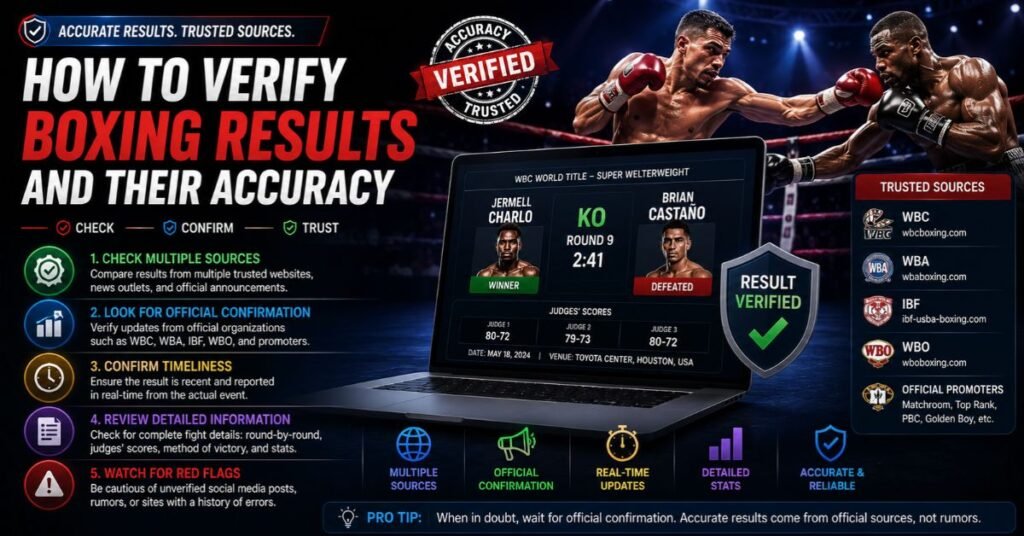
Speed causes errors. A rushed post may name the wrong winner. It may call a TKO a KO. Screenshots spread fast and often lack context. That’s why fight result verification matters. Many fans share a wrong score before the cards are read. A short check can save you from passing along bad news. You’ll also sound smarter in the group chat.
Use a simple three-step routine. First, match the event details. Second, check an official source. Third, separate live talk from the final word. The next sections walk through each step. This is how to verify official boxing results with confidence. It also points you to reliable sources for professional boxing results. Take a minute. The payoff is verified fight results you can trust.
Confirm the Fight Date, Event, and Weight Class
Boxers often meet more than once. A correct result from the first fight can answer the wrong question about the second. So match the names, the date, and the weight division. Watch for similar spellings too. Two fighters may share almost the same name. A different weight class can also signal a different bout. Check the event title and venue. These small checks protect you from mix-ups. They take seconds and prevent big mistakes.
Check Official Boxing Organizations and Promoters
Strong sources include boxing commission records, sanctioning body notices, and a promoter fight report. Established reputable boxing databases help too. BoxRec is a well-known example. It tracks fighters and bouts across the world. Compare at least two sources. If they disagree, note what stays unclear. Then watch for updated fight records. Sources sometimes fix errors after the event. A careful fan checks back later.
See Also: Afextop.com Review: What It Is, How It Works, and Is It Safe?
Distinguish Live Updates From Confirmed Final Results
Live posts, unofficial scorecards, and fan predictions are opinions. Only the announced result and official records are final. This is the gap between official boxing results vs unofficial scorecards. It also shows confirmed versus predicted results in action. A pre-fight pick stays a pick, even if it sits beside a result headline. Results can also change after a review. Boxing result corrections do happen. Always look for an update note before you share a score.
Common Mistakes to Avoid When Reading Boxing Results
One clip can fool anyone. A highlight reel shows a fighter’s best moments and hides the rest. Many fans also confuse aggression with scoring. Pressure only counts when punches land. Others cry “robbery” at every close card. A close boxing decision can be fair even when you disagree. Some readers skip the stoppage time. A finish in the first ten seconds differs from one just before the bell. Others miss corrections after the event.
The table below sums up the traps. Spot them early and you’ll read boxing match results like a pro. Pay attention to round-by-round results when possible. They show the real flow of the fight. A little care makes every boxing event summary more useful.
| Mistake | Why it misleads | Better habit |
|---|---|---|
| Watching only highlights | Hides the opponent’s best rounds | Read the full recap or cards |
| Equating aggression with scoring | Missed punches earn little | Look for clean punching |
| Calling every close card a robbery | Judges can differ fairly | Check round scores |
| Ignoring stoppage time | Timing changes the meaning | Note the round and clock |
| Missing corrections | Early reports can be wrong | Revisit the page later |
Frequently Asked Questions
What Does Results SFFareBoxing SportsFanFare Mean?
It’s a search phrase tied to boxing results and SportsFanFare content. It doesn’t prove a page holds official boxing records. Check each page to see whether it offers completed fight outcomes, previews, or general guides. Then confirm key details with an official source before you trust them.
Where Can I Find the Latest SFFareBoxing Results?
Start with the page you found. Look for names, date, method, and scores. Then confirm with a promoter report or a reputable database such as BoxRec. Comparing two sources is the best way to catch errors. It takes a minute and builds trust in the latest boxing results.
Does SportsFanFare Provide Live Boxing Scores?
Don’t assume so from the keyword alone. Visit the site and see what it truly offers. A page that talks about live boxing scores may not run a live service. If you need real-time updates, use a trusted broadcaster or a promoter’s official channels too.
What Is the Difference Between a KO and a TKO?
A KO follows a completed count after a knockdown. A TKO follows a referee stoppage, a corner retirement, or a medical stop. Both end the fight early. The difference lies in how the ending happens. Records often list both as knockout results.
Does a Unanimous Decision Mean a One-Sided Fight?
No. A unanimous decision only means all three judges picked the same winner. The margins can still be tight. A 115–113 card is far closer than 118–110. Always read the boxing judges’ scores and not only the label.
Can an Official Boxing Result Change After a Fight?
Yes. A review, protest, or ruling can change an outcome. A failed drug test is one example. Rules vary by commission and region. That’s why you should look for updated fight records and boxing result corrections when a report mentions a later decision.
What Is the Difference Between a Draw and a No Contest?
A draw is an even result under the scoring process. A no contest awards no win, loss, or draw. It often follows an early accidental foul. In short, a draw is a finished result with level scores. A no contest ends without any of the three.
Why Should I Verify Boxing Results With Official Sources?
Early reports often contain wrong names, scores, or methods. Social posts can spread mistakes fast. Boxing commission records and promoter reports give a stronger base. A short check protects you from sharing bad information. It also builds a habit of trusting facts over hype.
Final Thoughts
Great fans follow a simple routine. Confirm the event. Read the method of victory. Check the scores. Then verify the source. Add the abbreviations, scorecard basics, and schedule tips from this guide. You’ll read results SFFareBoxing SportsFanFare coverage with real confidence. You’ll also spot weak boxing news and updates from a mile away.
So what’s next? Bookmark this guide for your next fight night. Share it with a friend who loves the sport. Then enjoy the main event and every undercard bout with sharper eyes. Whenever you search for SFFareBoxing results again, you’ll know what to look for. Happy watching.