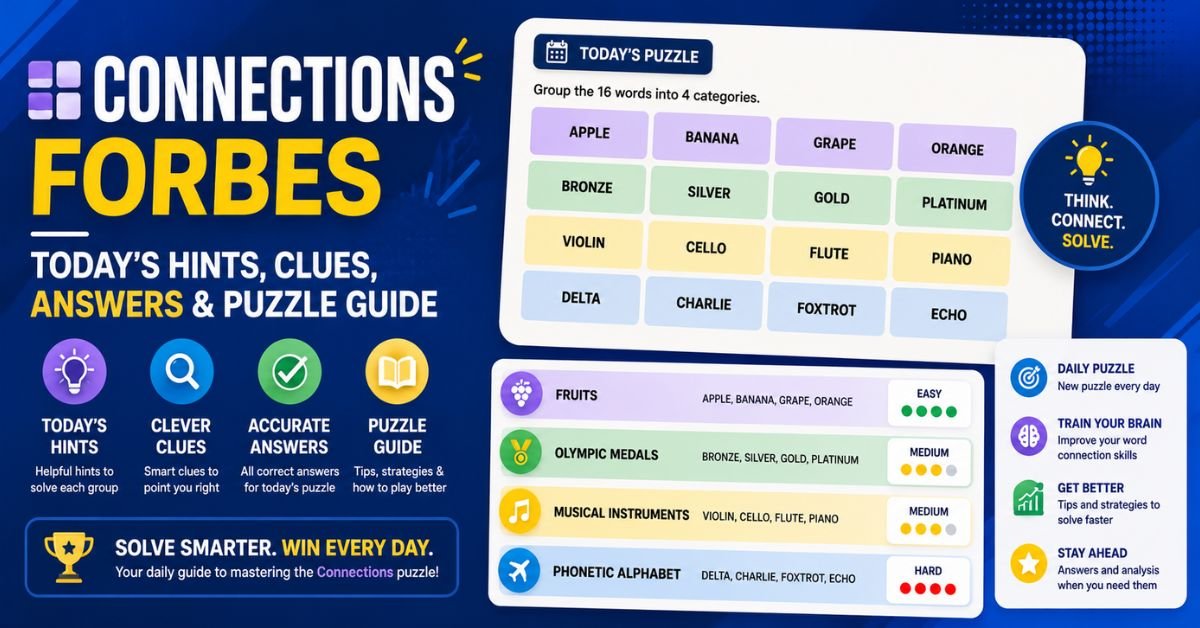
Connections Forbes: Today’s Hints, Clues, Answers & NYT Puzzle Guide
You spot four words that clearly belong together. You tap them. The game says no. Every Connections game fan knows that sting. The Connections word puzzle looks easy at first glance. Then a sneaky word ruins your plan.
This Forbes puzzle guide helps you fix that. You will learn how Connections Forbes pages work. You will see how NYT Connections hints differ from full answers. You will also pick up Connections puzzle strategy tips that make today’s Connections puzzle feel lighter. Take what you need and leave the rest.
What Is Connections Forbes?
Connections Forbes is a search phrase. Players type it when they want Forbes help with the New York Times (NYT) daily word puzzle. Many also search Connections Forbes Today, Connections Hint Forbes, or Forbes Connections Hints. They want a nudge, a clue, or a full solution. The phrase points to a style of help more than a single page.
It is not a separate game. It is a Forbes Connections daily guide built around the NYT Daily Puzzle. Most guides work in layers. First you get a light Connections game hint. Next come Connections category hints. Then you may see one sample word per group. The last layer holds the complete puzzle solutions and puzzle explanations. You can stop at any layer. That choice makes spoiler-free assistance possible. You can read the guide on Forbes or on other puzzle sites.
What Is the NYT Connections Puzzle?
The NYT Connections puzzle is a daily word puzzle from The New York Times. You see a 16-word grid. Your job is to find four related words again and again. That gives you four word groups, or four groups of four. Each group shares a link. The link may be a word meaning, a phrase, a name, or a joke hiding in plain sight. Good players think about category relationships, not just single words.
You can play it free at the official NYT Connections page. A fresh puzzle arrives each day. Forbes notes that each game goes live at midnight local time. That means players around the world get a new board at different moments. The game is a favorite Word Association Game among Daily Word Games fans. Its charm lies in lateral thinking. You must look at a word from several sides.
How Does the Connections Game Work?
You pick four words and press submit. If you are right, the group locks in and shows its color. If you are wrong, you lose one try. The game allows only four incorrect guesses. These are your limited mistakes. A “one away” note appears when three of your four words fit together. You can also shuffle the board to refresh your eyes. Shuffling often reveals a link you missed. Use these tools wisely, because careful word elimination beats wild guessing every time.
Four Word Groups and Their Color Categories
Each group wears a color. The yellow category is usually the easiest. The green category comes next. The blue category is harder. The purple category is the trickiest. This order shows puzzle difficulty at a glance. Think of it as understanding Connections color groups in a simple way. The table below shows the idea.
| Color | Usual Difficulty | Typical Link |
| Yellow category | Easiest | Plain meanings or common themes |
| Green category | Fairly easy | Themes with a small twist |
| Blue category | Harder | Trivia, phrases, or names |
| Purple category | Hardest | Wordplay or hidden patterns |
How Connections Forbes Daily Hints Work
A good Connections hints and full answers page works like a ladder. You climb one step at a time. The first step gives a soft push. The next step names the category clues. The top step shows the daily puzzle answers. You choose where to stop. That is the heart of Forbes Connections hints. It lets you stay in charge of your own fun.
Why does this matter? A page that shows every answer at the top ruins the game. A layered page protects your thinking time. You can solve three groups alone and peek at one clue for the last. Pages like the TechRadar daily guide use the same layered style. That guide opens with a spoiler warning and then lists the day’s words before it gives any hints. That order helps you avoid Connections Daily Answers by accident.
General Hints Without Spoilers
The softest hints name no words at all. A line such as “think about things you can fold” gives a direction. It does not give a group. These Spoiler-Free Connections Hints suit players who want a tiny push. They let you use logical reasoning and word associations on your own. Try one general hint, close the page, and return to the grid. Often that one nudge is plenty.
Category Clues and Word Group Names
Connections Category Hints go one step deeper. A clue might say “baseball teams” or “sound-alikes.” That narrows the field fast. A group name is different. The name states the exact link in a few words. Clues point toward the link, while the name states it. Use Connections Puzzle Clues first. Save the Word Group Connections names for later. This habit keeps the Connections puzzle explanation fresh until you truly need it.
Complete Answers and Word Group Explanations
The full answer list shows all four groups. A strong guide adds a short Connections category explanation for each one. That part matters most. It shows why the words fit and why the decoys do not. You learn the setter’s thinking. Over time you start to predict it. NYT Connections answers without reasons help you once. Connections puzzle solutions with reasons help you for months.
See Also: Tech Almawadahit.com: Complete Guide, Features, Content & Platform Review (2026)
Daily Puzzle Difficulty Overview
Some guides rate the day’s puzzle difficulty. A quick rating helps you plan. An easy day may need no hints at all. A hard day may deserve a clue early. This rating also guards your streak. You can decide whether to push on or peek. Treat the rating as a rough guide. It reflects one writer’s view, and your own experience may differ.
Why Do People Search for Connections Forbes Today?

Players search for many reasons. Some are stuck on one group. Some want to protect a long streak. Others are simply curious about the answer. Many like a steady source they trust. A familiar page feels like a friendly neighbor. You know where it lives and how it talks. That comfort is why Connections Forbes Today stays a popular phrase.
Timing plays a part too. Searches rise right after the puzzle resets. They rise again around lunch and after work. The audience is truly worldwide. Because each puzzle launches at midnight local time, a player in Lahore may start well before a player in Los Angeles. That gap can spoil things. A friend in an earlier time zone may post an answer while you sleep. Smart players keep that risk in mind.
How to Use Connections Forbes Hints Without Spoiling the Puzzle
Think of hints as training wheels. They help you balance. They are not meant to ride the bike for you. Good puzzle-solving techniques grow when you try first and read second. This is the best way for how to use Connections hints wisely. It also keeps the Daily Connections Puzzle fun for the long run.
The method has four easy steps. You begin with the lightest clue. Then you open one group at a time. After that you check full answers only if needed. Finally you study the logic. Follow this path and you will learn how to solve NYT Connections with less stress. You can also solve Connections without spoilers most days.
Start With General Clues
Play for a few minutes before you read anything. Look for obvious links and rough guesses. Then open the lightest hint and nothing more. A small push can break a mental jam. If it does not, wait a little. Walk around or drink some water. Your brain keeps working in the background. A fresh look often shows a hidden connection that was invisible a minute ago.
Reveal One Category at a Time
Open one category clue and solve that group. Then close the page again. This keeps the rest of the board mysterious. It also builds your pattern recognition. Each solved group removes four words. The grid shrinks from sixteen to twelve. Twelve words are far easier to read than sixteen. That drop is why this step works so well.
Check the Full Answers Only When Needed
Use the full list as a last resort. You might also use it after the game to review. Some days a group is simply too odd. That is fine. Read the answer and then ask how you could have spotted it. The goal is to learn from incorrect puzzle guesses, not to feel bad about them. Seen this way, an answer page becomes a quick lesson.
Understand the Logic Behind Each Group
After every solve, ask one question. Why did this work? Maybe the words all follow the same word. Maybe they hide a smaller word inside. Write the pattern in your head. Over weeks you will identify common word patterns quickly. This is how you improve Connections puzzle skills. It also builds critical thinking that helps in daily life.
Understanding the Four NYT Connections Difficulty Levels
The colors show the setter’s planned order of puzzle difficulty. The correct order is yellow, green, blue, then purple. Easy groups come first in the setter’s mind. Hard ones come last. Knowing this helps you plan. You can start with the group that feels safest and move up. That is a simple way to handle easy and difficult Connections categories.
Still, the colors are not strict laws. A yellow group can hide a clever trap. A purple group can feel simple once you spot the trick. Treat the colors as a map, not a promise. The table gives a quick view.
| Color | Difficulty | Common Clue Style | Quick Tip |
| Yellow | Very easy | Plain word meanings | Start here |
| Green | Easy to medium | Themes and simple phrases | Test five-word overlaps |
| Blue | Medium to hard | Trivia and proper nouns | Check capital letters |
| Purple | Hard | Wordplay and twists | Say words out loud |
Yellow – The Easiest Category
The yellow category uses clear, everyday links. You might see types of fruit or ways to walk. The words match in a direct way. Most players solve it first. Even so, stay alert. A yellow set can include a word that also fits a harder group. Count your candidates before you submit. If you find five words, one belongs elsewhere.
Green – Moderately Easy Connections
The green category adds a small twist. The link may be a phrase or a theme with a slight bend. You may need to say the words together to hear the link. It is still friendly. Many players solve green second. Use it to shrink the board. Solving green often makes the blue and purple groups easier to see.
See Also: Uploadblog.com: Complete Guide, Features, Benefits, and Platform Review (2026)
Blue – More Challenging Word Relationships
The blue category asks for a second look. It often uses trivia, phrase endings, or cultural references. This is where red herrings thrive. A word may seem to belong to a bright yellow theme but truly belongs here. Test each word’s multiple word meanings. If a word fits two groups, hold it back. Solve the clearer groups first and let blue come to you.
Purple – The Most Difficult and Creative Category
The purple category is the playground of wordplay. You may find hidden words, missing letters, or words that all take the same prefix. Sometimes the link is a joke. Saying the words aloud helps. So does adding a word in front or behind each one. This group rewards lateral thinking. It is often the last group left, and the leftover four words usually fit it by default.
Common Types of NYT Connections Categories
Setters build groups from a handful of tools. Knowing them saves time. Synonyms form the simplest type. Fill-in-the-blank phrases form another. Some groups hold words that all follow or precede one key word. Others use homophones or hidden words. Proper nouns such as brands, places, and people appear often. Pop culture, slang, and short forms also show up. Learning these types is part of how Connections categories work.
Here is a short table with made-up examples. Each one is original and shows the idea clearly.
| Category Type | Made-Up Example |
| Synonyms | HAPPY, GLAD, CHEERFUL, JOYFUL |
| Fill-in-the-blank | BOARD: SKATE, CHALK, DASH, KEY |
| Homophones | KNOW, NO, KNEW, NEW |
| Proper nouns | Names of rivers or car brands |
| Things you can fold | LAUNDRY, MAP, PAPER, CHAIR |
A real case shows how this works. In game #1072, one group was homophones: PAIR, PARE, PEAR, and PÈRE. Other words on that board, such as TWIN, could tempt you toward a “two of something” idea. That is a classic misleading word combination. The lesson is simple. Always ask whether a theme is about meaning or about sound.
Proven Strategies to Solve NYT Connections Faster
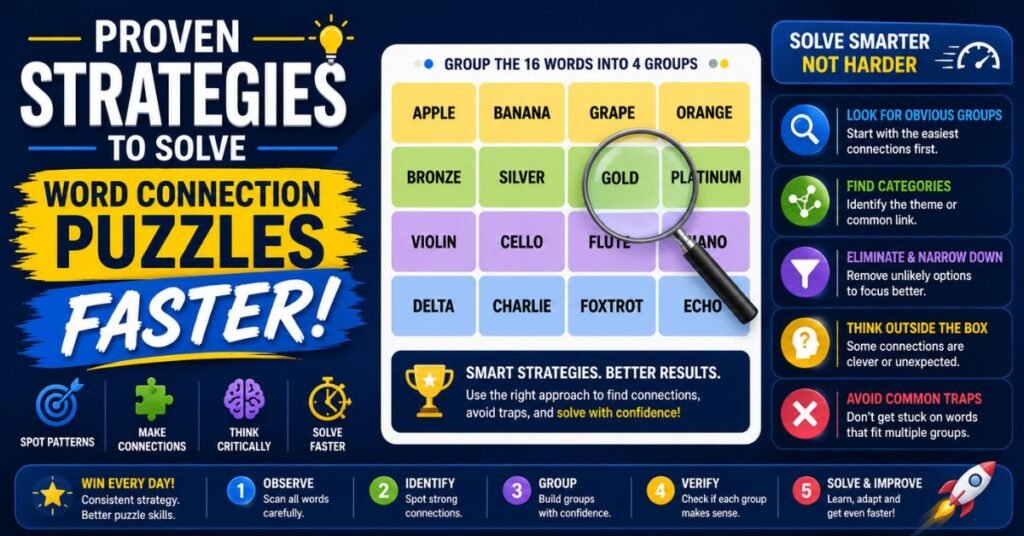
Picture a messy drawer. You do not fix it by moving every item at once. You pull out the obvious things first. Pens go together. Keys go together. What remains gets easier to sort. Solving this Connections word puzzle works the same way. These strategies for solving word puzzles train your pattern recognition step by step.
Six moves cover most boards. Find the clearest four. Check second meanings. Hunt for wordplay. Beware decoys. Clear solved words. Leave odd words for last. Together they form a full Connections puzzle strategy. Use them daily and they become habits. These Connections puzzle-solving tips also apply to other Daily Word Games.
Identify the Most Obvious Four Words
Scan the grid and spot the tightest link. Then count. Do exactly four words fit, or do five? If five fit, you have found a decoy. Do not submit yet. Look for the word that has a better home in another group. This tiny pause saves many lives in the game. It is the heart of word elimination.
Look for Multiple Word Meanings
Short common words are the sneakiest. A word like SPRING can mean a season, a coil, or a jump. Test each word with at least two meanings. This habit helps with understanding alternative word meanings. It also exposes hidden connections that a first glance misses. When a word seems out of place, change its meaning and try again.
See Also: Bvostfus Python: What It Is, Features, Installation, Safety & Alternatives (2026)
Recognize Wordplay and Hidden Connections
Say the words aloud. Add a prefix or suffix. Look for smaller words tucked inside bigger ones. Check whether they sound like other words. These steps help you identify hidden word relationships. They matter most in purple groups. Many phrase combinations only click when you hear them. Your ears often catch what your eyes miss.
Watch Out for Red Herrings
Red herrings are words that look right but are wrong. The setter places them on purpose. When five words fit one theme, one is a trap. Ask where the extra word could live instead. This is the core skill behind recognizing misleading word combinations. Think of it as detective work. The obvious suspect is rarely the culprit.
Eliminate Incorrect Word Combinations
Every solved group clears the table. Sixteen words become twelve. Twelve become eight. The last eight are far simpler. Try listing which words cannot go together. Cross those out in your mind. This turns a messy grid into a clean puzzle. Word elimination is quiet but powerful.
Save Unusual Words for the Final Groups
Odd words often belong to blue or purple. Names, slang, and strange spellings are common clues. Do not fight them early. Solve the plain groups first. Then the odd words stand alone and their link becomes clear. This patient order is a mark of a skilled solver.
Common Mistakes to Avoid When Playing Connections
Most lost games come from habits. Few come from weak vocabulary. Players guess too fast. They trust the first meaning. They skip names. They rush. Each habit costs a try, and you only have four. Learning to avoid mistakes in NYT Connections is as useful as learning new words.
Tie each habit to your four limited mistakes. That small budget makes every guess count. A calm player will often win with zero errors. A hasty player may run out of tries by the third group. Fix the habits below and your streak will thank you.
Guessing Before Finding Strong Connections
A “close enough” guess feels bold. It usually costs a try. Wait until you can state the link in a simple sentence. If you cannot, you are not ready. Use the shuffle button and look again. Strong links feel clear, while weak links feel foggy. Trust that difference.
Ignoring Alternate Word Meanings
The first meaning that pops up is often the trap. Players see one sense and stop. The setter counts on this. Always ask what else the word could mean. This single question stops many errors. It also helps you learn from incorrect puzzle guesses because you see exactly where your thinking went narrow.
Overlooking Proper Nouns and Wordplay
A capital letter, an accent mark, or an odd spelling is a clue. Names of people, places, and brands hide in plain sight. So do puns. Scan the board for words that look “dressed up.” These often point to a blue or purple group. Spotting them early gives you a big edge.
Rushing Through Possible Categories
Speed feels exciting. Yet this puzzle rewards patience. Take a break if you feel stuck. Come back after a minute. Your mind may reset and show a new link. Slow play wins more games than fast play. There is no prize for a quick loss.
Benefits of Playing NYT Connections Every Day
A daily puzzle is a small, happy routine. It takes only minutes. You can play it with coffee or on a bus. Friends often share results in group chats. That adds a social spark. Playing the NYT Daily Puzzle can also give you a little pride each morning.
Keep expectations realistic. This game is for fun. It is not a medical tool. Still, many players enjoy how it exercises the mind. You practice reading closely and thinking flexibly. You can also develop vocabulary through word games without feeling like you are studying.
Vocabulary Development
Each puzzle exposes you to new words and fresh meanings. You meet idioms and slang. You learn that one word wears many hats. This steady exposure supports vocabulary development. The learning is gentle and sticky because it comes with a story. You remember the day you finally cracked a tricky group.
Critical Thinking and Pattern Recognition
You weigh options all the time. Does this word fit here or there? You test a theory and then adjust. That loop builds critical thinking and pattern recognition. Over time you see links faster. The habit can improve critical thinking skills in simple, everyday ways. You may notice it when you read, plan, or solve other problems.
Memory and Problem-Solving Skills
To solve the grid you hold several ideas at once. You remember which words you ruled out. You keep track of possible groups. This is a light workout for working memory. It also trains steady problem-solving habits. Better still, it feels like play. Enjoyable practice is practice you will actually repeat.
Where to Find Reliable Daily Connections Hints and Answers
Start with the official game at NYT Connections. It is the home of the puzzle. For help, try the Forbes hint pages and other well-known sites, such as TechRadar. Many gaming and news sites publish Daily Connections Puzzle guides. Choose ones that show clear layers. Be careful with random sites that copy titles. Some pages use famous names just to attract clicks.
Use a short checklist to judge any page. Does it show the right date and puzzle number? Does it offer layers from hints to answers? Does it explain why each group works? Is the page clean and easy to read? A page that passes these tests will serve you well. A page that fails them is not worth your time.
How to Avoid Spoilers When Searching for Connections Hints
Searching can spoil the game in one glance. Add the words “hint only” to your search. Skip headlines that say “answers.” Scroll slowly and cover the screen if needed. Close the tab as soon as you have your nudge. A little care keeps Today’s Connections Puzzle fresh. It also keeps your Forbes Connections daily guide useful instead of harmful.
Social media can leak answers too. Mute puzzle words on your feeds. Ask friends in group chats to use spoiler tags. Remember time zones as well. Because each puzzle goes live at midnight local time, a friend ahead of you may share results early. Mute their posts for a few hours. These simple tricks keep your Solve Connections without spoilers goal alive.
Frequently Asked Questions
What Does Connections Forbes Mean?
It is a search phrase. People use it to find Forbes hint and answer guides for the NYT Connections game. It is not a separate game or a special product. It simply points to a style of Forbes Connections Hints that offers layered help.
Does Forbes Create the NYT Connections Puzzle?
No. The New York Times makes the puzzle. Forbes writes guides about it. The puzzle’s editor is Wyna Liu at the Times. Guide writers only explain and help.
Are Connections Forbes Hints Spoiler-Free?
The early sections usually are. They give general nudges and category clues. Later sections reveal the complete puzzle solutions. Stop scrolling when you feel ready. That is how you stay in control of spoiler-free assistance.
What Do the Yellow, Green, Blue, and Purple Colors Mean?
They show rising difficulty. Yellow is easiest. Green is next. Blue is harder. Purple is the hardest. The order is a guide rather than a strict rule.
Where Can I Play the NYT Connections Game?
You can play on the NYT Games website and in the NYT Games app. Start at the official Connections page. A new puzzle appears each day.
Can I Play Previous Connections Puzzles?
Yes. An archive exists. Access may depend on an NYT Games subscription, so check the official site for current rules. The archive is great for practice.
Should Beginners Use Connections Hints?
Yes. Hints are a fine teacher. Start with the lightest one. Move up only when needed. Over time you will need fewer.
Final Thoughts
Hints are a ladder and not a shortcut. Use Connections Forbes pages to climb one rung at a time. Try the puzzle first. Read a general clue. Open one category and solve it. Check the full answer only when you must. Then study the logic. That path builds puzzle-solving techniques that last.
So here is your challenge. Play one puzzle this week with no hints at all. Notice how your Connections Puzzle Strategy has grown. Then share your streak with a friend. Come back to this guide any day you need a gentle nudge. Happy puzzling!