RobTheCoins Blockchain: What It Is, Features, Claims, and How to Verify It
Search for the RobTheCoins blockchain and you’ll get five different answers. One page calls it a custom network. Another calls it a trading tool. A third treats it like a person. So what’s the truth?
This guide sorts fact from claim. You’ll learn what the Robthecoins platform publishes, how blockchain technology really works, and which statements lack proof. You’ll also get a simple checklist to test any blockchain network yourself. Think of it as a beginner-friendly blockchain guide with a built-in lie detector.
What Is RobTheCoins Blockchain?
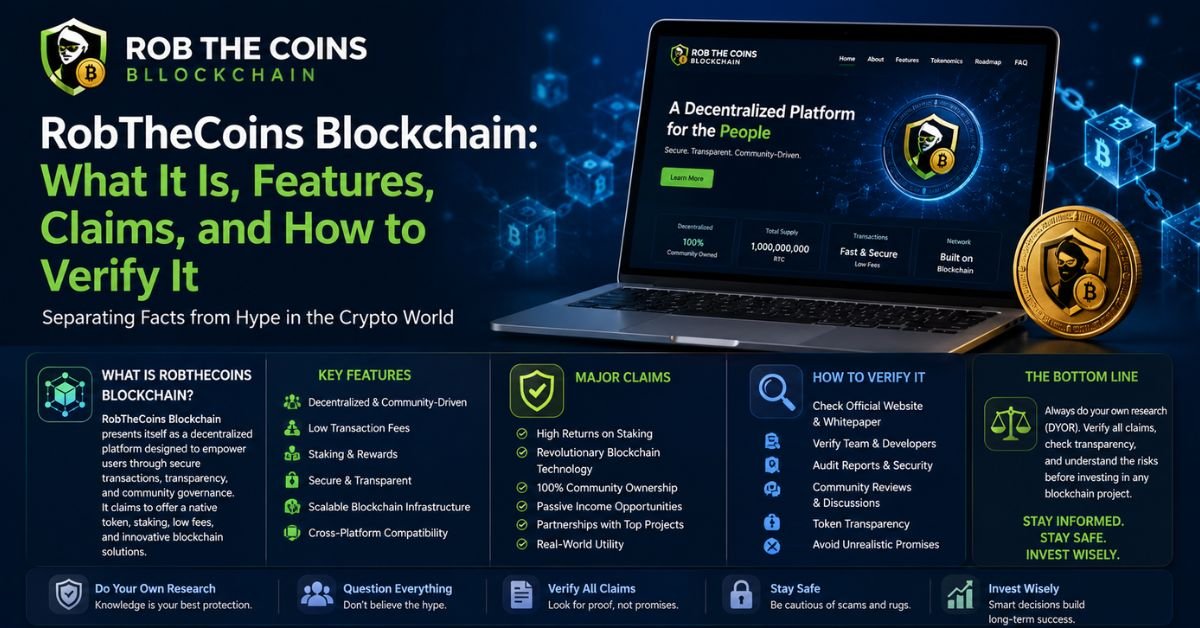
Most sources describe RobTheCoins as an educational platform that helps beginners understand cryptocurrency, blockchain technology, and investing. That makes Robthecoins blockchain content a library of articles. It works as a blockchain learning platform for newcomers. Topics include cryptocurrency basics, digital assets, and blockchain for beginners. In short, this is blockchain education content, not a ledger of its own.
So why does the phrase “RobTheCoins blockchain” cause confusion? Picture a library full of train books. The library teaches you about trains, but it isn’t a train. The same logic applies here. The Robthecoins platform explains distributed ledger technology, yet that doesn’t prove it runs one. If you ask, “What is Robthecoins blockchain?”, the safest answer is simple. It’s educational material about blockchain fundamentals, with unproven claims of a separate network layered on top by third parties.
Is RobTheCoins Blockchain a Real Blockchain Network?
Here’s the direct answer. No public evidence confirms an independent network. A due-diligence review found that public sources lack the technical anchors needed to confirm core network claims. The same review adds a fair point. This does not prove the network doesn’t exist. Missing proof is a warning sign. It isn’t a verdict.
A real blockchain network leaves footprints. It has a public block explorer where anyone can view blocks and wallets. It has open code that developers can inspect. It also has technical documentation that explains how the system runs. Searches run for this guide found none of these tied to RobTheCoins. Pages change over time, so check the official site yourself. The sections below show exactly how.
Why Different Websites Describe RobTheCoins Differently
Many sites repeat each other without checking facts. That’s why the descriptions clash. One page says the project uses a custom blockchain built for security and scalability. Another calls it an AI-driven crypto trading platform. A third claims it refers to mining strategies for extracting coins. Some even describe a single crypto influencer. These stories can’t all be true. When sources disagree this much, treat the loudest claim as unconfirmed. Good blockchain information is consistent, sourced, and easy to trace back to an official page.
What RobTheCoins Actually Publishes About Blockchain
The most reliable description is also the plainest. RobTheCoins publishes articles. Typical topics include blockchain fundamentals, decentralized finance (DeFi), NFTs, business uses, and investing tips. This makes it one of many blockchain learning resources for beginners. Readers get blockchain terminology explained in everyday words. That’s useful. However, articles about a technology don’t prove ownership of one. Always separate what a site teaches from what it claims to run.
See Also: RobTheCoins: What It Is, How It Works, Features, and Business Model
Blockchain Content vs. an Actual Blockchain Product
Content teaches. A product operates. This table shows the gap clearly.
| Feature | Blockchain content | Blockchain product |
| Main output | Articles and guides | Blocks and digital transactions |
| Proof you can check | Author, sources, dates | Block explorer and open code |
| Key documents | Blog posts | Blockchain whitepapers and docs |
| Risk to readers | Misleading advice | Lost funds and crypto-related risks |
| Example | A beginner guide | Bitcoin |
Use this table whenever a site blurs the line. If a page asks for money, it must show product-level proof.
How Blockchain Technology Works
Imagine a shared notebook that thousands of people hold at once. Every page is copied to everyone. If one person tries to change a page, the others spot it fast. That’s blockchain explained in simple terms. A distributed ledger records data across many computers instead of one central server. The result is decentralization, where no single party controls the record.
Now let’s see how blockchain technology works in practice. When you send a payment, the request spreads across the blockchain network. Computers check it against the rules. Approved transfers go into a block, and the block joins the chain. This process supports digital record-keeping that’s hard to alter. Satoshi Nakamoto described the goal in the 2008 Bitcoin whitepaper as “a purely peer-to-peer version of electronic cash.”
How Blockchain Transactions Are Verified
Verification happens in four quick steps. First, you sign a transaction with a private key. This uses cryptography to prove the request is yours. Second, the network receives it. Third, nodes run transaction validation by checking your balance and signature. Fourth, a validated block gets added to the chain. This is blockchain transaction verification in plain words. It explains how blockchain transactions are verified without a bank in the middle. Each step leaves a public trace, which boosts blockchain transparency.
Blocks, Hashes, Nodes, and Distributed Ledgers
A block is a container for recent transactions. A hash is its digital fingerprint. Change one tiny detail and the fingerprint changes completely. Each block stores the hash of the block before it, which links them like train cars. Nodes are computers that keep a copy of the chain. Together they form distributed ledger technology. If a hacker edits one copy, the other copies expose the lie. That’s why many experts call this decentralized technology hard to tamper with.
Consensus Mechanisms: Proof of Work and Proof of Stake
Thousands of computers must agree on one truth. Consensus mechanisms make that happen. Proof of Work (PoW) asks miners to solve hard puzzles. Proof of Stake (PoS) asks validators to lock up coins as a promise of honesty. Bitcoin uses PoW. Ethereum switched to PoS in 2022 to cut energy use sharply.
| Factor | Proof of Work (PoW) | Proof of Stake (PoS) |
| Who validates | Miners | Validators |
| Energy use | High | Low |
| Main cost | Hardware and power | Locked coins |
| Famous example | Bitcoin | Ethereum |
The Role of Smart Contracts
Think of a vending machine. You insert money and pick a snack. The machine delivers without a clerk. Smart contracts work the same way. They’re programs on a blockchain that run when set conditions are met. For example, a contract can release payment once a delivery is confirmed. They power decentralized finance (DeFi), NFTs, and many blockchain applications. Bugs can be costly, though. That’s why audits matter in blockchain development.
Key Features of Blockchain Technology
Why does blockchain technology matter? Because it combines several strong features at once. Each one is useful alone. Together they build trust between strangers. That’s a big deal for digital financial systems, where trust usually needs a middleman.
Keep one point in mind. These are features of blockchain in general. They don’t automatically apply to every project that uses the word. Understanding cryptocurrency and blockchain means asking which features a given project truly delivers. The four features below show what to look for.
Decentralization and Transparency
In a decentralized system, many participants share control. No single company can freeze or rewrite the record. On public chains, anyone can view transactions. This openness improves blockchain transparency and helps people understand decentralized systems. For example, you can look up any Bitcoin transaction on a public explorer in seconds. Privacy still exists because wallets show codes, not names.
Cryptographic Security and Immutability
Blockchain security rests on cryptography. Digital signatures prove who approved a transfer. Hashes lock each block to the one before it. Once data is confirmed by many nodes, changing it becomes extremely costly. People call this immutability. Strong data security like this protects digital assets. Still, hackers often target wallets, exchanges, and weak code instead of the chain itself.
Distributed Data Storage
Traditional systems keep records in one place. If that place fails, the data may vanish. Blockchains store copies across many machines. This design removes a single point of failure. It also supports durable digital record-keeping for contracts, ownership, and payments. The trade-off is size. Every node must store the data, which raises costs as the chain grows.
See Also: JournalWord.com What It Is, Content, Features, Safety, and SEO Analysis
Consensus and Network Validation
Agreement is the engine of every chain. Nodes follow shared rules and reject invalid blocks. This keeps the blockchain infrastructure honest even when some participants cheat. Strong validation also guards against double spending, where someone tries to use the same coin twice. Different chains pick different methods, so always check which consensus mechanisms a project uses.
Key Blockchain Topics Covered by RobTheCoins
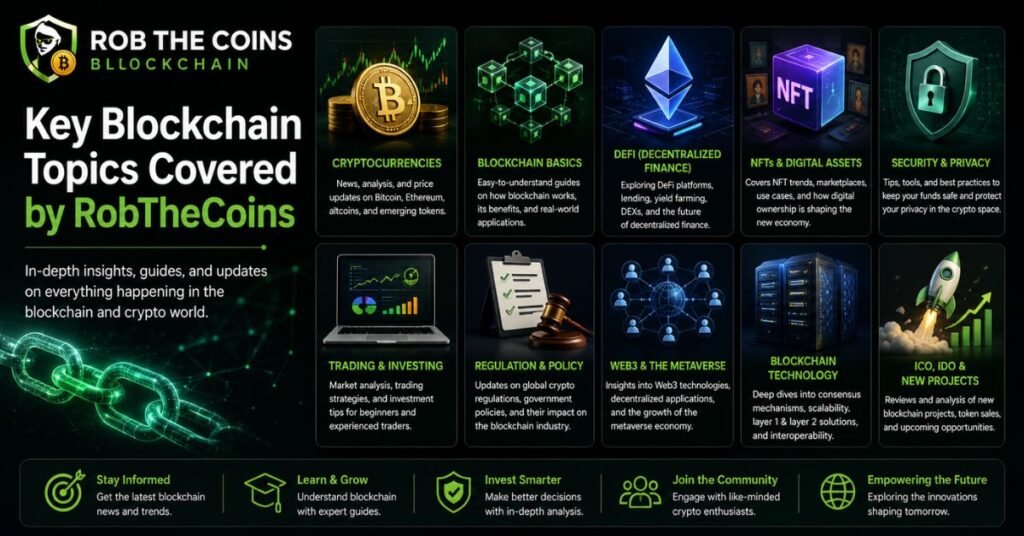
The Robthecoins platform covers a wide range of topics. Most target newcomers who want blockchain education for beginners. Articles lean toward blockchain concepts without technical knowledge. That suits readers who find developer docs too heavy. It also matches the Robthecoins blockchain learning guide style, where ideas build step by step.
Depth is the limit. This is blockchain education content, so it won’t teach you to code a chain. Treat it as a map, not a toolbox. You’ll learn the landscape first. Then you can move on to blockchain development resources when you’re ready.
Blockchain Fundamentals and Cryptocurrency
Start here if everything feels new. Core lessons explain what a ledger is, why coins exist, and how wallets work. This is the heart of cryptocurrency education. You’ll meet Bitcoin, altcoins, and stablecoins. Clear cryptocurrency basics also teach you how crypto market trends swing prices. A solid base helps you avoid hype later.
Decentralized Finance (DeFi)
Decentralized finance (DeFi) rebuilds banking tools on blockchains. Users can lend, borrow, and swap coins through smart contracts. No bank approves the deal. Returns can look attractive. Yet risks include hacks, bugs, and sudden price drops. Good digital finance education explains both sides before you click “connect wallet.”
NFTs and Smart Contracts
NFTs are unique digital tokens that prove ownership of an item. That item could be art, music, or a game asset. A smart contract records who owns what. This makes NFTs a clear example of blockchain use cases beyond payments. Prices can swing wildly, so learn the basics before buying anything.
Blockchain Applications Beyond Cryptocurrency
Many people link blockchain only to coins. That’s too narrow. Businesses test it for tracking goods, storing records, and proving identity. These blockchain applications show practical uses of blockchain technology outside trading. They also point to emerging blockchain technologies that may shape daily life.
Crypto Investing, Taxation, and Security
Money topics need extra care. Cryptocurrency trading can bring gains and heavy losses. Tax rules differ by country, so check local law or ask a licensed adviser. Security habits matter too. Use strong passwords, enable two-factor login, and never share seed phrases. Building crypto awareness protects you more than any prediction ever will.
Real-World Applications of Blockchain Technology
Does blockchain leave the lab? Yes. Companies and governments run pilots across many fields. Some projects work well. Others fade. Looking at real-world blockchain applications helps you judge which claims are grounded.
Here’s a quick view of blockchain technology in everyday life. You may not notice it, but it can touch your payments, groceries, and records. The table below sums up the main blockchain use cases.
| Sector | Main use | Core benefit |
| Banking | Cross-border payments | Speed and lower fees |
| Supply chain | Product tracking | Trust and traceability |
| Healthcare | Record sharing | Data security |
| Real estate | Title records | Fewer disputes |
| Government | Registries and voting trials | Blockchain transparency |
Banking and Financial Services
Banks move money through slow, layered systems. International transfers can take days. Blockchain rails can cut that to minutes. Stablecoins and digital transactions already help workers send money home. Banks also explore tokenized assets and faster settlement. However, strict rules still shape what’s allowed. Progress depends on law as much as technology.
Supply Chain Management
Supply chain management is a favorite case for blockchain. Here’s a well-known example. Walmart tested a food-tracing system with IBM. Tracing a package of mangoes back to its farm dropped from about seven days to a couple of seconds. Faster tracing helps remove unsafe food quickly. Shared records also reduce arguments between suppliers, shippers, and stores.
Healthcare and Digital Identity
Medical files sit in many separate systems. That slows care and raises privacy risks. Blockchain can log who accessed a record and when. It can also support digital identity verification, so people prove who they are without sharing every detail. Estonia, for instance, uses blockchain-based tools to secure parts of its national records. Strict privacy laws still apply, so sensitive data usually stays off the chain.
Real Estate and Smart Contracts
Buying property involves piles of paper and many middlemen. Blockchain land registries aim to simplify this. A digital title shows who owns a plot. Smart contracts can release funds once conditions are met. Several governments have run pilots, including Sweden’s land authority. Legal recognition remains the big hurdle in most places.
Government and Voting Systems
Governments use blockchain for registries, licenses, and public records. Voting is more sensitive. Supporters like the audit trail. Critics warn about privacy, hacking, and voter access. Most experts urge caution. Trials are growing, yet full national blockchain voting is still rare. This shows why blockchain trends need honest scrutiny.
See Also: AnalyzingMarket.com: Business, Finance, Technology, and Market News
Benefits and Limitations of Blockchain Technology
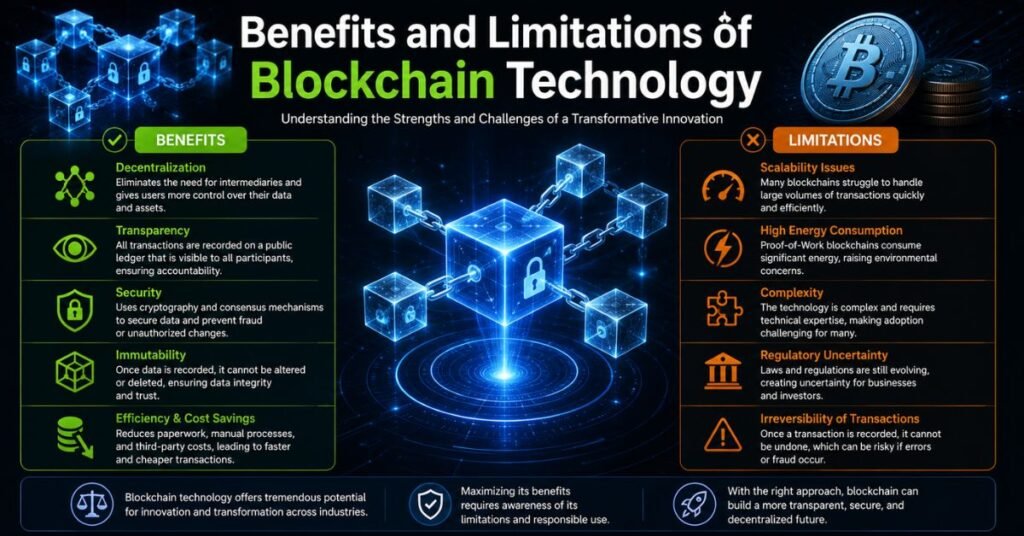
Every tool has strengths and weaknesses. Blockchain is no exception. Knowing the advantages and disadvantages of blockchain keeps you from falling for hype. It also helps you spot weak claims in any blockchain information you read.
The table gives a fast overview. Read it before you trust any bold promise.
| Benefit | Limitation |
| Strong data security | Wallet theft and scams |
| Clear audit trail | Public data raises privacy worries |
| Fewer middlemen | Complex laws across countries |
| Global access | Slow speeds on some networks |
| Shared records | High energy use on some chains |
Improved Security and Data Integrity
Altering confirmed blocks is extremely hard. Each block links to the last through hashes. Many nodes hold copies, so cheating gets noticed. This protects data integrity for contracts, payments, and records. Still, blockchain security has gaps. Weak passwords, fake sites, and flawed code cause most losses. The chain may be strong while the user is the weak link.
Greater Transparency and Reduced Fraud
How blockchain improves data transparency is easy to see on public chains. Anyone can trace a transfer from wallet to wallet. That makes hidden changes harder. Auditors and regulators can follow the trail too. Fraud doesn’t vanish, though. Scammers simply move to fake projects and fake promises. Transparency only helps when people actually check the data.
Faster Transactions and Lower Costs
Removing middlemen can cut fees and waiting time. Cross-border payments show the biggest gains. Yet speed depends on the network. Bitcoin handles only a handful of transactions per second. Newer chains and layer-two tools move far faster. Always compare fees and confirmation times before choosing a network.
Scalability and Energy Consumption Challenges
Blockchain scalability means handling more users without slowing down. Many chains struggle with this. Busy periods raise fees and delay payments. Energy is another concern. Proof of Work (PoW) chains use large amounts of power. Proof of Stake (PoS) cuts that sharply. Developers keep testing fixes, which makes scalability a key area of blockchain innovation.
Regulatory and Integration Issues
Laws on crypto differ across the world. Some countries welcome it. Others restrict or ban it. Companies also struggle to connect blockchain tools to old systems. Staff need training, and costs can climb. These hurdles slow adoption more than the technology does. Smart readers watch both the code and the rulebook.
RobTheCoins Blockchain: Claims vs. Verifiable Evidence
Here’s where careful reading pays off. Third-party pages make bold claims about a “RobTheCoins blockchain.” A claim is only a statement. Evidence is something you can check. This section lines them up side by side. It’s a lesson in blockchain learning resources analysis, and you can reuse it on any project.
The table below lists common claims and their status. “Not found” means searches for this guide turned up no primary source. It doesn’t mean the claim is false. Pages and projects change, so confirm on the official site.
| Claim | Where it appears | Evidence found | Status |
| Custom blockchain | Third-party blogs | No explorer or code found | Unverified |
| RTC token | Some articles | No official token page found | Unverified |
| AI market insights | Some descriptions | No public tests found | Unverified |
| Audit reports | Some descriptions | None found | Unverified |
| Education platform | Multiple pages | Matches site content | Best supported |
What Is the RTC Token Claim?
Some articles say RobTheCoins has an RTC token. That’s a blockchain whitepapers and technical documentation question, and none was found. Be careful here. The best-documented RTC belongs to a different project called RustChain, which lists its own live explorer and whitepaper. You can see its code on GitHub. Sharing a ticker proves nothing. Never buy a token because its symbol matches a name you’ve read about.
Does RobTheCoins Have a Public Block Explorer?
A block explorer is a search engine for a blockchain. Etherscan is a famous example for Ethereum. It lets you view blocks, wallets, and digital transactions in real time. Real networks almost always have one. Searches for this guide found no explorer linked to RobTheCoins. That gap matters. Without an explorer, nobody can independently confirm that the blockchain network exists or processes anything.
Is There a Verified Whitepaper or GitHub Repository?
Serious projects publish a whitepaper that explains goals, design, and token rules. They also host code on GitHub so developers can review it. Bitcoin and Ethereum both do this, with docs at ethereum.org. No whitepaper or repository tied to RobTheCoins surfaced in searches. If one exists, the owners can point to it clearly. Until then, treat network claims as unproven.
How to Check Blockchain Ownership and Development Activity
Start with the domain. Look up who registered it and when using a WHOIS tool. Next, open GitHub and check commit history, contributors, and last update dates. Active projects show steady work. Dead ones go quiet. Then check trackers like CoinGecko or DefiLlama to see whether a token or protocol is listed. Finally, search for audits from known security firms. Real blockchain development leaves a long, public paper trail.
RobTheCoins Blockchain vs. Established Blockchain Networks
How does the RobTheCoins blockchain compare with proven networks? The honest answer is that they sit in different categories. Bitcoin and Ethereum are live blockchain infrastructure. RobTheCoins is mainly blockchain education content. Comparing them is like comparing a cooking blog to a restaurant.
The table shows what a verified network offers. It also shows what remains unconfirmed for RobTheCoins. Use it as a template for any blockchain learning resources comparison you run in the future.
| Check | Bitcoin | Ethereum | RobTheCoins |
| Public block explorer | Yes | Yes | Not found |
| Open source code | Yes | Yes | Not found |
| Whitepaper or docs | Yes | Yes | Not found |
| Consensus method | Proof of Work (PoW) | Proof of Stake (PoS) | Not stated |
| Main role | Digital money | Smart contracts platform | Education platform |
Is RobTheCoins Blockchain Content Reliable?
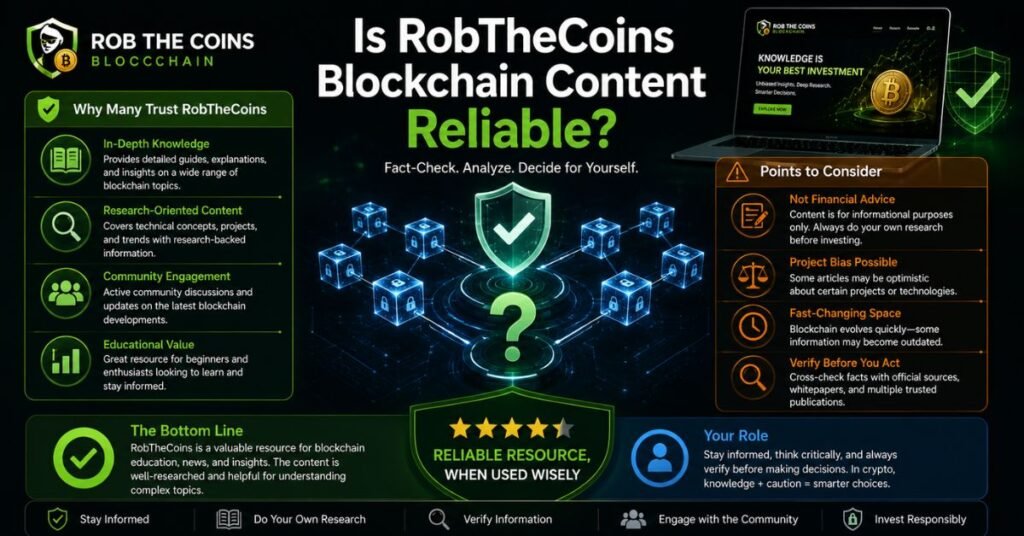
Is Robthecoins blockchain reliable? Judge the content and the network claims separately. As a beginner-friendly blockchain guide, the articles can help you learn blockchain terminology. As proof of a working network, they fall short. Education content is a starting point. It isn’t a source of financial truth.
Smart readers cross-check. Compare any technical point with primary sources such as the Bitcoin whitepaper or Ethereum’s developer docs. This habit builds crypto awareness and protects your money. One community saying sums it up: “Don’t trust, verify.”
Signs of Trustworthy Blockchain Information
Good sources share a few habits. They name their authors and show dates. They link to primary documents. They explain risks as clearly as benefits. They also separate blockchain technology from price speculation. Finally, they update old posts when facts change. If a site does all of this, you can lean on it for blockchain education with more confidence.
Potential Red Flags to Watch For
Some warning signs show up again and again. Promises of guaranteed returns come first. Anonymous teams come next, especially when they ask for deposits. Vague claims about “advanced technology” with no technical documentation also raise alarms. Pressure to buy fast is another trap. Many crypto-related risks begin with a page that sounds exciting but proves nothing.
Reading Blockchain Articles vs. Trusting Investment Claims
Reading is safe. Investing is not. An article can teach you how consensus works without risking a cent. A claim that asks for money needs far stronger proof. Hold both to different standards. Learn freely from guides. Demand explorers, code, and audits before you move funds. This simple split protects most beginners from costly mistakes.
How to Verify a Blockchain Project Before Investing
Want a fast way to test any project? Use five checks. They take about thirty minutes. They can save you from losing everything. These steps are also the best answer to “how to understand decentralized systems,” because they teach you what real ones show.
See Also: Securly Pass: Complete Guide to Features, Benefits, Safety & How It Works (2026)
Here’s the checklist at a glance. Work through it in order.
| Step | What to check | Free tools |
| 1 | Official domain | WHOIS lookup, official social links |
| 2 | Block explorer | Etherscan, project explorer |
| 3 | Code and trackers | GitHub, CoinGecko, DefiLlama |
| 4 | Whitepaper and docs | Project website |
| 5 | Team and history | LinkedIn, news archives |
Step 1: Confirm the Official Domain
Fake sites copy real ones with tiny spelling changes. Always find the official link from a trusted source such as CoinGecko or the project’s verified social account. Check the domain age with a WHOIS tool. A brand-new site claiming years of history is suspicious. Bookmark the correct address once you confirm it. That one habit blocks many phishing traps.
Step 2: Check Its Block Explorer
Open the explorer and look for activity. You want real blocks, real wallets, and steady transaction validation. Check how many wallets hold the token. A handful of wallets owning most of the supply is a danger sign. If no explorer exists, ask why. Real blockchain transparency means anyone can look.
Step 3: Review GitHub and Blockchain Trackers
Visit the project’s GitHub page. Look at the number of contributors and the dates of recent updates. A busy repository suggests living blockchain development. Then search trackers for listings and market data. Missing from every tracker? That’s worth noting. Keep in mind that a listing alone doesn’t prove quality.
Step 4: Examine the Whitepaper and Technical Documentation
Read the whitepaper slowly. Does it explain the consensus mechanisms, token supply, and rules clearly? Or does it use buzzwords with no detail? Strong papers state limits and risks. Weak ones promise miracles. Compare the claims with real technical documentation. If you can’t follow it, that’s a signal too. Good projects explain themselves.
Step 5: Verify the Team and Project History
Search for the founders by name. Check their work history, talks, and past projects. Look for news coverage from reputable outlets. Review community forums for complaints. Anonymous teams aren’t always bad, since Bitcoin’s creator is anonymous. Yet anonymity plus a request for your money is a risky mix. Take your time here.
Mini case study: Imagine a new token promises 20% monthly returns. It has a slick site and no explorer. The team is anonymous, and no code exists online. Steps 2, 3, and 5 all fail within ten minutes. A quick check turns a tempting offer into an easy pass.
Who Should Read RobTheCoins Blockchain Content?
This content suits curious beginners best. If you want blockchain education for beginners, it offers a gentle start. It also fits readers who want beginner-friendly cryptocurrency education without heavy math. Small business owners can use it to explore blockchain use cases such as tracking and digital record-keeping.
Developers and serious traders may want more. Coding needs hands-on tutorials and official docs. Trading needs live data and risk tools. This table helps you pick among the best resources for learning blockchain.
| Resource type | Best for | Depth |
| Beginner platforms like RobTheCoins | Newcomers | Light |
| Official docs (ethereum.org) | Developers | Deep |
| Whitepapers | Technical readers | Very deep |
| Online courses | Structured how to learn blockchain technology paths | Medium |
The Future of Blockchain Technology
Where is the field going? Experts watch latest blockchain technology trends closely. Costs are falling and tools are improving. Meanwhile, rules are slowly taking shape. That combination points to steady growth. It also means more projects, good and bad, will compete for your attention.
Stay curious but skeptical. Real blockchain innovation arrives with proof, not promises. As emerging blockchain technologies spread, the verification skills in this guide will matter even more. Treat them as a long-term habit.
Growing Enterprise Blockchain Adoption
Large companies keep testing blockchain for logistics, finance, and records. Most prefer private or permissioned networks that they control. These systems focus on efficiency and audit trails instead of coins. Adoption is gradual. Many pilots end quietly, while a few scale. Watch for projects with clear savings and named partners.
Decentralized Finance and Digital Assets
Decentralized finance (DeFi) keeps evolving. Tokenized assets, such as bonds or property shares, are a growing theme. Regulators are paying close attention. Safer designs and better audits may widen access. Risks remain high, so start small. Smart learners study the digital assets they use before they commit funds.
Central Bank Digital Currencies
Central bank digital currencies, or CBDCs, are digital versions of national money. The Bahamas launched its Sand Dollar in 2020. Nigeria followed with the eNaira in 2021. Many other countries run pilots. CBDCs differ from Bitcoin because a central bank controls them. They show how digital financial systems may blend old and new ideas.
Scalability and Improved User Experience
Today’s wallets can feel clumsy. Fees and delays frustrate newcomers. Developers are building layer-two networks and simpler apps to fix this. Better design could bring blockchain into daily life without users noticing. Progress in blockchain scalability will decide how fast that happens.
Conclusion
Here’s the bottom line on the RobTheCoins blockchain. As an education source, it helps readers explore blockchain technology and cryptocurrency. As a standalone network, it lacks public proof. No explorer, whitepaper, or repository tied to it appeared in searches. That gap deserves caution.
So take action. Use guides to learn, then verify everything before you spend. Follow the five steps, check primary sources, and trust evidence over excitement. With good habits, blockchain for beginners becomes a skill you can build step by step.
Frequently Asked Questions
Is RobTheCoins blockchain a real blockchain network?
No public evidence confirms it as an independent network. A due-diligence review found public sources lack the technical anchors needed to confirm network claims. No explorer, whitepaper, or repository was found. Verify on the official site, since information can change.
What is the RTC token associated with RobTheCoins?
Some third-party articles mention an RTC token. No official source confirms it. The best-documented RTC belongs to RustChain, a separate project. A matching ticker doesn’t link two projects.
Does RobTheCoins offer blockchain education for beginners?
Yes. Most descriptions call it an educational platform that simplifies cryptocurrency and blockchain concepts for beginners. It works as a blockchain learning platform for first-time readers. Cross-check technical details with primary sources.
What blockchain topics does RobTheCoins cover?
Topics include blockchain fundamentals, cryptocurrency basics, decentralized finance (DeFi), NFTs, and smart contracts. It also covers business uses, investing, taxes, and security. Depth stays conceptual instead of developer-level.
How can I verify whether a blockchain project is legitimate?
Follow five steps. Confirm the official domain, check the block explorer, review GitHub and trackers, read the whitepaper, and research the team. If any step shows nothing, slow down. Real projects leave public proof.
Is it safe to invest in a blockchain project without a whitepaper?
It’s risky. A whitepaper explains the design, supply, and rules. Without one, you can’t judge what you’re buying. Missing documents are a major red flag. Never invest money you can’t afford to lose.